

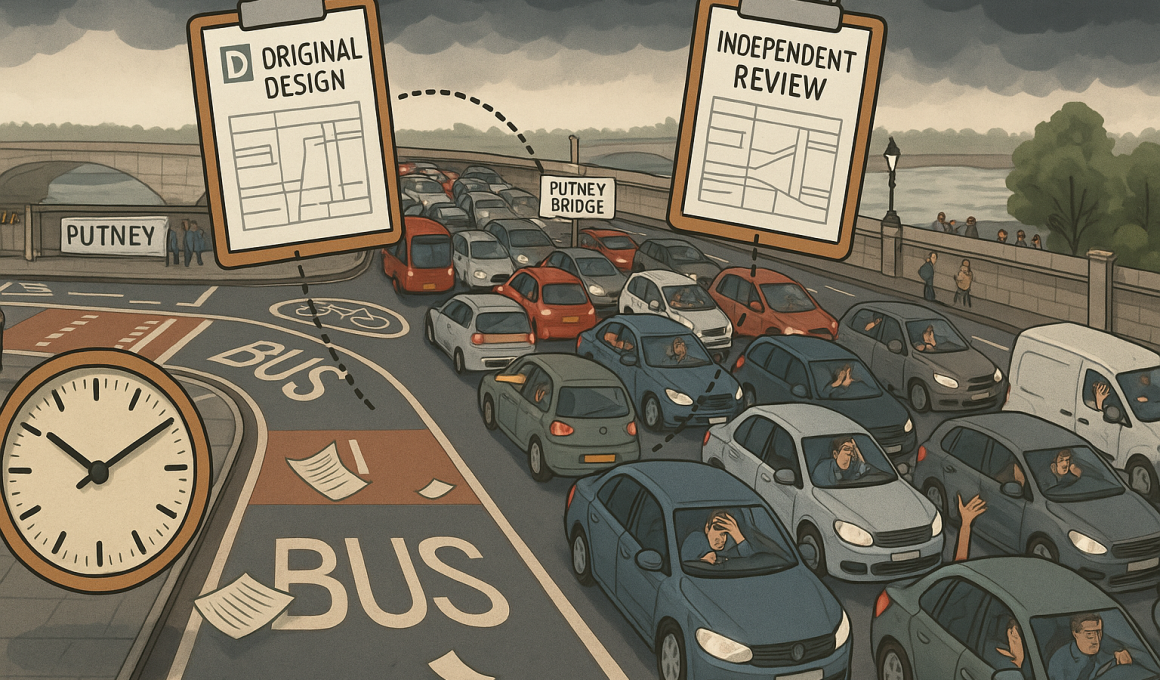
Wandsworth Council has commissioned not one but two separate companies to review the controversial Putney Bridge junction redesign that has caused months of chaos across SW15 – an institutional response that doubles down on analysis when the community has made it plain it is looking for swifter solutions.
The council has hired both the original junction design team and an independent company to assess the redesign’s performance: an unusual dual approach that represents the council’s attempt to accelerate solutions through comprehensive studies rather than direct action.
It is a characteristic institutional approach of seeking certainty through extensive analysis and suggests some officials recognise that standard review processes may not be sufficient given the scale of community discontent. But it also means that residents would face at least another year of severe congestion as the reviews go through the council’s bureaucratic processes. A more active community-led approach would yield faster results.
Survey data reveals frustration
The reviews come as new survey data prepared for tomorrow’s meeting between the Putney Action Group and Cabinet Member for Transport Jenny Yates shows the depth of community frustration. A stark 86% of respondents gave the junction the worst possible score, a result that reflects the daily experience of gridlock and chaos.
The survey findings align with visible evidence of the junction’s problems: lengthy tailbacks along Lower Richmond Road and Putney Bridge Road, plus extraordinary congestion spreading throughout Putney’s side roads as drivers seek alternative routes.
Analysis of traffic flow data obtained by Putney.news reveals the fundamental issue behind the gridlock: the redesign prioritises the smallest user groups while creating problems for the majority. Cars account for 80-84% of traffic flow through the junction, yet the design gives priority to buses (1-2% of vehicles) and cyclists (4-6% of vehicles).
Unfortunately for Putney residents, that was what the new layout was specifically designed to do, with the council’s own director of traffic and engineering confirming that “the recent changes made were not to improve the flow of traffic, but to improve the junction primarily for cyclists and pedestrians.”
This priority mismatch has created a system where dedicated bus lanes and expanded cycle infrastructure consume space needed for the car traffic that dominates junction usage. The result: even buses with dedicated lanes get trapped in the general congestion that spills beyond their designated areas.
Original designers vs. independent assessment
The council’s decision to hire both the original designers and an independent company creates an intriguing dynamic. Having the original design team review their own work raises obvious questions about objectivity, with community concerns that this approach may not provide the critical analysis needed.
However, the parallel commissioning of an independent review suggests the council understands these concerns and wants comprehensive analysis before making expensive changes to recently completed work. The dual approach appears designed to build a thorough case for whatever modifications prove necessary.
Behind the scenes, Transport for London (TfL) emerges as a significant factor in any potential solutions. TfL has a substantial say over junction design and was the organisation that argued against previous designs, primarily because it insisted buses must flow freely through the area. That, combined with a broader push by all organisations involved with traffic to make cycling and cycle safety a priority in London, has led to a design the satisfies no one.
It is with some irony that TfL’s bus-priority demands have contributed to a design so congested that even buses struggle despite their dedicated infrastructure, while cyclists fear for their safety despite being given dedicated bike lanes because of the erratic behaviour on the part of car users frustrated at long waits in traffic.
Community pressure for speed over studies
One community group will be using its meeting tomorrow with Jenny Yates to argue against the slow review approach in favour of immediate action. It may be an uphill battle: even with multiple real-world data and surveys pointing to the extraordinary negative impact of the redesign on all road users, the council insists that it needs to look carefully at things before making decisions.
“I would say it’s a little premature to conclude on the impacts of this,” the director of traffic O’Donnell said in an email exchange just last month.
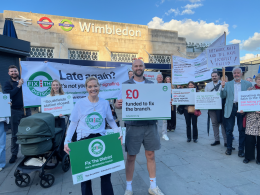
The Putney Action Group and a large number of the residents they have surveyed feel that the situation demands much swifter action than that and the council will be asked this week to recognise what residents already know to be true: no amount of tweaking is going to fix a fundamental design problem.
While the commissioning of dual reviews represents the most concrete council response to date to resident complaints about the junction redesign, it also means more months of studies while gridlock continues. The key question is whether the review process can move faster than traditional timelines.
The council does however have one embedded approach that is specifically designed to move issues forward faster that its typical processes would allow for: a Task and Finish Group.
If the council wants to prove it is serious about residents concerns and moving forward with a solution swiftly, it needs to actively recognise that its normal approach is insufficient.
Putney needs a dedicated group looking at the junction design, empowered to pull in data and input from other groups and make swift recommendations for improvement. Without that, residents are set to suffer more months – or possibly years – of severe congestion.

Can you please publish details as to how to join this action group? thank you