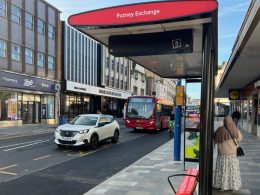
The junction at Putney Bridge handles over 12,500 daily vehicle movements and suffers pollution levels of 37.7 mcg/m3: nearly four times the World Health Organisation’s safe limits. Survey data shows thousands of residents now avoid Putney High Street entirely, with nearly 90% reporting they are “very unsatisfied” with traffic conditions. Uber drivers confirm that they now refuse to accept rides that start, end or even pass through Putney because of the congestion.
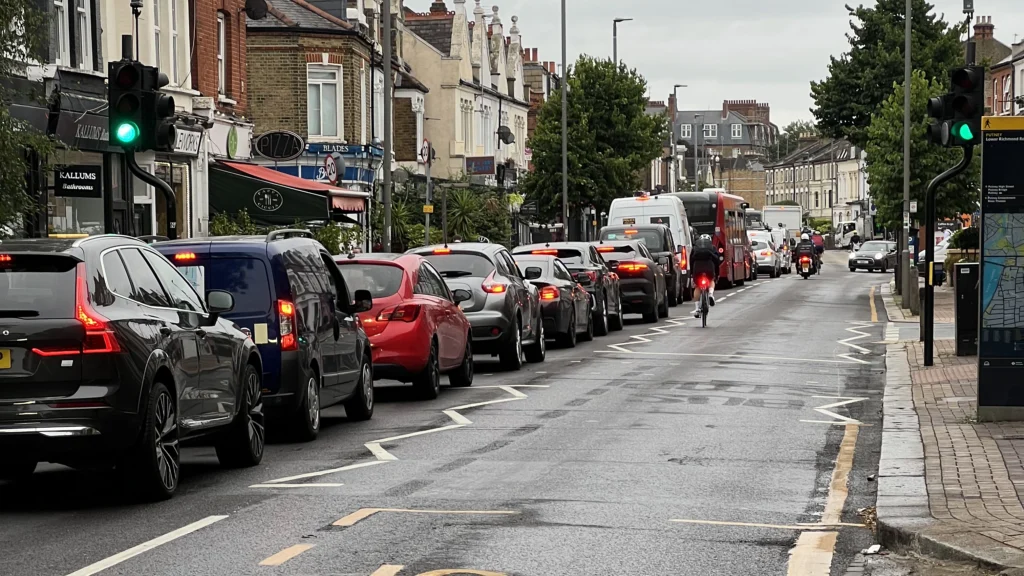
Traffic in Putney is beyond bad; it is intolerable, averaging just over 15mph – and that’s not accounting for the fact that between 7-10am and 3-7pm, Putney looks more like a parking lot than a thoroughfare. Our political representatives are more than aware of this thanks to organisations from the long-established Putney Society to the newly created Putney Action Group being very vocal about it.
And yet when Putney.news ran an extensive review of what the powers-that-be are doing about the situation, we discovered a system of uncertainty and confusion where nobody can be held accountable for promises made or results delivered. The result months later is that traffic remains unacceptably high.
Who’s actually in charge?
When residents demanded action at a public meeting back in May, Putney MP Fleur Anderson pointed to internal taskforce meetings as evidence the crisis was being addressed. We decided to find out what had changed.
The confusion starts with basic facts about the meetings themselves.
Wandsworth Council informed us that Anderson has chaired five internal meetings on this issue on 8 February, 28 March, 25 April, 23 May, 20 June with the next one due this week.
But Anderson told Putney.news that she “co-chairs” the meetings with the cabinet member responsible for transport, Jenny Yates, and described these meetings as “Putney Bus Taskforce” meetings with a broader scope than just traffic.
When we asked for copies of the minutes of these meetings to see what had been discussed and decided, the council told us that “no written minutes or notes were made.” But when we relayed this back to Anderson, she told us that notes were taken each meeting including action points that were distributed to all parties.
The approach being taken is effectively a political game of pass the parcel.
The upshot: no one appears to agree on who is in charge of the meetings, or what the status of documents resulting from these meetings is. When pushed, the council told us that as far as it is concerned, the “minutes and actions” are kept by the MP’s office.
This creates an accountability gap: not only can residents not access records of meetings about local issues through the normal channels but it appears the council doesn’t recognise the results of meetings that its own cabinet member co-chairs.
Anderson defended the effort as “quite a unique approach” that’s “getting results.”
Promises vs reality
Anderson provided us with a list of achievements from the taskforce meetings:
- Reopening of the Green Man bus stop
- Removal of parking bays outside the Star and Garter
- Updated loading bans on the High Street
- A TfL junction review
However, a fuller review paints a more complex picture:
Green Man bus stop: The reopening was already under review following extensive resident pressure and council promises, making Anderson’s role unclear.
Star and Garter parking: The parking bays have seemingly changed but the bigger problems on the same stretch of road that include traffic light timing, split car lanes, and bus drivers changing outside Kenilworth Court causing tailbacks remain unaddressed.
Loading bans: The council has provided a phone number for residents to report violations and promised to “take this seriously,” but there are no obvious signs of increased enforcement or public awareness of this beyond a note in the Putney Society’s monthly Bulletin.
TfL junction review: The council has announced a review but provided no timeline, scope, or concrete details about progress. We had asked repeatedly for such details and so far received nothing.
The daily reality
While representatives debate meeting structures and claim achievements, residents describe unchanged daily struggles:
“My elderly mother is terrified that buses will drop her off somewhere and she wouldn’t know how to get back,” said one resident whose story reflects the ongoing transport chaos.
A Type 1 diabetic reported having to “choose between my health and missing appointments” when buses terminate early due to traffic delays.
Business owners say the crisis continues to affect commerce:
“Both staff and visitors have reported extended travel times and difficulties with parking — reducing productivity, limiting customer access, and affecting overall business viability.”
Despite months of taskforce meetings, the Putney Action Group survey of over 1,000 residents found that more than two-thirds have lost faith in authorities, with two-fifths saying they won’t bother reporting issues and a third saying they tried but were ignored.
The accountability problem
The arrangement Anderson describes creates a democratic blind spot. When meeting records are held by an MP’s office rather than the council, residents cannot use normal transparency mechanisms to check what was promised, what was decided, or what progress has been made.
To recap: Wandsworth Council measures the traffic; TfL controls the lights; our MP runs the meetings; and no one recognises each other.
It is also not within the MP’s power to do anything. Based on the council’s responses, it is not in their power either: they told us that they can’t provide any details until they are reviewed and approved by TfL.
This matters because there is no way to independently verify that anything has been done, or will be done, or who’s responsible for it if it doesn’t get done. The approach being taken is effectively a political game of pass the parcel.
Following the paper trail
This accountability gap isn’t just about these specific meetings — Putney.news investigations suggest it reflects a systematic problem with how agencies handle transparency requests.
To build a picture of what was going on, we submitted multiple Freedom of Information requests to both the council and Transport for London. The responses weeks later reveal a troubling pattern.
The council maintains detailed traffic monitoring with 15-minute precision using sophisticated software, yet claims meeting records about managing this traffic are held elsewhere and inaccessible.
When we asked for basic planning documents showing how the junction redesign was approved, it claimed it would take over 200 hours to locate relevant information — exceeding FOI cost limits.
The fundamental question for Putney residents is whether they’re comfortable with local decisions being made in meetings they cannot see or scrutinise, by representatives who cannot agree on basic facts about their own processes, producing results they cannot independently verify.
While the council provided extensive traffic data from the junction, Transport for London – which is responsible for the traffic signals at the same location – stated they have “no manual counts, camera-based surveys on record” and “no automatic sensors at this junction.”
TfL also claimed that providing correspondence with the council about the junction would involve “hundreds of potentially relevant emails” too resource-intensive to review. That is despite Anderson claiming the agencies work closely together in taskforce meetings which would – in theory – make such a search incredibly simple.
This implies that TfL also considers that the Taskforce meetings chaired (co-chaired?) by Anderson are also given no official status by the organisation.
To recap: Wandsworth Council measures the traffic; TfL controls the lights; our MP runs the meetings; and no one recognises each other.
The pattern across multiple FOI requests suggests either remarkably poor coordination between agencies responsible for London’s traffic, or deliberate information management designed to avoid transparency. Putney.news continues to investigate which.
A system that doesn’t work for residents
Local government transparency exists so residents can hold their representatives accountable. When meetings about local issues are documented outside normal council processes, that accountability breaks down.
Anderson may well believe her approach is more effective than traditional council procedures. But the results so far have not resulted in any decline in congestion and thanks to the meeting’s unclear status, residents have no means to verify them or hold anyone responsible when they aren’t delivered.
The fundamental question for Putney residents is whether they’re comfortable with local decisions being made in meetings they cannot see or scrutinise, by representatives who cannot agree on basic facts about their own processes, producing results they cannot independently verify.
After months of these taskforce meetings, residents still face dangerous pollution levels, avoid their own high street, and report overwhelming dissatisfaction with transport conditions. Whether this represents innovative governance or political theatre is for you to decide.
What residents can do
- Attend Council meetings to ask questions about traffic improvements and timelines
- Contact ward councillors to demand clarity on meeting structures and accountability
- Request information directly from Anderson’s office about specific taskforce outcomes
- Continue documenting the real impact of traffic delays and pollution on daily life
The bigger issue extends beyond Putney: when local democracy becomes this confusing and unaccountable, residents everywhere should be concerned about whether their representatives are solving problems or simply creating the appearance of action while avoiding responsibility for results.