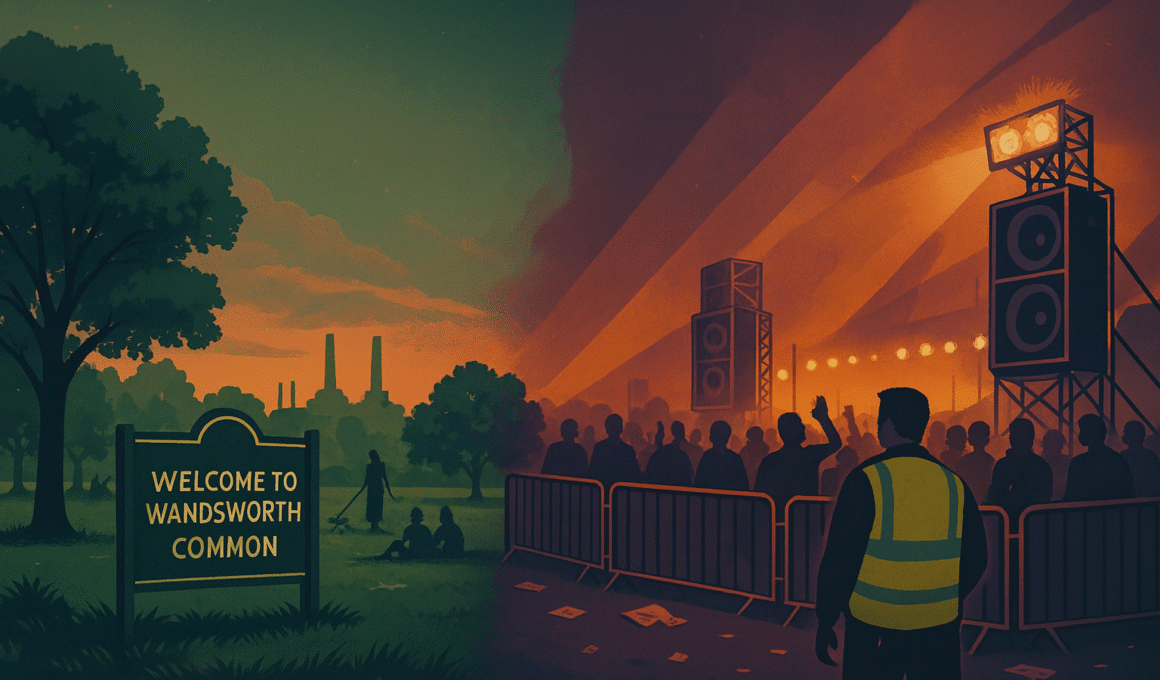
Despite a wave of public concern, Wandsworth Council is pressing ahead with major changes [pdf] to how events are run in its parks. More events. Bigger crowds. Louder nights. And, many fear, more trouble to come.
The decision will be confirmed at a Cabinet meeting on Monday 14 July. But in truth, it’s been on the cards for months.
The council wants to follow the path taken by Lambeth — turning public green spaces into venues for regular, often commercial events. Think food festivals, beer gardens, fitness expos, outdoor concerts. The council says these bring people together. But they also bring noise, disruption, and in some cases, late-night drunkenness.
And they bring money.
Wandsworth’s parks are managed by Enable Leisure & Culture, a not-for-profit company that runs events on the council’s behalf. Enable pays the council a £3.7 million annual fee — income that helps cover the cost of looking after the borough’s parks and open spaces. So the more events there are, the more money flows back to the council.
This is the context behind the new policy — and explains why, even after more than 860 people responded to a public consultation, the final version is, in its impact and approach, largely the same.
Where residents see open spaces as community space that give respite in an otherwise density crowded city, the current council views Wandsworth’s parks as underused assets that can help lift its financial pressures.
Yes, some concessions have been made. Events will usually have to end by 10pm. Wandsworth Common will be protected from large-scale events. Battersea Park is getting its own policy, still to come — a likely attempt to avoid digging up old memories of the now-abandoned Formula E racing plan.
But for most other parks — and for Tooting Common in particular — things are about to change.
A risky shift in who decides
The biggest shift may not be what’s allowed — but who gets to say yes.
Under the old rules, local advisory groups had a say before big events were approved. Under the new policy, that decision will sit squarely with the council. Advisory groups will still be consulted — but only after the council has given the green light.
That means there’s no one with the power to say no before plans are set in motion.
The same goes for residents. While the council has introduced some conditions — events shouldn’t take over whole parks, smaller events should be quiet beyond park boundaries — these can all be waived if the Cabinet agrees.
Even the winter ban has been lifted. From October to March, grass areas were previously off-limits to protect the ground. Now, events can go ahead so long as a Cabinet Member signs them off.
Where the council has listened — and where it hasn’t
Some community concerns have been addressed. The 10pm curfew is new. Rules around fencing, site inspections and noise have been tightened a little. The worst fears — like full-scale festivals taking over Wandsworth Common — have been avoided, for now.
But there’s no escaping the overall direction. The council is giving itself far more flexibility. It has the final say. And it’s made clear it intends to use that power to increase the number and scale of events across the borough.
When locals asked for clearer environmental safeguards — like mapped exclusion zones for sensitive habitats — the council said it would “consider” these during implementation. In practice, that means nothing is locked in. Every decision will be made on a case-by-case basis, with no set rules and no public oversight.
There’s also been little sign of a plan to deal with the practical knock-on effects: drunk or high festival-goers, overcrowded transport, late-night disruption. These were key concerns from both residents and park groups. The council’s answer? It’ll be handled under existing licensing or policing rules.
That may not be enough. Lambeth’s experience with Clapham Common shows what can go wrong when large events outgrow the space and support around them.
Public pressure made a difference — but only just
The council says the unusually high number of consultation responses is thanks to its own outreach. In reality, it was local community groups — including this news site — who raised the alarm, explained what was happening, and encouraged people to take part.
The council first unveiled the new policy in January. The consultation ran through April and May. The final version will be approved this month.
We’ve gone through all the public feedback and council responses. Our score for Wandsworth’s “listening council”? 5 out of 10. It heard what people said. It made some changes. But when push came to shove, the council kept the power — and left the door wide open to far more commercial activity in its parks.
Only time will tell whether the trade-off was worth it.
Read more about this crucial Council decision: