This afternoon the Boat Race course gets rowed the wrong way round, by hundreds of boats, one at a time.
The Fours Head starts at Mortlake, by Chiswick Bridge, at 12.45pm and finishes at Putney, four and a quarter miles downstream. Every place is taken: the organisers stopped taking entries at the end of October with about 20 more crews than places. It is free to watch, and Putney Embankment overlooks the finish.
The organisers have warned of “a significant risk of fog on Saturday morning”, and say it will be cold.
Expect the Embankment to be busy well before the start. More than 180 crews boat from Putney, so for the day the riverside turns into a boatyard.
Trailers come in one way only, along Thames Place by the Duke’s Head, and line up on the river side of the road, where they double as boat racks. The road is closed to other vehicles, and anything parked there without permission is removed by Wandsworth Council, which charges a fee to get it back.
Boats are rigged on the pavements and in the parking bays, never in the road, which has to stay clear in case the emergency services need it. The pavement beside Leaders Gardens is cordoned off, because of the number of boats there.
Then the Putney crews row away upriver, under Hammersmith Bridge, to wait for the start. Every crew in the race has to be in place by 12.35pm, in a line of boats that stretches from Chiswick Pier up to Kew Rail Bridge.
There is only so much room in that line, which is partly why entries are capped. In 1997 the Port of London Authority let the organisers take 550 crews, which they describe as the largest number of crews entered in one race in the UK. They have since cut it back to 480, after problems with marshalling.
The tide, the stream, how long the river can be closed and the November weather also set limits, and in 2023 and 2024 the weather won and the race was called off.
Once it starts, the boats come down the river one after another. The fastest cover the course in under 20 minutes; last year the quickest took 17 minutes 55 seconds. Over the line, they keep rowing under Putney Bridge and the railway bridge before turning back.
Look out for the stickers on the sterns. They are there so the photographers on the bridges can tell who is who. Last year spectators lined Hammersmith Bridge and Barnes Railway Bridge.

A race for the rowers who did not count as amateurs
The race exists because of a rule about who counted as an amateur.
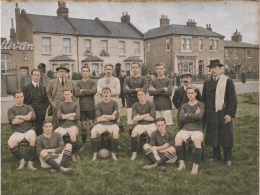
In the early 1950s, if the members of your rowing club worked with their hands, your club could not join the Amateur Rowing Association. It did not consider you an amateur. Those clubs had their own body instead, the National Amateur Rowing Association, and its Thames branch set out to give them a head race for fours. It had even picked a date when it found that someone else was already doing it.
That someone was the Tradesmen’s Rowing Clubs’ Association, which looked after people who worked with boats for a living. It ran its race as an open event, and in 1955 thirty-four crews rowed three miles from Chiswick Steps to Putney Pier.
Clubs from the Amateur Rowing Association started entering too, alongside the tradesmen and the clubs it would not admit. By the end of the 1950s the two associations had merged, and in 1962 the race dropped the tradesmen from its title and became the Head of the River Fours.
Women’s crews joined in 1977, when the women’s version of the race, run separately since 1959, merged into it. They now make up about 40 per cent of the entries.
In 1988 it took on the whole Championship Course from Mortlake, and the record over it still stands at 17 minutes 21 seconds, set by a Tideway Scullers School quad in 2006.
Tomorrow the river does it all again. The Veteran Fours Head, for older crews, is due to start at 1.30pm, though that time is provisional.