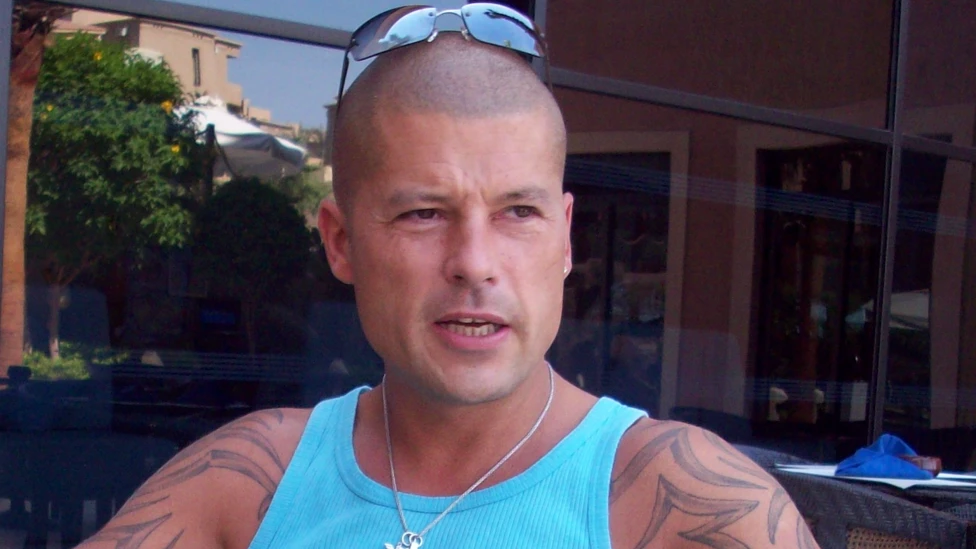
Warren Arter, a former Metropolitan Police detective, was found dead in his cell at HMP Wandsworth on 12 July 2024, two weeks after his wife died in Barbados.
More than two years on, the inquest into his death has still not been heard. The Prisons and Probation Ombudsman investigates every death in custody but publishes its report only after the inquest, so its findings on how the prison looked after him are not yet public.
His case is the subject of a BBC Panorama investigation, The Predator in the Police, on BBC One at 9pm tonight.
Arter was a detective inspector working on rape investigations in south London. He met his wife, Rebekah, in 2006, when he was the officer investigating a domestic abuse complaint she had made. From 2016 he was investigated over claims that he had sexual contact with women he met through his work, and in May 2023 the Met sacked him for drug offences.

Rebekah was 47 when she died in a hotel room in Barbados on 28 June 2024. A week later Arter flew home and was arrested at Heathrow over alleged offences against another woman. He was charged with misconduct in public office and held at Wandsworth to await his case at Woolwich Crown Court.
Panorama reports that Arter gave hotel staff and Rebekah’s family conflicting accounts of how she died, and that the Met sent no detectives to Barbados, although her family asked for help and a senior commander was briefed four days after her death. The Met told the BBC it made that decision because no allegation of criminality had been made.
At the inquest into Rebekah’s death in August 2025, the assistant coroner for South London, Professor Andrew Harris, could not establish how she died and recorded an open conclusion. He found that in March 2024 the police watchdog, the Independent Office for Police Conduct (IOPC), had passed the Met a report from a woman alleging further sexual offences by Arter. Because of errors with a flagging tool on Connect, the Met’s new computer system, it never reached a unit that could investigate it.
“Had this error not occurred it is likely that Rebekah’s husband would have been arrested and remanded,” the coroner wrote. He rejected the family’s argument that the inquest should examine whether the state had failed in its duty to protect her life.
Since the inquest
In September 2025 the coroner sent a formal warning, known as a prevention of future deaths report, to the Home Secretary, the Justice Secretary, the IOPC and the Met. His concern was that the IOPC and the Met may have missed chances to see that Rebekah was a victim of domestic abuse and coercive control, which would have let her be protected.
Investigations into Arter, he noted, had uncovered a large number of women with whom he had inappropriate relationships, and found he misused his police powers. A Detective Chief Inspector recognised in hindsight that he was “an exceptionally persistent and damaging offender against women”, although no charges over that were ever brought. When he was sacked, the risk to Rebekah was not apparently considered.
The coroner called the abuse of police powers against women “a national issue of concern”, and said ministers should consider whether more investigation was needed. The four had until 14 November 2025 to reply, unless he gave them longer.
When his report was published on the judiciary’s website in July this year, it came with replies from the Met, the IOPC and the Home Office. The Met’s runs to 11 pages without mentioning Connect, or the error the coroner said had let Arter stay free. The IOPC told the coroner it had twice held back from contacting Rebekah while it investigated her husband.
No reply from the Ministry of Justice has been published, yet Rebekah’s report is not on the list of overdue replies published by the Chief Coroner, the judge in charge of coroners in England and Wales. The Ministry is also responsible for the prison where Arter died. We asked it whether the Justice Secretary replied to the coroner and, if not, why not, and whether the prison service has had the Ombudsman’s findings on Arter’s death.
A government statement to Putney.news, sent through the Home Office late last night, answered neither question. It said Rebekah’s death “was tragic and our thoughts remain with her friends and family”. On Arter, a government spokesperson said: “As with all deaths in custody, the Prisons and Probation Ombudsman is investigating Warren Arter’s death and it would be inappropriate to comment further until that investigation has concluded.”
The report nobody can read
When Arter died, the Ministry of Justice said: “As with all deaths in custody, the Prisons and Probation Ombudsman will investigate.” The Ombudsman now lists its investigation into his death as “pending inquest outcome”. Until the inquest, its final report goes to the family, the prison service and the coroner.
Of the 21 deaths at the prison where the Ombudsman’s records give an inquest date, 12 waited more than two years for it. Arter is one of six men who died at Wandsworth whose Ombudsman investigations are listed as waiting on an inquest. The longest wait is for Morgan Sullivan, who died aged 20 in November 2022.
When an inquest does sit, the report follows quickly. The inquest into Aktar Uddin’s death on Christmas Day 2021 concluded on 5 October this year, and the Ombudsman published its report two days later.
We read all three replies to the coroner so you don’t have to.
Members can read what the Met, the police watchdog and the Home Office told the coroner, each set against his concern that chances to protect Rebekah were missed. That includes why the IOPC held back from contacting her, twice, while it investigated her husband.
Already a member? Log in
What members get from this story
- What the Met’s 11-page reply leaves unsaid about Rebekah
- Why the IOPC held back from contacting her in 2017 and again in 2023
- The government’s answer on police reform, set against Arter’s own case
Already a member? Log in
Arter was never charged over what the investigations into him uncovered. He was suspended anyway, and stayed suspended on full pay for almost seven years before the Met sacked him.
At Rebekah’s inquest, her son, Elliot Usher, told the coroner: “My Mum was let down in life, please do not let her be let down in death.”
Nothing official has yet been made public about how Wandsworth cared for the man accused of abusing her. When his inquest is heard, the Ombudsman will publish its findings.
Panorama: The Predator in the Police is on BBC One at 9pm tonight and on BBC iPlayer.
If you are affected by anything in this article, Samaritans are available 24 hours a day, 365 days a year. Call free on 116 123, email jo@samaritans.org, or visit samaritans.org.
The National Domestic Abuse Helpline is free and open 24 hours a day on 0808 2000 247. Rape Crisis England and Wales: 0808 500 2222.
INQUEST supports families bereaved by a death in state detention: inquest.org.uk or 020 7263 1111. The Wandsworth Prison Improvement Campaign works to improve conditions at the jail: wandsworthprisoncampaign.co.uk.