

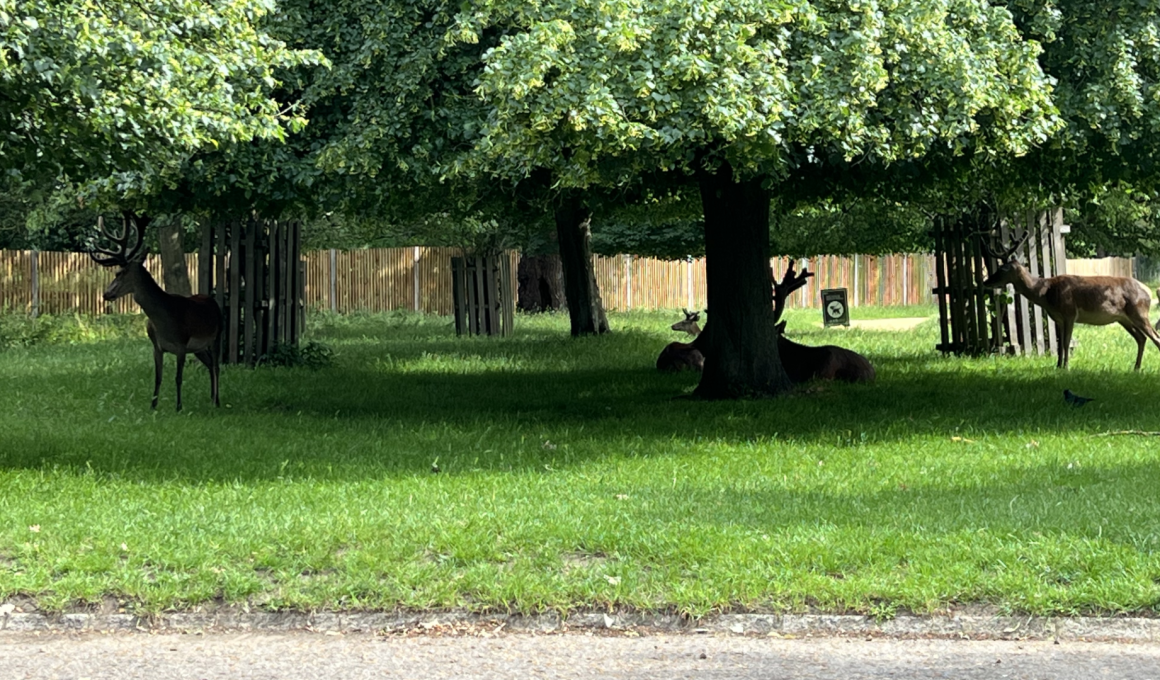
A stag was shot dead in Richmond Park on Saturday evening, minutes after it injured a man having a picnic near Roehampton Gate. The man, in his 60s, went to hospital with chest wounds. The animal was destroyed by a Royal Parks wildlife officer and, according to the man’s own account to the emergency services, none of it was his fault: the stag came out of nowhere.
It did not come out of nowhere. This particular animal had stopped behaving like a wild deer weeks earlier and had been filmed in an almost identical encounter ten days before it died. Whatever happened in the seconds before the man was hurt, the conditions for it were built over a summer, by people who almost certainly thought they were doing something harmless.
The same stag, ten days earlier
Earlier this month a video circulated on social media showing a shirtless man in Richmond Park fending off a stag with a long branch as the animal went for his picnic. Royal Parks has confirmed to Putney.news that the stag in that footage was the same one shot dead on Saturday. It backed off that time – despite, it must be said, some serious and ill-advised provocation. It did not back off on Saturday, and a man went to hospital.
The Park’s explanation for how a wild stag became a public danger is unglamorous and specific. It does not involve the rut, or a startled animal, or bad luck.
“Despite repeated and regular warnings about not feeding or approaching the deer, signage up across the park, and volunteer rangers speaking to visitors to educate them about the issue, visitors have continued to stroke and feed the deer and, as a result, this particular stag had completely changed its behaviour due to this human intervention,” a spokesperson said. “It separated from the rest of the herd, became a loner and started to associate people with food so would seek them out rather than naturally forage and graze for food.”
None of this was necessary. Royal Parks supplements the deer’s food only in deep winter, when they may be short of certain minerals. Even through this summer’s drought, there is plenty in the park: dry grass, leaves, leafy vegetation, brambles, nuts and seeds. An early autumn has already started dropping beech nuts and horse chestnuts, the deer’s main autumn food, which they need to build fat stores before winter.
Human food is not a treat for them. It is not good for their digestive systems and can actually ruin their ability to process the food they are built to eat. They will also swallow the plastic and foil it comes wrapped in, which can kill them outright. There is a reason why the Parks staff continually ask visitors not to feed the wildlife.
But even a cursory glance at social media will reveal dozens of videos of people portraying the park and its wildlife as a magical setting where deer will wander up to you while you are picnicking, like a modern-day Disney movie.
Knowledge has passed down for generations about how you are a guest in the deer’s garden, not the other way around, and how, as cute as they are, deer remain wild animals that can be admired but must be left alone. That knowledge is being lost – or overrun – by the digital world and Instagram content that filters everything through a different lens: that of unique personal experiences.
Two accounts of Saturday evening
An eyewitness to Saturday’s tragic events told us that far from the stag appearing from nowhere and becoming unexpectedly aggressive, the family that ended up going to the hospital had in fact draw the stag closer, fed it, stroked it, took photographs, and kept returning to the animal even after it made it plain it no longer wanted to be disturbed.
Three videos show how unremarkable the scene looked. In one, the stag stands in the open a short distance from a group of adults and children; a boy in a white t-shirt holds a football and watches. In another, it works its way through bags and picnic things left on the grass, sniffing and nudging at them, while people stand a few feet away. A man in a light green shirt edges towards it, gesturing, trying to move it on. The stag lifts its head and its antlers come up. Nobody in the frame is running.
The last video is the one that stays with you. A marked police car sits in the middle of the field with its lights going. An officer stands in the dry grass holding a large firearm, talking to a member of the public. Birds go up from a tree, and behind them the stag is still there, still standing over someone’s picnic. Cyclists cross the field. Then the video ends. What happened next is not recorded.
The warnings are not decoration
Royal Parks has asked the same thing of visitors for years, and this month has asked it twice more. Stay at least 50 metres from the deer. Never feed or touch them. If one comes towards you, gather your things calmly and move away, and do not try to move the animal yourself. Two days after the Richmond Park shooting, the charity posted that it was “shocked and alarmed” to see fresh footage of visitors feeding deer in Bushy Park.
There is nothing new about the risk. In 2018 a seven-year-old girl was gored by a stag in Bushy Park; the park said at the time that witnesses saw her family standing very close to the animal, taking photos. Nor is there much left to enforce it: the Met disbanded the Royal Parks Police last year, part of £260m in cuts, leaving park regulations to a charity’s rangers and an overstretched borough force.
“A stag is a big, powerful animal that can run at 30mph, and its antlers can be incredibly dangerous,” the Royal Parks spokesperson said. “The deer have been a feature of Richmond Park for centuries and have always roamed freely. The park is not a petting zoo and we really want to keep it that way.”
The charity was clear that Saturday’s decision was not one it took lightly, and it is worth being equally clear about who made it necessary. It was not the wildlife officer who pulled the trigger. Nor the man who was hurt, although he should never have engaged a wild stag in the first place. But it was everyone who this summer edged closer for a photograph, held out a hand, offered some food, decided that the warnings did not apply to them this one time. Every one of those interactions made a small contribution to a stag that no longer steered clear of people, and associated them with easy food.
On Saturday, the blurred line was finally crossed, a decision was forced onto parks staff and the stag was shot. We have to hope this will be the last. It can be if we remember – and remind others of – nature’s realities.

We were in the park to watch the eclipse and saw three men who were feeding and patting that deer. I went over and told them that they should not get so close to a wild animal or feed them as likely it would mean they need to be shot. They shrugged me off. This is so tragic.