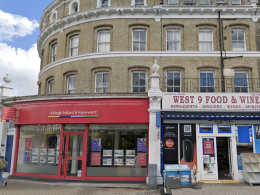
Wandsworth planning officers have recommended approval for a permanent gym at Rosslyn Park rugby club, 15 months after the application was lodged and four years after the council ordered the club to tear down a gym it had built on the same protected land without permission.
The decision is due by 13 August. It will be made by a single planning officer rather than a public committee, and it turns on a question with consequences well beyond one rugby club: what, in practice, does protection of London’s open land actually protect against?
In July 2022, the council authorised legal action against Rosslyn Park over unauthorised structures at the Priory Lane end of its ground, including a prefabricated gym and a set of Deliveroo dark kitchens. The club was given 28 days to remove them or face prosecution. The gym went.
When Putney.news visited in May, the club’s gym was operating inside the clubhouse bar: rubber matting laid across the floor, weight plates stacked against the wall beside the beer taps, barbells racked under the 1979 club flag. Kit out in the morning, kit away again after.
The application would end that, replacing a portakabin-style office beside the road with a permanent prefabricated building. Objectors say it is essentially the same gym as the one that was removed, moved slightly closer to the houses and the road.
Why a rugby club needs a gym
Modern rugby is a strength sport, and a club fielding national-league sides cannot run on pitch training alone. Rosslyn Park’s gym opened in 2018. A member of 43 years’ standing told the council it had become, alongside the 4G pitch, the most significant addition to the club in his time there.
“It is a critical component of a sports club that plays at a national level, supports several social sides and hundreds of minis and youth players as well as four ladies netball teams,” he wrote. “Without it these simply couldn’t exist.”
Four hundred and thirty-five people wrote in to back the application. The letters describe classes mixing children with pensioners, members drawn from Barnes, Mortlake and East Sheen, and a facility people credit with holding them together. One supporter from Kingston put the practical version plainly: the club is “restricted to current training”, and the building would let it grow.
The objection is not about rugby: almost every objector says so. The argument is about land. Rosslyn Park’s ground is Metropolitan Open Land, which under the London Plan carries the same protection as green belt. The Putney Society put it bluntly in its submission: “Nothing should be built here, certainly not a gym for commercial rental to others.”
CPRE London, objecting alongside them, noted that if a commercial gym is needed there are vacant commercial buildings nearby. The protection only means anything at the point where it stops something people want.
Living next to it
Residents of Woking Close and the stretch of Upper Richmond Road beside the ground describe years of early-morning music, floodlights left burning overnight, bottles emptied into bins at midnight, and gym sessions starting at six.
One Woking Close resident wrote that he had complained to club management repeatedly. Two students at 445 Upper Richmond Road told officers the opposite of what the club is arguing: since the old gym building came down, one wrote, “it has actually become quieter.”
The council has already found against the club on noise once: it served a statutory abatement notice over music from the site. But the club has persisted due to its clear need for a proper gym. The application was validated on 14 May 2025 and objections arrived through that summer. In February, the club submitted additional material, including a noise assessment concluding the impact would be negligible.
In response, neighbours commissioned their own. An independent acoustic consultancy filed a competing report on 2 March 2026. Objectors’ central criticism of the club’s assessment is that its baseline was measured while the gym was already operating, so the noise complained of was folded into the background it was judged against.
The council reconsulted. More objections came in. The application now reaches a recommendation with both sides holding rival expert reports and the same disagreement they started with.
The neighbours counted the comments before we did
Reviewing the support letters in July 2025, one commentor tallied where the supporters lived: on her count, 18% in SW15, 18.4% in SW14, and 63.6% neither, with none of them direct neighbours. She listed supporters writing in from Preston, Sevenoaks and Leicestershire.
Putney.news mapped all 457 comments that could be traced to an address. The typical objector lives about a two-minute walk from the ground, close enough to hear a car door at six in the morning. The typical supporter lives about forty minutes’ walk away, the far side of the borough. One in twelve lives more than twelve miles away, further out than the nearest stretch of the M25, and a handful wrote in from Preston, Bath and Wales.
The crossover comes at roughly a six-minute walk. Inside that, most people who wrote in objected. Beyond it, support runs to nine in ten.
None of that settles anything. It shows a club with a wide and genuine constituency, and a small number of households who live with the consequences.
What happens next, and what cannot
Wandsworth does not decide applications by counting comments. An application with 500 objections carries no more formal weight than one with five. Under the National Scheme of Delegation introduced this year, most applications including this one are decided by an officer rather than by councillors, however many people write in.
If permission is granted, the neighbours have almost nowhere to go. An applicant refused permission can appeal. An objector cannot appeal a permission. The only route is judicial review, a challenge to the legality of the process rather than the merits of the decision, with costs capped at £5,000 for individuals under environmental costs rules.
Which is why the conditions matter more than the 482 letters. The council has recommended approval “with conditions” but has not published what they are. Objectors have asked for limits on opening hours. The club’s own noise report proposes management measures. Neither becomes binding until an officer writes it down and the council can enforce it.
A rugby club playing at national level needs a gym its players can use before work. The people whose bedroom windows face the pitch need to sleep until seven. Both are reasonable, and a sports club in a built-up corner of south west London has to find a workable compromise. We should find out later this week exactly what that is.