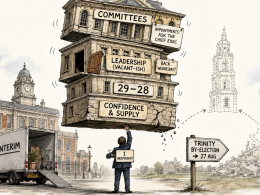
Robert Morritt was confirmed as Leader of Wandsworth Council on Wednesday night in a 30 to 26 vote, settling a week of doubt over whether he had the numbers to succeed Aled Richards-Jones, who resigned as leader on 10 July.
The Special Council meeting saw the Labour party put up its own group leader, Simon Hogg, as a rival candidate and insist on a roll-call vote for both, even though it knew it had no chance of winning. All 29 Conservative councillors backed Morritt, together with independent councillor Malcolm Grimston, whose confidence and supply agreement with the Conservative group has kept the administration in office since May. Twenty-six Labour councillors backed Hogg. Cllr Victoria Asante, Labour, Battersea Park, was absent for the whole meeting.
The scale of concern inside Morritt’s own party over his appointment has not gone away however. As we reported, Morritt was removed as a councillor in 2013 after a series of investigations found his conduct “totally unacceptable” and a Conservative Central Office complaint against him and a fellow ward councillor last year upheld a finding of bullying. We understand there may be a second upheld complaint as well.
Both allegations were put to Morritt at the time and he did not respond. Tonight, in the face of turmoil and their political rivals, the party closed ranks behind him in the vote. The concern continues. One Conservative source, speaking anonymously last night, told Putney.news “everyone knows Morritt’s history, the past allegations of impropriety… appointing someone with so much toxic baggage is bound to backfire.”
Twenty-four extra police officers
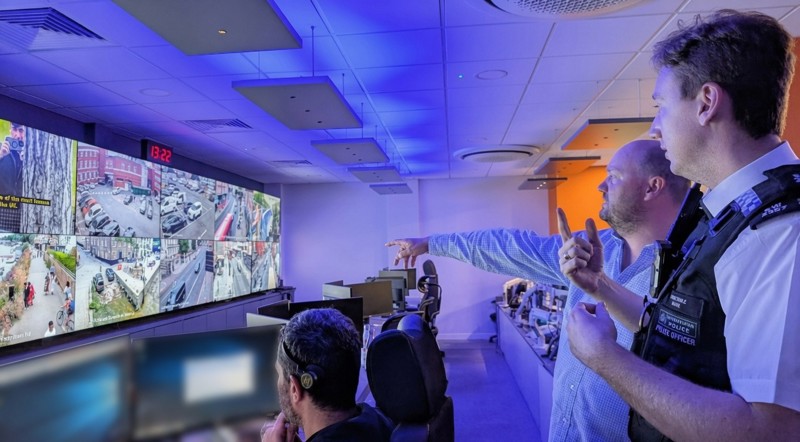
The most eye-catching announcement of the night came from Peter Graham, the new deputy leader and cabinet member for finance, who told the meeting the council intends to fund 24 additional police officers within this financial year, two sergeants and 22 constables, forming a standalone team under council control rather than being added to existing ward teams.
The money comes from the Neighbourhood Community Infrastructure Levy, released through a review of existing schemes rather than new spending. The council published a news item explaining more late in the evening.
Graham said the model was based on schemes already running in other London boroughs, where councils fund additional Metropolitan Police officers who work alongside existing local policing. Wandsworth’s proposed number is large by comparison: Westminster funds nine officers this way, backed by close to £3m over three years. The exact cost of Wandsworth’s scheme is still being negotiated with the Met, with an update promised in September.
Not back to normal
Tonight’s meeting was only the second sitting of the new council since May’s election, and it underlined how far Wandsworth still is from functioning normally.
The borough is now in a pre-election period ahead of the Trinity ward by-election on 27 August, restricting what the administration can say publicly about its own finances. Graham said as much in his own foreword to the council’s Spending Review report [pdf], published minutes before the meeting: pre-election rules “would prevent” the full communication residents are owed, so the initial findings were being presented “while taking the opportunity of this additional time to further evaluate some of the options available.”
It is the second council meeting out of two that the ruling party has delivered critical papers just moments before the meeting begins, giving nobody but those who wrote them time to read and digest them. Typically, they are published a week in advance, and the opposition quite rightly took them to task on the issue.
“There has been no consultation on this, there’s been no transparency, there’s been no scrutiny. I don’t think most of the Conservative councillors knew what Councillor Graham was going to do,” noted opposition leader Cllr Hogg, adding: “This is a bizarre way to do business.”
Scrutiny committees, suspended since the election, do not return until September. New councillors elected in May will not get to question a cabinet member or attend a committee meeting until then, four months after voters chose them.
The constitution, and the numbers behind it
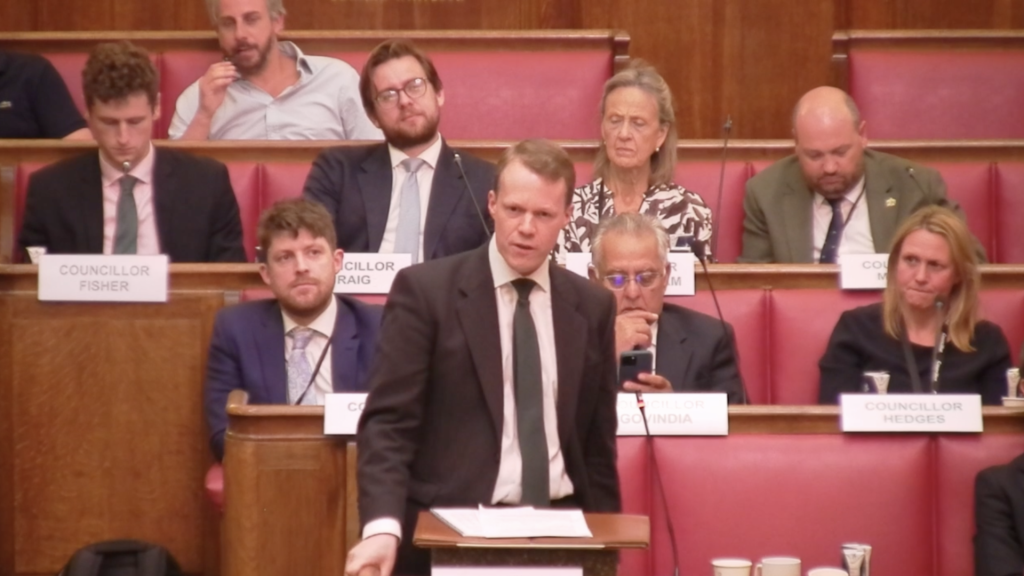
Earlier in the meeting, councillors voted 29 to 26 to adopt a constitutional reform package agreed at General Purposes Committee two days earlier. Independent councillor Malcolm Grimston, whose vote keeps the administration in office, used his speech to appeal for more reasonable conduct across the chamber.
As ever, it was heard, pontificated upon and then set aside: Labour councillors gave speeches talking about working together and listening to residents but then focussed in on one measure designed to give more councillors an opportunity to speak and used it as reason to vote against the measure claiming it was anti-diversity. Labour voted as a bloc, as always.
The real reason for the opposition is that the changes reversed a series of anti-democratic measures introduced just a year earlier by Labour that had concentrated power in the Leader’s Office. The short-lived “deputy cabinet member” role, used to buy political favour at taxpayers’ expense, has now gone.
Graham’s report to the meeting set out the scale of the problem the new administration says it has inherited: a budget gap projected to reach £137m by 2028/29, a 40 per cent cut to government funding, reserves forecast to run out by the same year, and planned borrowing rising to £1.14bn by 2035. A transformation programme launched under the previous administration in September 2025 had, by May 2026, identified £14m of savings against a stated target of £45m.
Twenty-eight minutes, a lengthy reply and a cultural problem
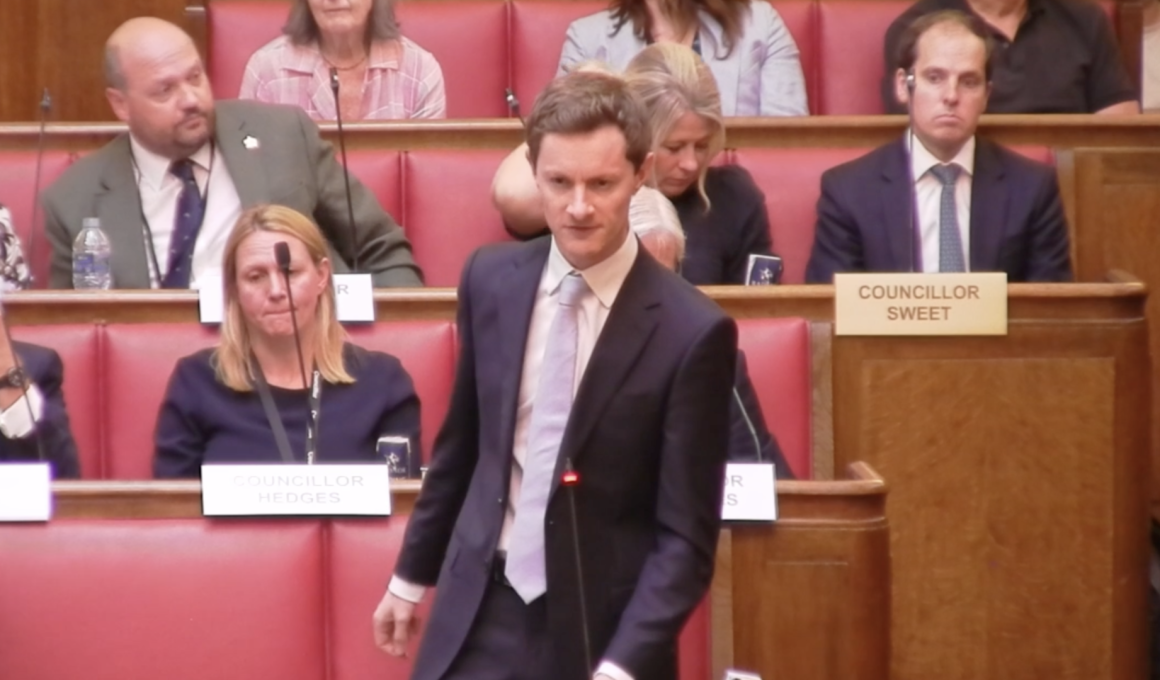
Cllr Graham’s report to the meeting ran to a lengthy 28 minutes, a fact noted by the Mayor when she gave opposition leader Cllr Hogg an equal amount of time to respond.
Cllr Hogg made much of it, opening by telling the chamber: “I have to say that is one of the most disappointing statements that I’ve heard delivered in this chamber and not just because it was very, very long.” He went on: “I won’t take that long,” and then, mid-speech while heckled, that he would “respond at about a quarter the length.” But verbosity remains a trait of our council leaders and after 19 minutes, Hogg finally sat down; the second-longest contribution of the night by a wide margin. Two-thirds of Cllr Graham’s time, not one quarter.
The exchange went well beyond policy disagreement. It was polished enough to draw laughter from the Labour benches, laughter with a sneer, humour with an unpleasant undercurrent that only moments earlier the council had been urged to reflect on – and draw out – as a toxin in Wandsworth politics.
Hogg returned more than once to dismissing Graham’s own research as digging through rubbish, at one point telling him “I know you’ve been looking through our waste paper basket and our dirty washing,” and earlier describing it as “weird rummaging through our emails… really embarrassing stuff.”
Labour’s Cllr Aydin Dikerdem went further still, telling Graham he was “living your political fantasy,” mocking him for having “your little plinth” and calling the session “the Peter Graham show,” before adding: “I’m so humiliated for you all that you allowed this to happen… it must be the greatest evening of your life.”
It got laughs. It was also, underneath the delivery, a councillor mocking a colleague to his face in a public meeting, not disputing his figures. Graham hit back in kind but with more of a focus on policy than personality: “As ever with Councillor Dikerdem, it’s basically bring on the debt. I don’t think he’s ever seen money he didn’t want to apprehend from somebody else, to pay for one of his own schemes.”
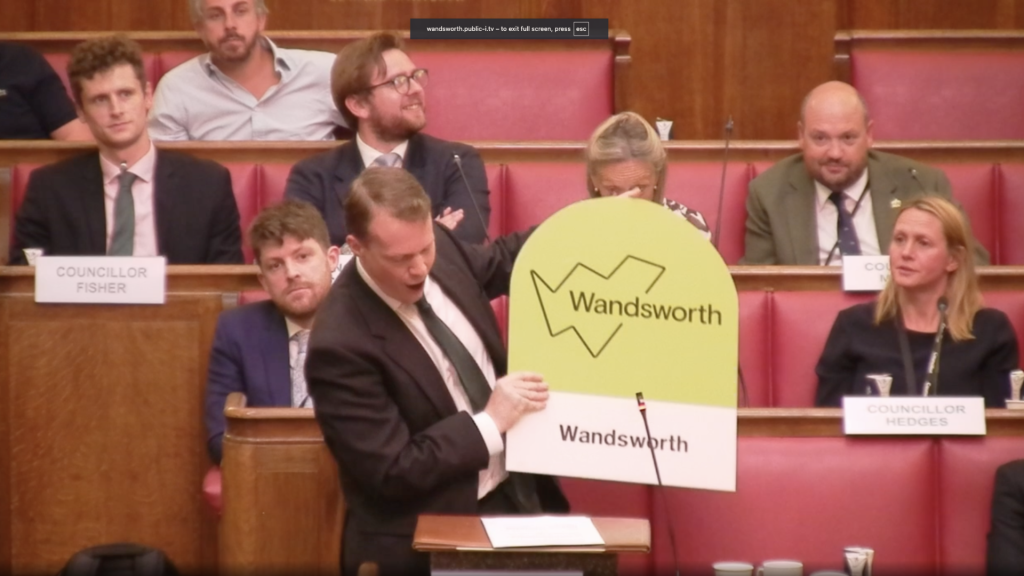
On the vanity-spending jibes aimed at his own side, he turned it back on Hogg directly, holding up a series of greeting cards produced for the former leader at taxpayers’ expense: cost: £600. Later, he held up an office sign for what was supposed to be for Cllr Hogg’s new leader’s office. Cost £700.
“I’m not sure I can think of anything more vain than producing personalised gift cards at the expense of a taxpayer…. We will take no lectures from them.” Whatever the rights and wrongs of the finances underneath it, the tone in the chamber by this point had curdled into something closer to score-settling than scrutiny.
What’s coming
Among the findings Graham raised in the chamber, two stood out enough that we will examine them properly tomorrow in a separate piece: an alleged secret plan to move council staff out to Nine Elms, in the far corner of the borough, which Graham said would cost taxpayers £240,000 to unwind, and which he said Hogg had signed up to without even his own side knowing; and a wider pattern of spending Graham characterised as wasteful under the previous administration, including on external lobbying and office refurbishment. Putney.news has put questions to Graham on both and is waiting on his response.
The council also confirmed a reshuffle of Overview and Scrutiny Committee chairs and outside-body appointments, and Labour’s Cllr Kemi Akinola was confirmed as the party’s new Deputy Leader of the Opposition. Scrutiny returns in September; the Trinity by-election, which could hand the Conservatives outright control without needing Grimston’s vote, is on 27 August.