


Wandsworth’s planning committee has approved what residents believe is the first Laser Quest ever built directly beneath residential flats, overruling the local MP and two ward councillors.
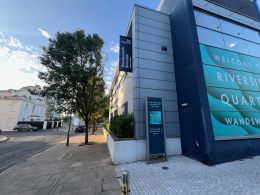
The Planning Applications Committee voted on Tuesday night to allow a long-vacant ground-floor office at Jessica House, Red Lion Square, to become a Laser Quest children’s party venue. Fleur Anderson MP and both Wandsworth Town ward councillors, Sarah Davies and Noel Dube, formally objected. So did the great majority of the 61 residents who responded to the consultation. The council’s own report recorded 30 formal objections against a single letter of support; one ward councillor’s letter puts the true objection count at twice that. The committee approved the application anyway.
The unit needed committee sign-off since the space was previously restricted to office-use only, as a way to protect scarce commercial space in Wandsworth Town Centre. But the office has sat empty nearly eight years, since a Job Centre left in September 2018, and has been marketed for over six years without a single taker. Under the council’s own planning rules, a unit marketed unsuccessfully for 18 months can have that protection lifted. This one cleared the threshold more than four times over.

What residents were told, and what the business was selling
Laser Quest Wandsworth’s letter to residents was direct: “There will be no alcohol served,” it said. “It is not a late-night use venue. It is not an evening social or drinking venue.” But the operator’s website, screenshotted by residents before the page came down, had advertised something else entirely: private hire for up to 40 people, including the option to “bring your own alcohol for adult groups (no corkage fee).”
It’s not clear whether the operators intended to offer adult parties with alcohol, or whether they simply copied across content from other Laser Quest websites, which do offer adult parties with alcohol. But either way, the idea was met with a storm of protest and even though they didn’t apply for a license, and said repeatedly there was no goal to do so, the issue ended up dominating discussion of the application.
The damage to resident trust had already been done before the application even reached committee. Contractors carried out installation work at the unit late into the night on 21 January this year – running past 11.45pm, according to more than eight residents’ objections – not only prevented local residents from sleeping but occurred two weeks before the planning application had been validated. First impressions count, as they say, and the venue’s new neighbours, kept awake by banging, did not start with a positive one. The application was subsequently scrutinised with some vigour.
The committee report noted that vibration transmission “had not been specifically assessed”, with officers judging the risk instead on the nature of the activity. They attached a condition requiring the arena’s fit-out to be fixed to the floor rather than the walls as a way of mitigating the problem.

Everything else residents threw at it
Beyond the alcohol contradiction and the pre-validation works, objectors reached for almost every argument available. Fire safety. Disabled access. Falling property values. One resident was candid about what sat underneath the objections: “The reason I bought my flat here was because of its calm and quiet atmosphere,” she wrote, adding that the venue would likely decrease her flat’s value.
Many of the flats above the unit were marketed by the developer, Galliard Homes, using words like “luxury” and “deluxe,” with “white reconstituted stone worktops” and “large format white marbled floor tiling.” Planning law doesn’t recognise “we don’t want this under our luxury flats” as a reason to refuse an application. It does recognise noise, safety and amenity impact, so that’s the language objections arrived in, whatever sat behind them.
Two residents raised genuine personal circumstances rather than amenity concerns, including a health condition and an approaching family arrival, but those kinds of concerns don’t count unless there is a specific community of people in a place.
The debate that ate the meeting
For a venue that was never proposing to serve alcohol to the public, the committee spent a striking amount of time on the possibility that someone might smuggle it in anyway.
“I am very concerned at the idea of having a bring your own alcohol policy,” said Cllr Leonie Cooper, pressing for a stricter condition. “I don’t know how you can control that, because anyone can put anything into a water bottle, can’t they?”
Committee chair Cllr Ravi Govindia was unmoved. “I don’t think there is any premises anywhere where there is a check on whether your water bottle contains gin or not,” he said. “I’m sure you’re not allowed to take alcohol into the GLA chamber,” – a reference to the fact that Cllr Cooper is also the area’s London Assembly representative – “but it is quite possible to take it in your thermos flask if you want to. So let’s just be realistic about our contributions.”
Two councillors, Wiles and Akinola, then volunteered, unprompted, that they had personally enjoyed laser quest as adults. Cllr Tony Belton was startled. “I must say I hadn’t associated Councillor Akinola with violent sport,” he said. “I will be very careful in future.” The chair threatened to change her seating arrangement.
Belton’s own attempt to limit the permission to two years failed for want of a seconder. The application passed with conditions, plus an informative covering alcohol, parking and deliveries.
Council officer Ellen Richards had the last word on the subject. “I’ve never been to a laser quest,” she told the committee. “Apparently our environmental health officer has. He took his children there.”
What happens next
Options for residents are limited, since the decision is now final and there is no live consultation to join. Anyone with ongoing concerns can contact Cllr Sarah Davies or Cllr Noel Dube.
Both are on record opposing the application and are likely to want to know if problems emerge once the venue is trading. Noise, vibration or other condition breaches can be reported to the council’s environmental health team, which confirmed enforcement action remains available if the venue doesn’t stick to what it’s been permitted to do.


1 comment