

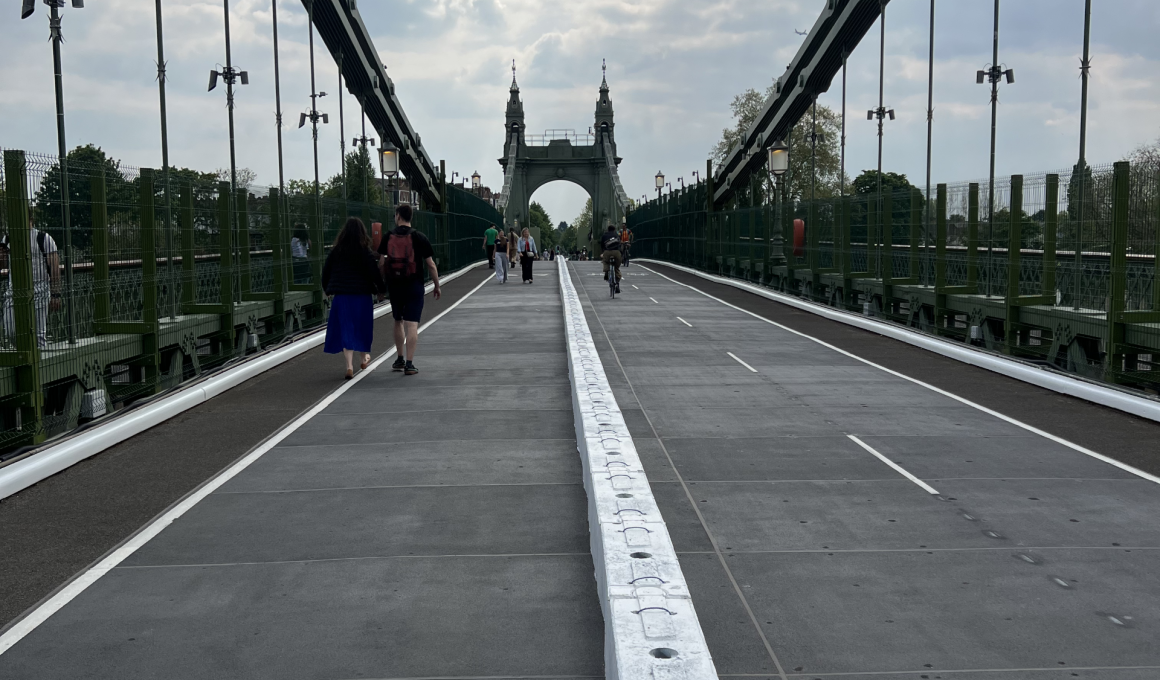
A council report this week all but confirmed what has looked obvious for years. Hammersmith Bridge, shut to cars and buses since 2019, is not being repaired. It is being left. The council’s own report says a genuine fix “would essentially require a brand new bridge to be built,” and there is no money, from anyone, to build one.
That is not really a story about a bridge. It is a small, everyday example of something bigger: the ability to find solutions to complex problems. That failure does not belong only to the people who sit on councils and in government buildings. It belongs to residents too, including the ones convinced they already know who’s to blame.
One version of the current situation says the bridge is basically fine, that it isn’t really the problem, it is open because it carries people and bicycles – and that Putney’s traffic misery has some other cause.
The bridge is, of course, not fine. It is effectively on life support, and advanced modern engineering is the only thing preventing it from falling into the Thames. It has carried no cars, no buses, no lorries and no ambulances for six years. But the language that “Hammersmith Bridge is open” is out there and being used by people exhausted by six years of argument they’d rather was over.
In this version there is also a way to counter the claims of greater increased congestion: traffic stats. The increase in congestion resulting from the bridge closure can be explained through official figures for Putney Bridge, the neighbouring crossing absorbing everything Hammersmith can no longer carry. They show 37,089 vehicles a day in 2025 against 41,084 in 2019. Nearly a tenth of the traffic that used to cross has simply not come back.
Then there is a second opposing version of the situation with Hammersmith Bridge that uses different numbers to reach a different place: that traffic is only bad because of the closure, and reopening the bridge would fix it. Wandsworth’s own transport figures show traffic up 16% since 2020, and the council has used that rise to argue for urgent action on the crossing.
It is a real number, measured from the emptiest year of traffic London has recorded in living memory. Measured against 2019, before any of this began, traffic is still down. Both figures come from the same government dataset, against different starting points. Whoever reaches for this version is living with something genuinely unbearable, a commute that eats anywhere from 20-40 minutes every morning, and a single fixable cause is a great deal easier to be angry about than six years of nobody paying for the fix.
Psychologists call this pattern ‘solution aversion’: people reject a description of a problem when they don’t like the only solution on offer. It is not confined to Hammersmith Bridge. It is what happens to any hard, expensive, shared problem once the honest answer requires compromise rather than a winner. Compromise only becomes possible once both sides admit what is true in the other’s account as well as their own, and that is a far harder thing to do than winning an argument about a graph.
The listing question
What is oddly missing from this week’s argument is any real discussion of why demolishing the bridge and building something newer and cheaper is not something that has been given deeper consideration. That option was rejected by the bridge “Task force” – although we’re still not allowed to know why. Hammersmith Bridge is Grade II* listed, a protection upgraded in 2008 that makes demolition close to legally impossible.
That single decision, made years before the 2019 closure, has shaped every plan put forward since: restoration bids, phased repairs, the £128m bid going to Monday’s vote, all of them repair options, because the cheaper alternative was removed from the table before anyone started arguing about money. Almost nobody mentions this. The argument this week is conducted as though the only open question were how much money exists, when the shape of what that money could even buy was decided long before the bridge shut. The reasoning behind that legal constraint was covered in detail earlier this week, but even that piece did not connect it to why this week’s row over traffic figures is happening inside such a narrow set of options.
That does not mean repair is unusually difficult because of the listing, or that it should be resented for existing. Grade II* status did not stop Network Rail spending £30m restoring Barmouth Viaduct in Wales, replacing two 160-tonne spans like-for-like, finished in 2023. It did not stop a full rebuild of the Union Chain Bridge on the Scottish border, Grade I listed in England, a higher protection tier than Hammersmith’s, reopened in 2023 for £10.5m after every component was removed and restored. Listed status blocks knocking a bridge down. It does not block replacing one. What is missing at Hammersmith Bridge is money and the will to find it, inside a set of options a heritage decision settled years ago, and that constraint deserves a place in the argument, not silence.
What happens Monday
None of this changes what happens next. Hammersmith and Fulham’s cabinet meets at 7pm on Monday to vote on the £128m bid, streamed live on the council’s YouTube channel for anyone who wants to watch the decision get made rather than read about it afterwards. The government’s answer on the money is not expected until autumn, and could land, in the report’s own words, “well below” what has been asked for.
What would actually help Putney is not one side winning this argument. It is the council, the government and residents admitting, in the same room, what is true in the other’s account as well as their own: that the bridge is genuinely failing, that the traffic is genuinely brutal, and that a heritage decision made years ago quietly decided the shape of every option now on the table. None of those facts cancels out the others, and none of them excuses ignoring it. That is a harder conversation than the one being had this week, because it asks everyone to give up the comfortable version rather than defend it. It is also the only conversation that gets a bridge rebuilt, rather than argued about for another six years.

It should be rebuilt there is no question about it. What is going to happen with other bridges on the Thames? Will they eventually close? We live in an ABLEIST society which the so called discussion groups to me support.
Its absolutely disgraceful that common sense does not exist in this.
Grade II Grade I in this should be thrown ou and rebuild as soon as possible.
Why don’t they put a toll on it if no one can afford it?
‘They’ just don’t want us to have cars at all…
Putney Bridge “Traffic is up 16% since 2020” – obviously we were all in lock down in 2020!
Not only was 2020 under COVID restrictions as you point out, but the figures used compared the traffic after the bridge was ‘closed’ with … wait for it, the traffic after the bridge was ‘closed’! In a career spent in collecting and analysing data, that claim by Wandsworth Council is my absolute favourite in its blatant, phenomenal dishonesty.
This is the most cogent analysis of the bridge debacle and emblematic of the failure of decision-making throughout the country. When did we stop prioritizing the greater good which here is to allow Londoners to cross the Thames in their (increasingly electric) cars and buses on Hammersmith Bridge. I lived in Castelnau Mansions in Barnes pre bridge closure and now live on Upper Richmond Road. How unnatural and ludicrous to behold the emptiness of the wide road that is Castelnau while traffic is at a standstill on Upper Richmond Road and Putney High St. As a previous reader asked, where is common sense?
Elizabeth, as is so often in this discussion, you have fallen intio the mistake of blaming the congestion in Putney High Street and Upper Richmond Road on the partial closure of Hammersmith Bridge. There is *no evidence* that there has been a significant increase in congestion in Putney as a result of Hammersmith Bridge: firstly, Putney, especially the High Street, has been congested for many years, well before the Bridge was closed to motor vehicles, and although it’s worse now, the cause is the rejig of the main junction on the south side of Putney Bridge
The Putney Bridge junction redesign is without doubt the main cause of the additional congestion Putney has experienced for eighteen months. But the claim that Hammersmith Bridge makes no contribution defies common sense and is contradicted by multiple official reports.
AECOM, the traffic consultants, list the bridge closure as a contributing factor. Our November 2025 reporting confirmed it has redistributed traffic patterns and signal timing across the area, even without a large rise in raw vehicle numbers through Putney. And both Wandsworth Council and TfL built the junction on the assumption that Hammersmith Bridge would reopen to traffic in 2026: their modelling accounts for bridge traffic in the same way it accounts for flows from the other direction when works restrict Wandsworth Bridge.
The obvious point barely needs stating. Hammersmith Bridge is the nearest crossing to Putney and once carried tens of thousands of vehicles a day; its closure is directly responsible for additional traffic here. Beyond that, every expert body that has examined the junction, AECOM, Wandsworth Council and TfL, reaches the same conclusion.
The article’s point was different: that seven years of argument over the bridge’s dire condition has left people talking past one another, and that the way forward is to resist solution aversion and find a fix that works for everyone.
the bridge could be moved and remain a pedestrian and cyclist bridge while a new bridge is being built in its place. We need more pedestrian crossings and we need the vehicular transit back to decongest not only Putney but other bridges. When I (rarely) drive across the river, I use any of the following bridges: Barnes bridge, Wandsworth bridge, Vauxhall bridge, Battersea bridge and even Tower bridge. All of them are avoiding the congestion charge and the Putney bridge.
So we should look at statitics at what the Hammersmith bridge closer did to traffic to ALL London vehicular bridges. Because many people like me use ANY bridge they can to avoid the Putney Bridge even though that’s my closest bridge.
“shut to cars and buses since 2019”, do not forget emergency vehicles.
I have to disagree with this being a complex problem.
Poor decisions have been made with little transparency.
When have government and quangos every hid a good decision?
We’re all the options and costs considered, including delisting or removing the present bridge?
What are the current costs and future costs in 10, 20, 50 years time of the various options?
With a national infrastructure budget of only £1billion, which will probably get smaller, cost and value should be paramount in any decision when it comes to tax payers money.
To me, the main difficulty is that this issue has “sides” at all. We should all be focusing on how best individually and collectively to move around in the 21st century, whether or not we drive, walk, wheel or cycle – or all of these. Just for the record I can drive, but don’t own a car. I travel mostly by walking and public transport, but also cycle and hire cars or take ubers/cabs when needed.
I agree that the lack of a plan & decision for Hammersmith Bridge after 7 years (and counting) is embarrassing and shameful – not to mention very costly.
But, I also think that the current situation offers a real chance for us to think about what we need and want from transport locally (and London as a whole), and build accordingly.
Private cars have many benefits – and for some people are essential. But getting around for short journeys in a large, congested city is not one of them. We know from decades of experience that we cannot build our way out of traffic congestion. Whatever we decide needs to be fit for the next 50 years, not just the next one or two.
For example, I think that Hammersmith Bridge is much more pleasant and safer to cross without the heavy motor traffic, and it’s used by thousands of people every day. There are thoughtful and future-facing suggestions/proposals for light public transport (e.g. pods) to open the crossing to more people. Currently these are all coming from local people.
I would like to see our leaders in Wandsworth, Hammersmith & Fulham & Richmond take responsibility for developing some options and outline costings, opening up discussions with local residents on some different options and moving forward with one of them. At least we would be spending the money currently patching up the bridge on something more sustainable.
F.Y.I New £10m bridge planned to connect east London boroughs
The bridge would span the borough boundary between Tower Hamlets and Newham and is a joint project between the two councils.
@enanicholls – had a look re the East London Bridge. Didn’t know anbiut it before. Agreed in 2024 – pedestrian and cycle bridge – hope they are going ahead with it. That sounds like the sort of thing we could work on in SW London – where can we expand pedestrian and cycle crossings to enable people to reduce car use for short journeys. The 3 boroughs could also cost the light public transport option for Hammersmith Bridge – – instead of just expressing disappointment about the current situation they could do something to move us forward – even if in outline form and ballpark costings. Again that would be
The size of project that has some hope of being built and would make a difference
Thank you for your coverage of this. Without getting into what the effect of the bridge closing has actually been, it seems daft not to have someone who feels responsible for looking out for the overall effect of changes in bridges to the road network. Just letting things happen doesn’t sound like a good recipe – though I am sure some Putney residents are daydreaming about how nice things would be if Putney bridge were suddenly out of action too.
In the short term, I wonder if the focus might best be on increasing the capacity of the infamous junction. That seems to have been the cause of quite a lot of the misery. Obviously that would cost money, but a tiny fraction of the cost of the bridge repair. Could we have an article about how much it would cost to undo the change, what effect doing so might have, and what stops that from happening?
Number of crossings is a useless measure of congestion or misery. A bridge in gridlock has zero crossings – but not zero demand. Average speed or average journey time is the only way to measure congestion.
LBHF could not be more different to Raymond Carver.Carver was an observer of a ‘submerged population’. He wrote his stories for people who had no one standing up for them, no one to speak for them. LBHF exploits these people, takes advantage of their apparent ‘apathy’ while consorting with a vocal bunch of champagne socialists who want plenty of space for their own SUVs and cargo bikes while suppressing others who are reliant on their cars and public transport to get to work, to transport their SEN children to school, to get to hospital appointments, to ease their disability. LBHF calls this ‘working with residents’.