

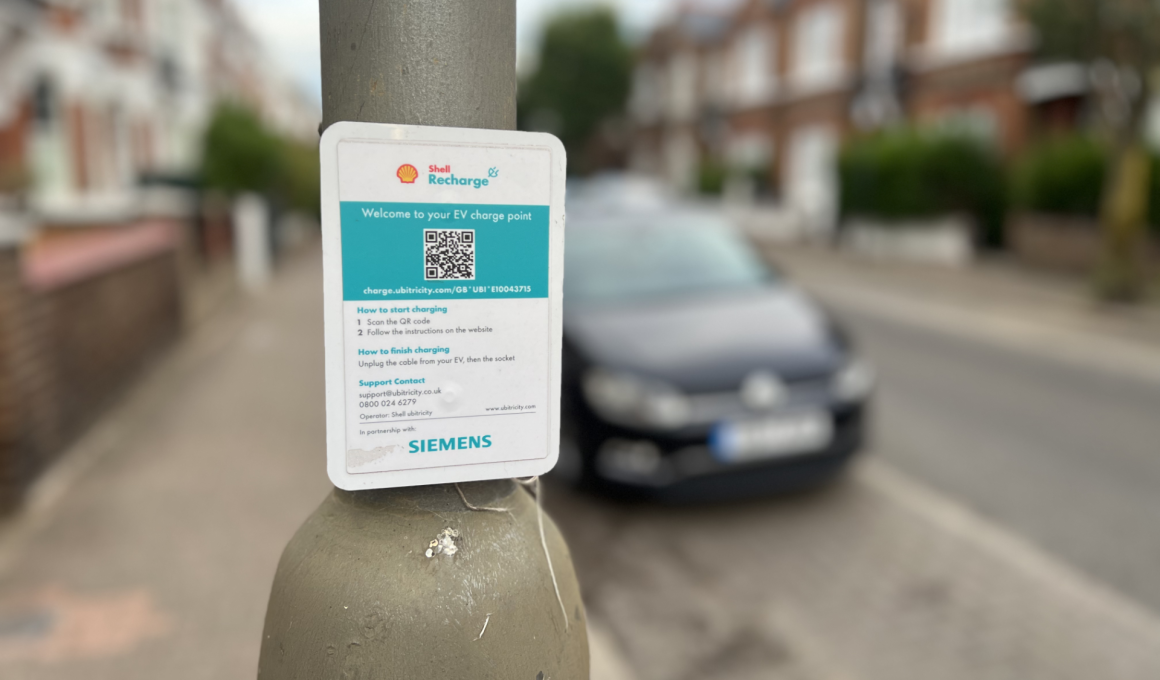
Wandsworth has 1,138 lamp-post EV chargers across two networks, each requiring a different app, with three different price bands, and a council warning that they are being targeted by fraudsters.
This is not a malfunction. It is what the network looks like when nobody is responsible for making it work as a whole.
The same pattern runs through the borough’s cycling infrastructure (six operators, no coordinator, unused bike racks sitting next to overflowing ones) and through its e-bike provision, where the boundary between two operators on the Thames towpath is drawn by commercial contract, not by where residents need to travel.
Wandsworth is not uniquely bad at this. It is a detailed example of a national problem: councils deploying green transport technologies through separate procurement processes, under separate regulatory regimes, with no requirement to join the pieces together.
1,138 chargers, two apps
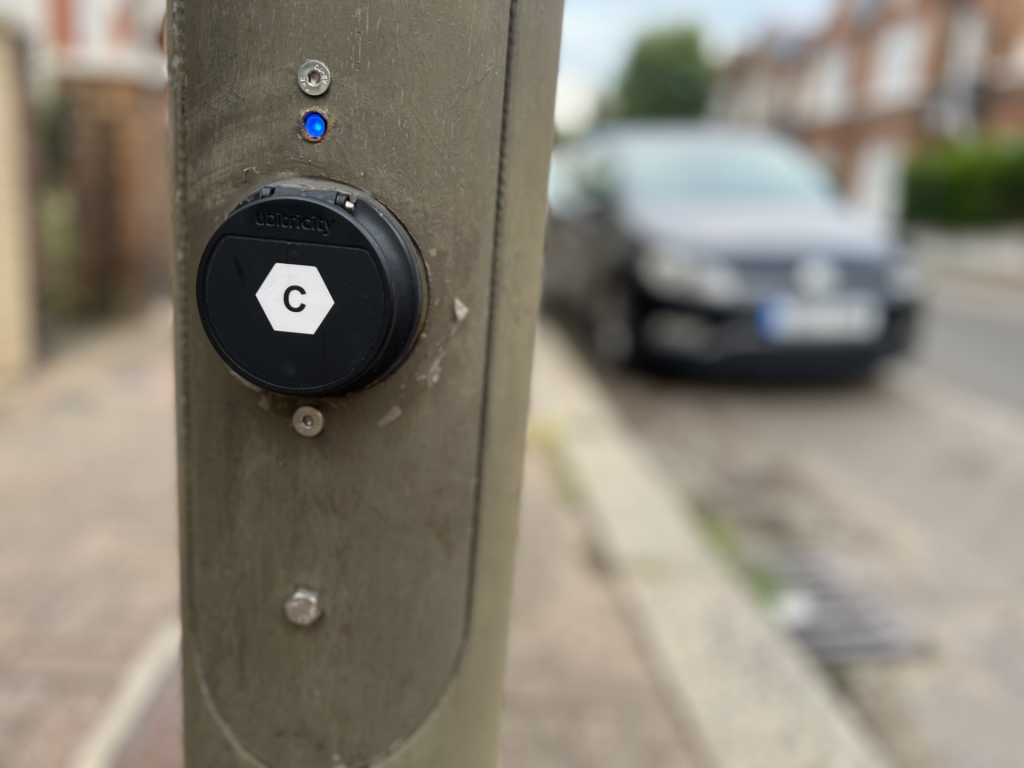
The 1,138 chargers split between two operators: 525 run by Shell Recharge (the trading name ubitricity adopted after its acquisition by Shell) and 613 run by char.gy. The two networks require separate accounts and separate apps. The ubitricity contract received full Transport Committee scrutiny before it was signed. The char.gy contract, as we reported in November 2025, was not examined by any committee.
From 1 April, Shell Recharge introduced a three-band pricing structure: 44p per kilowatt-hour off-peak (midnight to 7am), 55p standard, and 66p during the evening peak from 4pm to 8pm. The operator’s own guidance notes: “There are multiple different tariffs in place across the boroughs of Richmond and Wandsworth, so please ensure to check our Pay-As-You-Go or your e-mobility app before you start your charge.”
The council’s EV page tells residents that paying by QR code rather than through an app may be cheaper, but also warns that those codes are being targeted by fraudsters, directing residents to char.gy’s website and Action Fraud for guidance. If you use a QR code to pay, Shell Recharge places a £40 pre-authorisation hold on your bank account for the duration of the session. On the char.gy side, as we reported in November 2025, char.gy’s prices had risen 146 per cent, from 24p to 59p per kilowatt-hour.
It is, in short, a confusing mess. And it’s not just electric vehicles. Other forms of greener transport – pushed by local government without much joined-up thinking – are just as much a hodge-podge of taxpayer-discounted, unregulated and poorly thought through installations and charging systems.
The question the regulations did not answer
Mick Stone of the Putney Action Group pointed to the underlying problem about something different. He was looking at new bike storage hangars that had appeared on Putney streets. “I want to know the rationale for these things and where they’re being put,” he said. “Who’s responsible for such a stupid decision and failure to communicate?”
Stone was asking about cycling infrastructure. The question fits EV charging equally well.
In 2025, the House of Commons Public Accounts Committee found that public EV charging had become too complex for many users, with too many payment methods and pricing too unclear. The Department for Transport’s Public Charge Point Regulations 2023 addressed some of this: contactless payment is now required, reliability reporting is mandatory, and a 99 per cent uptime requirement for rapid chargers has been enforceable since November 2024.
These rules have helped. They have not answered the coordination question: who ensures that the multiple technologies a council deploys simultaneously work coherently for residents?
The same pattern in cycling and e-bikes
Putney’s cycling infrastructure runs across six separate operators with no obligation to coordinate. The council overshot its bike storage installation target by 49 per cent and published no revised target. A junction installed to improve conditions for cyclists at Putney Bridge Road was used by fewer than ten cyclists a day. The contract with the council’s main cycling infrastructure provider has never been published. Westminster’s equivalent contract with CycleHoop (four years at £200,000) is available on Contracts Finder.
On the Thames towpath, Lime operates the Putney side and Forest the towpath and Richmond side. The boundary between them is not drawn by where residents travel. It is drawn by the terms of each operator’s commercial deal. The London Assembly voted unanimously in August 2025 for a pan-London e-bike contract that would set standards across operators. TfL has not acted on it.
What keeps happening
Grant programmes arrive with tight timelines and specific mandates: deploy EV chargers, install bike hangars, contract an e-bike operator. The money covers installation. It does not require coordination between technologies, or between operators within the same technology, and no grant condition requires a council to name an officer accountable for the whole picture.
Separate procurement processes produce separate contracts. Separate regulatory regimes produce separate compliance obligations. The result, across all three technologies in Wandsworth, is the same: when something is unclear, check the website, download the app, report it via the portal.
This is the predictable outcome of how green transport infrastructure gets commissioned. And it matters, because these technologies only deliver their purpose if people can use them. An EV only replaces a petrol car if charging it is straightforward. An e-bike only replaces a car journey if people can ride it where they need to go. Every unnecessary barrier (an unexplained pricing change, a QR code that might be genuine or might be fraud, an access boundary drawn by a commercial deal) is a reason someone delays a purchase, abandons a journey, or stays with what they know.
The governance gap is not just inconvenient. It is working against the transition it is supposed to serve.
The £381 million Local Electric Vehicle Infrastructure fund, the largest public investment in EV charging since the programme began, is now in mobilisation phase. Most English councils completed their tenders in late 2025. The chargers are being installed. The same procurement pattern that produced Wandsworth’s two-operator, three-price-band network is repeating at scale.
What would change it
Westminster published its cycling contract. Waltham Forest published theirs, including a costed relocation clause. Neither required new legislation. What is missing in Wandsworth, and in most English boroughs, is a decision made before each new technology is commissioned: how does this fit with what is already running? Who is accountable across all of it? What gets published so residents can see the terms?
Wandsworth has been asked whether a cross-technology transport coordination framework exists and whether a named officer is responsible for green transport coherence. It has also been asked whether it was notified in advance of the April 2026 pricing change on the Shell Recharge network.
That decision has not visibly been made. There is still time for it to be made before the next wave of infrastructure arrives.
Wandsworth Council had not responded at the time of publication. This story will be updated if a response is received.
If you charge an EV in Wandsworth
Which app: Shell Recharge for the 525 chargers on the ubitricity/Shell Recharge network; char.gy for the 613 char.gy chargers. The lamp post shows which network it is on.
The price: Shell Recharge charges 44p per kWh from midnight to 7am, 55p from 7am to 4pm and 8pm to midnight, and 66p from 4pm to 8pm. Check the current char.gy rate in the app before charging.
QR codes: Paying by QR code may be cheaper than using an app, but the council warns that codes on public chargers are being targeted by fraudsters. Check char.gy’s guidance on recognising genuine codes, or use the app if in doubt.
Report faults: Shell Recharge: 0800 024 6279. char.gy: 0800 086 9606.
Raise the coordination question: Contact your ward councillors via democracy.wandsworth.gov.uk. The Transport Overview and Scrutiny Committee is expected to resume under the new administration.



The usual nonsense from bleating Stone. He says he wants “to know the rationale for these things and where they’re being put.” Well, he could try looking at Cyclehoop (https://cyclehoop.rentals/ ), who manage cycle parking for Wandsworth. There is a waiting list for every one of the 20 such locations on the west side of PHS, one as long as 44. So it’s really not too taxing of the intellect to see the way to understanding the rationale for “these things,” is it Mick?
Richard — the CycleHoop waiting lists are a fair point, and the data being publicly available is exactly how it should work. What’s less clear is the contract behind it: unlike Westminster’s equivalent arrangement, Wandsworth’s CycleHoop contract has never been published.
Stone’s question in the story isn’t really about whether the information is findable. It’s about who at the council is responsible for ensuring the networks work together – EV charging, cycling, e-bikes – as a coherent whole. That’s the gap the story is reporting.