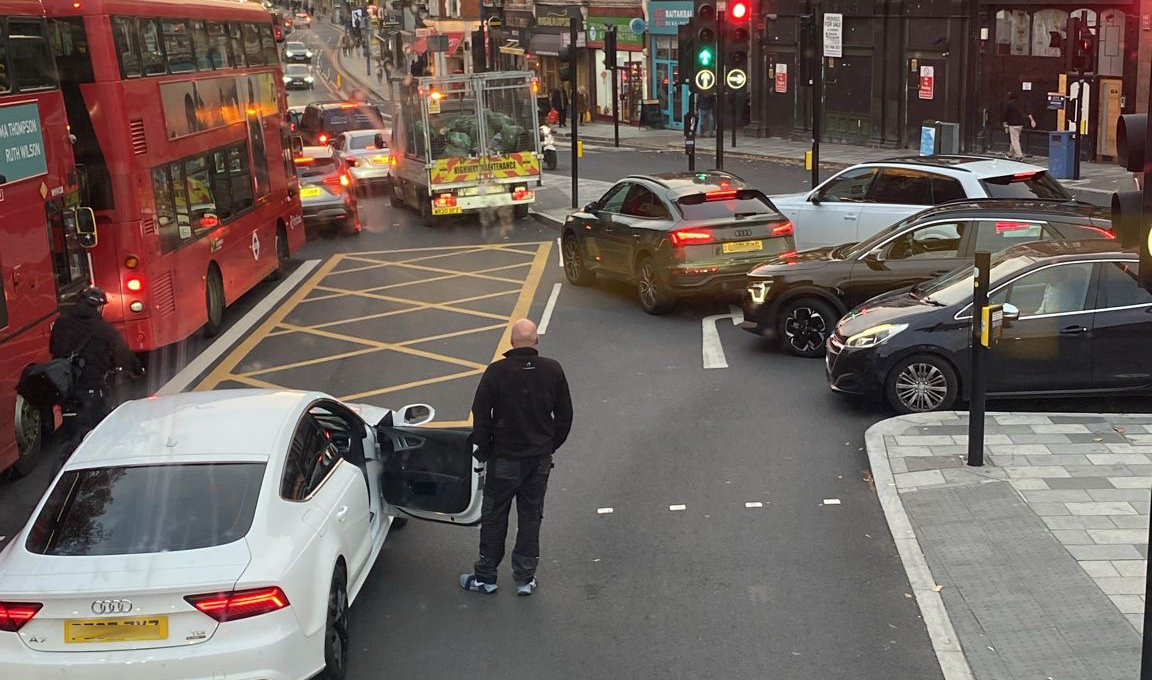
If there is one topic on which Putney residents are united, it is the new junction at Putney Bridge. Introduced nearly 18 months ago, it has been an unmitigated disaster, causing extraordinary congestion, severe knock-on effects and local fury.
If you live in the ward closest to the river, Thamesfield, every leaflet in the past weeks have featured the junction prominently, at the hustings three weeks ago it was also the dominant issue. So the question is: what can my vote do to shift the issue?
As the party in power for the past four years, and the group responsible for implementing the design, using traffic data from the Covid period to drive the design, Labour has become strongly associated with the junction’s failure. Residents made it abundantly clear to the leader of the council, Simon Hogg, back in October the depth of anger over the situation and the political cost of doing nothing.
Since then, there have been dozens of small fixes that have improved but definitely not fixed the issue. Hogg has at least been consistent: he says the design is here to stay but his council will do all it can around the edges to improve congestion. The Transport Committee has also made it plain that nothing significant is going to change, in part, it says because the redesign has – according to their reading of the situation – achieved its goals in terms of pedestrian and cyclist safety.
Most egregiously, the cabinet member in charge of transport Cllr Jenny Yates, has consistently outlined not what her administration will do about the situation but why it wasn’t her fault, spending over an hour during this election period giving residents a series of increasingly implausible explanations.
So the answer, at least in terms of this issue, should be obvious – switch to the opposition. Except, the one thing that Yates has been honest about is that it was the Conservatives that were initially responsible for the Putney Bridge junction redesign.
What they said at the hustings
The truth is that the previous Conservative administration designed it, appointed the consultants, and held the transport brief throughout the planning phase.
Their candidates are now standing on a promise to fix it but have been less than fully honest about their role in the first place. At the public hustings on 13 April, Conservative candidate Ethan Brooks told the roughly 200 residents that his party’s former transport lead, John Locker – also a Thamesfield councillor – had “never signed it off.”
That was met by immediate push back from the crowd, several of whom had sat in meetings with Locker and council and TfL officials when the whole process was working its way through. The council’s own post-implementation review names Locker as a participant throughout the design phase. He was in fact the councillor most in charge of the whole project. Cllr John Locker is not on the Thamesfield ballot today. He is standing on the complete opposite side of Wandsworth, in Shaftesbury and Queenstown.
Responding to voter anger, the Conservatives have promised to set things right. But even then, it’s not clear there is clarity over the situation. Referring to the large government grant used to offset the cost of the new junction – which was in itself a major reason for the rushed design because the funds were only available for a set period of time – Cllr Brooks told residents last month: “If we have to return £300,000 to put this right then we must.”
The actual government grant figure spent on the junction was £344,732. Council officials have used the grant, among many other reasons, to explain internally why it is so difficult to make changes to the junction. The rationale is, however, yet one more paper tiger.
A review of every major capital grant programme over the past three decades found not a single documented case of a council being required to return money for completed infrastructure that was subsequently reversed.
The claim has also never raised in any formal, minuted council setting. Not at the Transport Committee in November 2025, not at full council in March 2026. It has never been tested against professional advice or against any historical precedent. Brooks presented it to residents as the established cost of fixing the junction.
Official conduct
The truth is that any significant changes to the junction design are going to require elected councillors to plough through 100 roadblocks setup by officials who are loathe to admit failure and have already earmarked the resources needed to cover a dozen other issues across the borough.
Which leaves the Lib Dems, Greens and Reform. Among them, only the Lib Dems have pushed hard in this part of Putney for local’s votes and the junction has been their dominant message. Their main solution is to return the crucial turn from Lower Richmond Road onto Putney Bridge back to two lanes – something council officials have consistently claimed won’t have much of an impact and doesn’t fit modern safety standards. It is a policy that has also been adopted by the Conservatives.
The other proposed solutions are shifting bus stops – which are already under consideration and will likely have to wait until a contract renewal with TfL – and introducing so-called ANPR cameras that will read people’s number plates and fine non-residents if they use backstreets as ‘rat runs’.
None of that will fix the fundamental problem: the junction design does not work for the number of cars that go through it every day.
If there’s one thing politicians should learn from the junction design debacle, it’s that the details and the process matter. That may be driving what are cautious and limited plans to fix the traffic in Putney. But the truth is that until a more radical solution is agreed and arrived at, we will be tweaking at the edges, and traffic will remain intolerable.
The chairman who assembled the slate
While we’re looking at past roles of the Thamesfield Conservative candidates, one of them this year has had a particularly firm hand: most were selected under Robert Morritt, who is Chairman of Putney Conservatives and is himself on the ballot today. Mr Morritt has been away from frontline politics for some time but has returned just as the Conservatives sense that may be coming back into power.
In July 2012, Guido Fawkes began publishing a series of articles alleging that Morritt, then serving as electoral agent to Conservative ministers Justine Greening, Stephen Hammond and Jane Ellison, had gained financial advantage from Wandsworth Conservative Association funds.
The allegations centred on what Guido described as “more than £30,000 in missing money and a secret £25,000 Addison Lee bill.” Wandsworth Council suspended him from his council posts while the matter was investigated. An independent fraud investigation found the association “wanting.” Its findings included that Morritt “fell short of providing sufficient, acceptable detail to ensure that he did not gain financial advantage during his employment with the Wandsworth Group.”
Morritt called the investigation’s findings “totally spurious” and accused Guido of “malicious lies.” No criminal charges were brought.
On 31 October 2013, the Conservative whip was removed from him by a two-thirds majority vote. He continued as an independent councillor but could not stand again as a Conservative. His council career ended at the following election.
In January 2024, Guido reported he had returned and was “campaigning to have total control of the Putney Association and its finances.”
The Conservative Party did not disclose this history when Morritt was appointed Chairman or selected as a candidate. Depending on how Thamesfield residents vote today, Mr Morritt may be back at the heart of the Wandsworth political machinery.
Putney.news has fact-checked the Conservative manifesto and applied the same scrutiny to Labour’s transport claims during this election campaign.