

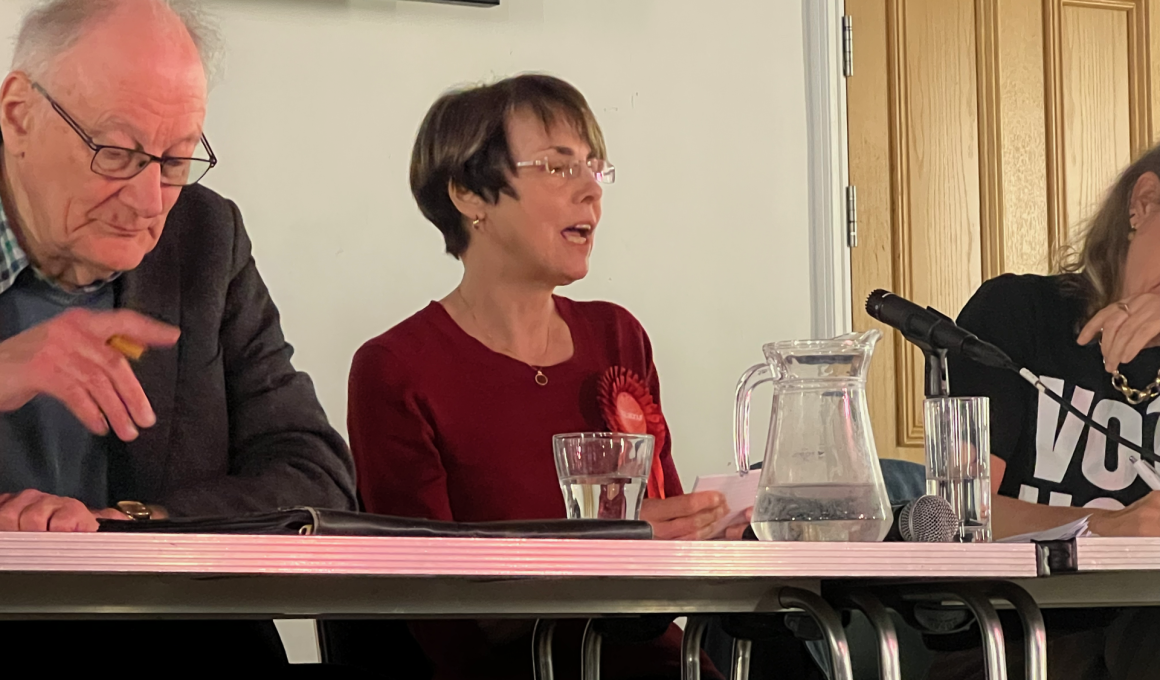
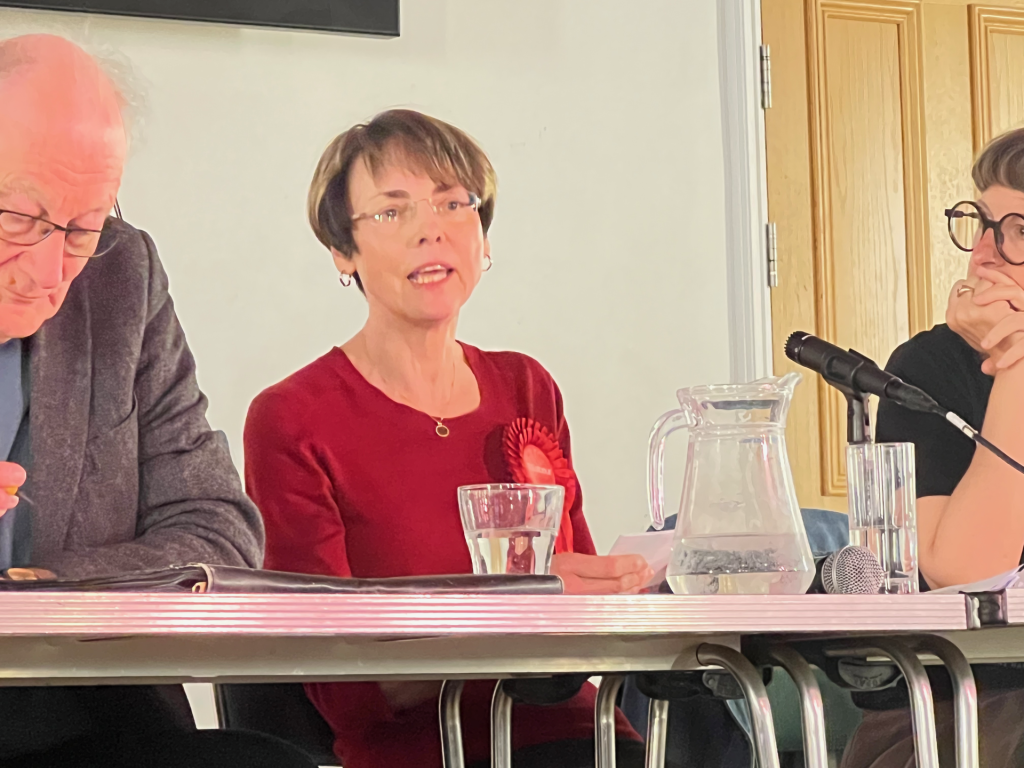
Cllr Jenny Yates, the Cabinet Member for Transport responsible for the Putney Bridge junction redesign, addressed residents at the Putney Society hustings on Monday. We checked every traffic claim she made against council papers, committee minutes, TfL documents, and FOI disclosures obtained by Putney.news.
Tap or click on each claim to see the full evidence.
“We were surprised”
False
Read the evidence ▼
Yates said: “We were surprised because it wasn’t what traffic modelling showed, all the modelling of this junction.”
The public record: TfL’s signals feedback, published as Appendix C to Paper 22-331 before the September 2023 committee vote, warned the scheme would cause “a lot of congestion,” queues “completely filling Putney High Street and into Putney Hill,” and “around 75% less green time” for some traffic movements. Paper 23-304, the report presented to the approving committee, acknowledged the design was “initially over capacity.” Yates attended that committee as Cabinet Member for Transport. From January 2025, she received monthly Bus Taskforce briefings documenting the junction’s failure. The May 2025 briefing stated the junction “seems to have worsened congestion” with “significant tail backs on Lower Richmond Road and Putney Bridge Road.”
The gap: The congestion was predicted in writing by TfL, acknowledged in the council’s own approval paper, and reported to Yates monthly for seven months before the hustings. Residents were told she was surprised. The full history of how the junction failed has been publicly available since November 2025.
“We inherited that scheme”
False
Read the evidence ▼
Yates said: “We inherited that scheme and it was supported unanimously at the Transport Committee in September 2023, and we went ahead with good faith and good intentions to make it safer.”
The public record: The junction redesign was conceived under the Conservatives. Paper 17-81 dates from February 2017. But Labour took control in May 2022. Everything that followed happened under Yates’s administration: the Road Safety Panel Group deferral in July 2022, all three stakeholder meetings between July 2022 and February 2023, the final TfL negotiation, and the unanimous September 2023 committee vote. Yates was the Cabinet Member for Transport at that committee.
The gap: Yates did not inherit a finished scheme. She inherited a design process and approved its output. The councillors who voted for it have since produced nothing to fix it.
“It long precedes Labour”
False
Read the evidence ▼
Yates said: “This traffic modelling, it long precedes Labour coming into power.”
The public record: Data collection in July 2021 does predate Labour’s May 2022 takeover. But the modelling process itself, the CYCLOPS design rejection in late 2021, the cycle gate rejection in April 2022, the RSPG engagement from July 2022, all three stakeholder meetings, and the final committee approval in September 2023 all occurred primarily under Labour. The most critical decisions about what the junction would look like were made on Yates’s watch.
The gap: The raw data predated Labour. Almost every decision about what to do with that data did not.
“A very lengthy impact assessment”
False
Read the evidence ▼
Yates said: “There was three different types of traffic modelling done and there’s a very lengthy and elaborate six-stage approval process that Transport for London goes through. So we had to submit the design and the data and they had to validate the traffic models, so there was a very lengthy impact assessment.”
The public record: The six-stage approval process exists and is confirmed in Paper 25-398. But TfL’s own Road Safety Panel Group deferred endorsement in July 2022, asking for additional modelling of Hammersmith Bridge scenarios. Whether those conditions were satisfied before the September 2023 approval has never been confirmed. TfL holds the August 2023 RSPG minutes but has not disclosed them. The “impact assessment” did not include any public consultation. Only 23 statutory consultees were contacted. Four responded. None raised capacity concerns. And TfL’s Appendix C, which warned of severe congestion, was attached to Paper 22-331 but its findings were not reflected in Paper 23-304, the report presented to the committee that approved the scheme.
The gap: The approval process existed, but its final review gate deferred, its public consultation reached almost nobody, and its own congestion warnings were not carried through to the approval paper. Calling it “lengthy” and “elaborate” describes the paperwork. It does not describe the scrutiny.
“Many, many more cyclists”
False
Read the evidence ▼
Yates said: “Many, many more people are crossing the junction on foot… many more cyclists are going through the junction. And that will be one reason why it’s slower.”
The public record: Pedestrian and cyclist counts have increased since 2021. But the 2021 baseline was collected days before Freedom Day, when most commuters were still at home. Some of the increase is simply people returning to the office.
AECOM’s data suggests cyclists make up roughly 30% of junction movements. That sounds significant until you consider how the count was taken. In June 2025, motor vehicles were backed up to Putney Hill on the High Street, to Wandsworth Common on Putney Bridge Road, and to Putney Common on Lower Richmond Road. It was gridlock. A traffic count measures what gets through, not what is waiting. Cyclists weave past queuing cars and get counted. Cars sit in the queue and don’t. The worse the congestion, the higher the cyclist percentage looks. Fix the junction and more cars get through per hour. The cyclist share drops. The 30% figure is a product of the gridlock, not an explanation for it.
One junction feature tells the story. A dedicated signal stage for cyclists turning left out of Putney Bridge Road served roughly 20 people across the entire three-hour morning peak. AECOM itself noted “a relatively low number of cyclists making this turn.” That stage cost Putney Bridge Road 21 seconds of green time per cycle, time taken from thousands of motor vehicles and bus passengers. The council has since removed it.
AECOM’s own para 4.25 is the clearest rebuttal: “the number of motorised vehicles remains at similar levels to 2021.” The congestion is not caused by more vehicles of any type. Every technical document identifies signal timing as the cause. And the people Yates credits as beneficiaries don’t agree: 80% of pedestrians and 77% of cyclists surveyed said the junction was worse for them.
The gap: Yates pointed at the cyclists. The documents point at the signals. A dedicated cyclist stage served 20 people per morning peak while costing thousands 21 seconds of green time. It has since been removed.
“I co-chair the bus taskforce”
False
Read the evidence ▼
Yates said: “I co-chair the Bus Taskforce with Fleur Anderson MP, it meets every month. TfL are in that Bus Taskforce and it’s through that close dialogue with them and through gathering evidence and data that we have got them to make some really key changes.”
The public record: All seven Taskforce emails disclosed under FOI (WBC-FOI-11510) were sent from Fleur Anderson MP’s parliamentary email. Anderson chairs, convenes, sets agendas, drafts action tables, and drives follow-up. Yates is listed as a recipient and action item assignee. No disclosed document describes her as co-chair.
But it goes further than that. When Putney.news asked the council for minutes, action points, or any officer-authored documents from the Taskforce meetings, the council had none. Not a single record produced by a council officer in connection with a body its own Cabinet Member for Transport claims to co-chair. TfL does not officially recognise the meetings. The council does not treat them as official council business. We reported this in September 2025.
The gap: Yates told residents she co-chairs the Taskforce. Every disclosed email shows Anderson running it. The council keeps no records from it. TfL does not recognise it. Yates attends a body that, by the council’s own admission, does not formally exist.
Cllr Jenny Yates is the Labour Cabinet Member for Transport and represents Roehampton ward. She is standing for re-election on 7 May. The claims above were made to residents at a public hustings organised by the Putney Society.
Six claims. Six times the public record said otherwise. Every document cited in this article is published in full in our Putney Bridge junction investigation series.

I have seen Cllr Yates up close at meetings and have listened to what local cycling and active travel groups have said about her.
She is simply out of her depth and puts politics above everything else. The last meeting I was at she hijacked the agenda to ensure the leaders position was enforced upon everyone. Glad the officers present saw through this and placated her knowing that she had no technical understanding of what actually the meetings was about !!
Brilliant work, thank you for your continued excellent work into this. I was the resident that asked her how on earth she could be surprised by the congestion. My father died on 20th February so I no longer have to regularly sit in a long queue on Putney Bridge Road. I resent every second that I had to sit in traffic as a result of Clllr Yates’ – and others’ – stupidity.