

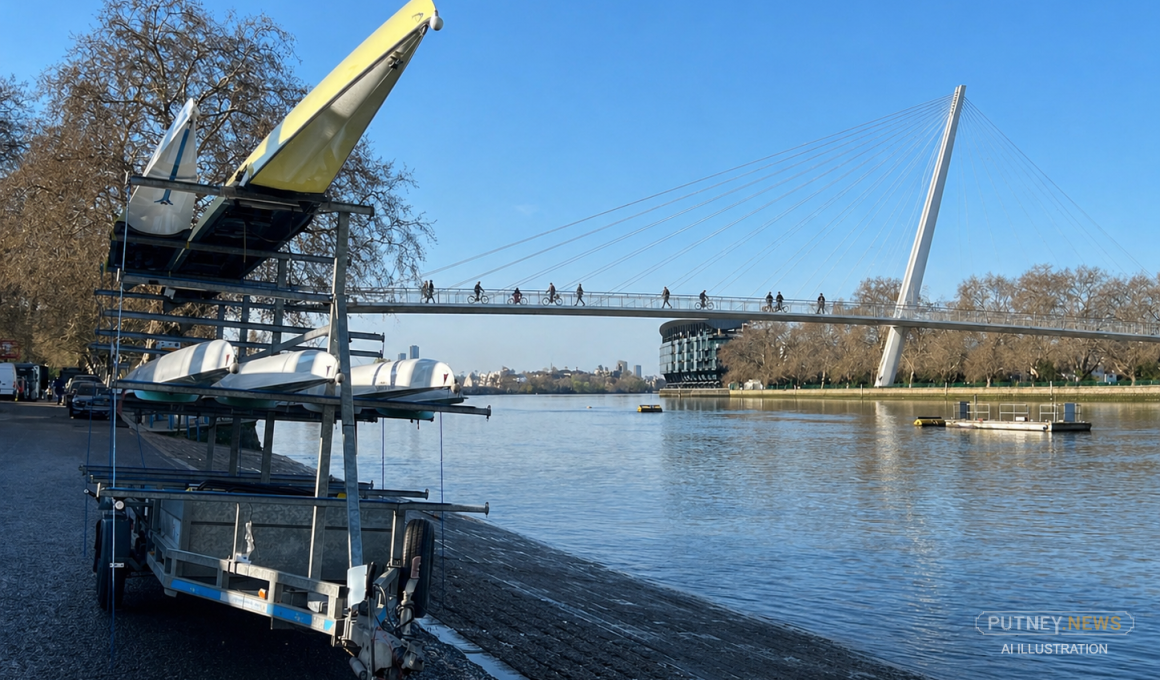
There’s something significant missing from the party manifestos and candidate pitches this election: vision. Bins, potholes, junction tweaks and promises to keep campaigning are one thing; lifting Putney up quite another. Without vision, problems become permanent, and what should be solvable starts to feel inevitable. Putney was built by people who refused to accept the world as it was. You have to imagine what’s possible if you’re going to turn it into what’s feasible. Here is our vision for what comes next: Putney 2030. The vision Putney deserves.

Part 1: A partial solution to our traffic problems
We have spent years arguing about one junction. Here is the bolder conversation we should be having.
Everyone who lives in Putney knows the feeling. You are sitting stationary on the bridge approach, watching the lights cycle through for the third time, calculating whether you are going to be late again. Or you are on a bicycle, squeezed into a lane that never quite works. Or you are on foot, waiting at a crossing that takes so long you start checking for gaps in the traffic.
The Putney Bridge junction has generated more reader correspondence, more council debate, and more frustrated conversations at school gates than any other issue we cover. Nine out of ten residents told us the redesign made things worse, not better. We have written dozens of stories on it, where it went wrong, and what needs to be done to fix it.
But here is what we have come to believe, after reporting on this junction for two years. We have been asking the wrong question.
The question has always been: how do we fix the junction? What the question should be is: why are pedestrians, cyclists and vehicles sharing the same crossing at all?
One bridge for everything
Putney Bridge is the only Thames crossing between Hammersmith Bridge (closed to vehicles) and Wandsworth Bridge, a stretch of river roughly three kilometres long. Every car, every bus, every cyclist, every pedestrian crossing the Thames in this part of London arrives at the same point. They all compete for the same narrow space.
Every day, 37,000 motor vehicles and 6,600 cyclists share the same crossing. The result is a junction that cannot work well for everyone, not just because of how it is designed, but because of how much it is asked to do. No redesign will fundamentally change that. The problem, ultimately, is not the design. It is the absence of infrastructure that was never built.
London has far fewer bridges that Paris, and far smaller bridges than New York. With the closure of Hammersmith Bridge, and now Albert Bridge, we are in an unsustainable situation. It’s time to think more boldly. And look to the past.
Putney had more than one crossing
The photographs below were taken during the construction of the current Putney Bridge in 1880 and 1885. They will surprise most residents: at that moment in Putney’s history, three separate structures crossed the Thames simultaneously. The old wooden toll bridge that had stood since 1729 was still in use. A water infrastructure crossing (the Chelsea Waterworks Company aqueduct, built in 1856) ran a few yards upstream. And the new granite bridge was rising between them.
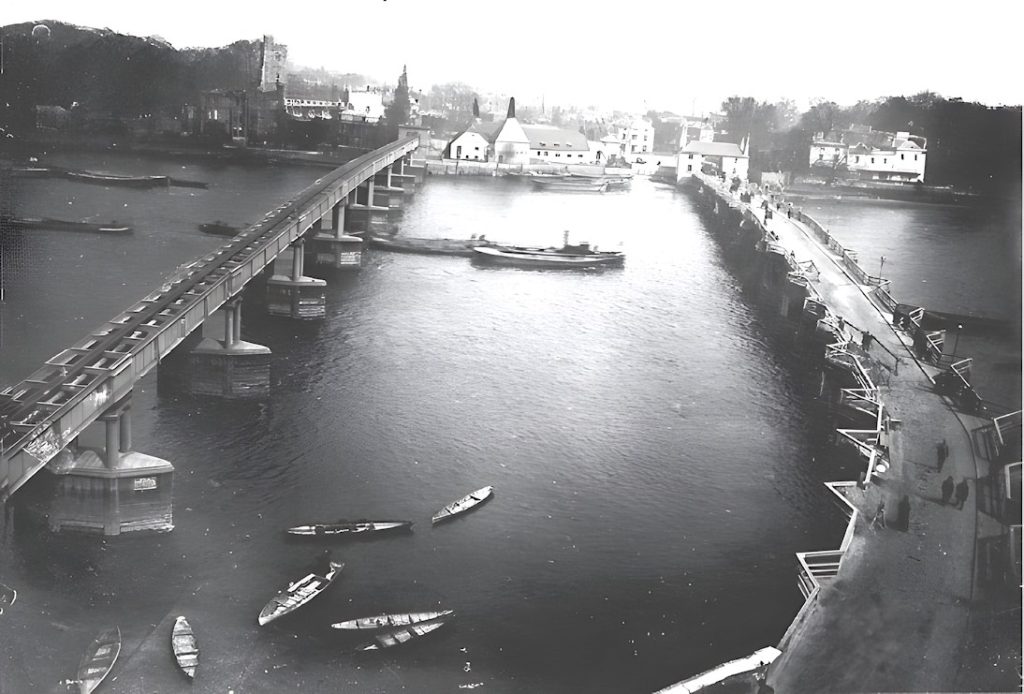
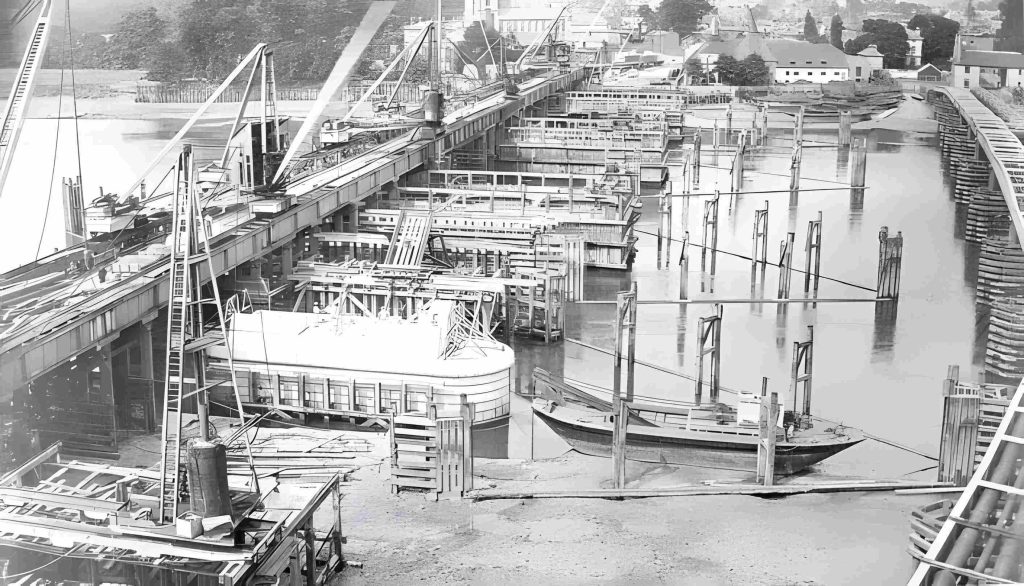
Multiple crossings serving different purposes on the same stretch of river was not unusual. It was how the river worked. We have simply forgotten it.
The proposal
There are at least three viable locations for a new dedicated pedestrian and cycling crossing in this stretch of river today.
The most immediately practical is alongside the District Line rail bridge. A lightweight walkway added to an existing structure is a fraction of the cost of a new bridge, and Sustrans, the active travel charity, has developed similar pedestrian additions to rail bridges elsewhere in the UK. The structure already crosses the river. The access points at both ends exist. A connection between Putney and Fulham, through to the Bishop’s Park cycle network and the wider routes beyond, becomes possible without building from scratch.
A second location, close to where the old crossing once stood, would deliver pedestrians and cyclists from Brewhouse Slipway in the pedestrianised party of Putney’s bank into Fulham’s Swan Draw Dock. A third option, further east where Beverley Brook meets the Thames, would connect into Bishop’s Park directly.
None of these would be cheap. All of them would be transformative. And the case for building one does not rest on vision alone: it rests on the evidence of what one crossing carrying everything cannot do.
What it would require
A new Thames crossing requires the Port of London Authority, TfL, Wandsworth Council and Hammersmith & Fulham Council to work together. It is not a project any single council can deliver alone. It requires a long-term political commitment, with a councillor or group of councillors willing to make this a sustained priority, to build the cross-borough relationships, and to pursue the Mayoral and national funding that exists for exactly this kind of strategic infrastructure.
This is not unprecedented, and the precedents are closer than most people realise. In Worcester, a dedicated pedestrian and cycling bridge across the Severn opened in 2010 for £1.8m, funded through the Sustrans Connect2 programme. Surveys before it opened predicted 31,000 trips a year. The actual figure was over 450,000. Worcester has since built two more.
In London, TfL took a dedicated walking and cycling bridge between Rotherhithe and Canary Wharf through feasibility studies, a design competition and a full public consultation (93% of respondents backed it) before costs hit £500m and the project stalled in 2019. These are two examples among many. Communities across Britain, from market towns to major cities, have been making this case and building these crossings for two decades.
The Rotherhithe bridge was not stopped because Londoners did not want it. It was stopped because no one found the money. That is a political problem, not an engineering one. The question is not whether a new crossing at Putney is possible. The question is whether anyone in local politics is prepared to say it should happen and mean it.
The payoff
A new pedestrian and cycling crossing changes everything downstream of the decision.
Putney Bridge carries its traffic. Pedestrians and cyclists cross the Thames on a route designed entirely for them, connecting into Fulham and the cycling network beyond. The junction, freed from its impossible job of serving every mode at once, can function properly for the first time. By pulling most cyclists and pedestrians out of the junction, you could get at least an extra 25% more traffic flow through it – and that is the difference between slowing down and coming to a halt.
Air quality would also improve in one of south-west London’s most congested corridors. Businesses on both sides of the river, and both sides of the High Street benefit.
It took vision to build the first Putney Bridge in 1729. It took vision to build the rail bridge in 1889. The next council will either find that vision or it will not.
How important is this to Putney’s future?
PUTNEY 2030 | Issue 1 of 5 |
This is the first of five pieces examining what bold thinking could change in Putney.


A pedestrian/cycle bridge would be nice, but how on earth would the change alliw an extra 25% of motorised traffic to flow over Putney Bridge? By removal of the bus lanes? That would be a terrible mistake! And increasing the flow over the bridge wouldn’t work because of bottlenecks further on.
A nice (but exoensive) idea that wouldn’t begin to solve the problem of a road network that cannot handle even the level of traffic now.
I think a pedestrian / cycle bridge is an interesting idea – hadn’t thought of it myself – but not sure about it – I really enjoy the view down the river (was walking there yesterday) and the bridge would change that. My concern is that we can’t even fix Hammersmith bridge (or Albert) so trying to add more bridges at this time maybe not the right solution. I think the priority remains Hammersmith Bridge.
The issue with Hammersmith Bridge is two-fold and not really about the existence or not of an actual bridge.
First it is Grade II* listed – because in its day it was a remarkable piece of engineering – and that ‘star’ means quite a lot – it means you basically need an Act of Parliament to be allowed to get rid of it. If it was ‘just’ Grade II, you could do what has been with other bits of failing infrastructure and replace it with a modern version but save the key elements and put them in a museum or put up a plague or boards to recognise its existence.
The second issue is the material it’s made from: Cast iron – the pedestals, anyway, which are the min issue. Cast iron is brittle. So a solution that others have used across the world is to simply move an old piece of infrastucture out the way, put in a modern piece and preserve the old one. Hammersmith Bridge would be fantastic (if expensive) as a pedestrian and bike bridge further up the river toward Putney. But the truth is that it probably wouldn’t survive being moved.
And so we end up with a failing bridge at a key intersection, with heavy legal protections and a massive bill for getting it up to its previous weight tolerances – which aren’t high enough anyway to deal with heavier modern cars.
The solution is actually quite obvious but no one seems to be willing to sign up to it.
Anyway, all that is to say: the policy and political disaster that is Hammersmith Bridge has got nothing to do with the ability to build modern bridges – which Putney could do with.
There is already an additional bridge for pedestrians and cyclists alongside the district line bridge, this article seems to be proposing something that already exists?
Yes, there is of course already pedestrian access along one side of the District Line bridge but let’s be honest it’s not a bridge – it’s two abreast and even that is crowded, and you have to haul your bike up the twisty steps. That said, I could have been more accurate in the article and suggested an extension or expansion or rebuild of what is there. It would also require construction of a ramp on and off, and that would likely mean using land belonging to the Hurlingham Yacht Club or the house next to it on the Putney side, and presumably TfL on the Fulham side.
Anyway, yes, it is the probably the fastest and cheapest option, there is a path of sorts there; I argue that it’s not really a bridge but an attached pathway.
Fulham Bridge, which carries the District Line, already has a pathway for pedestrians and cyclists.
Yes, should have been more precise. An expansion, or rebuild, or redevelopment of the attached pathway that is already there but limited in use.
I have mentioned this previously, the author of this thought provoking article asserts 9 out of 10 residents repeatedly say the new(ish) putney bridge junction has made matters worse.
The parliamentary constituency is stated at 103,000 to 113,000 residents.
So between 92,000 and 101,000 residents are unhappy with the much improved (especially for us old folk and parents with prams or walking toddlers) pedestrian crossings?
Unlikely.
I agree with the comment that the priority should be Hammersmith Bridge. There are journeys I no longer make (by bus) since Hammersmith Bridge closed to traffic. I would like to see a new vehicle crossing at Hammersmith with the old bridge retained for its current segregated pedestrian and cycle use. I hope we are getting closer to that goal. You published a very article siting a study about how funding for bridges needs to change
In my 15 years of living in Putney I have driven over Putney Bridge only 3 or 4 times. It would be nice if traffic moved faster when I am on the bus or in an Uber but I believe the volume of vehicles is to blame, not cyclists or pedestrians. The junction also seems to be working better than in the beginning.
Comparing bridge traffic with New York is not helpful. George Washington Bridge is a double deck bridge with 14 lanes of traffic. There are surely European cities with more relevance.
I personally would not use a pedestrian/cycle crossing in lower east Putney. I take a bus to the high street so I would naturally remain on the bus if I needed to cross the bridge. As for cycling, I go west & cross at Hammersmith or Chiswick because Putney Bridge has no cycle segregation and is terrifying.
Commentary is needed from cyclists who commute over Putney Bridge to central London. I think it is a good idea for these 6000 cyclists to have another, safer crossing but I am not convinced it would speed up vehicular traffic to any great degree.