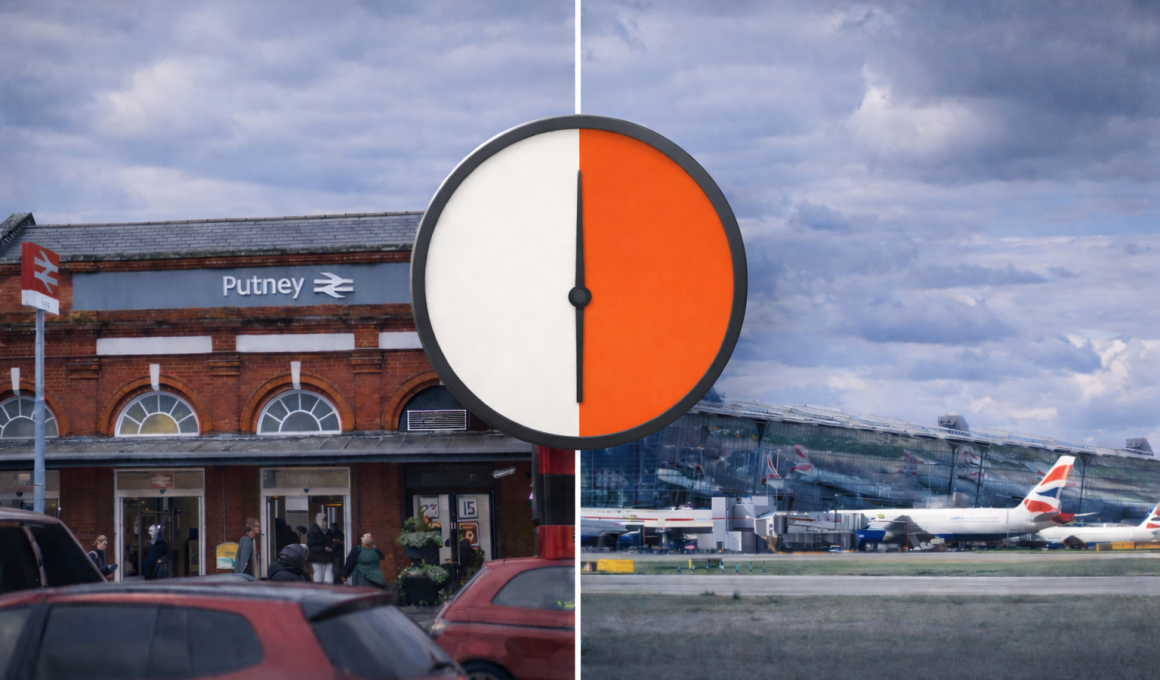
Stand on the platform at Putney station and the journey to Heathrow Terminal 5 begins with a familiar calculation. Walk to East Putney. Change at Earl’s Court. Piccadilly Line all the way to the end. Add the walking at each end and you are looking at an hour, minimum. On a good day, with luggage.
A company called Heathrow Southern Railway Limited has a different number in mind: 30 minutes. Direct. No change.
The proposal (a new railway connecting Heathrow T5 to the existing South Western Railway network via Staines) lists Putney as an intermediate stop. Four trains an hour, running through the station residents already use. It is not a sketch or a pamphlet. It has engineers, a cost estimate, a benefit-cost analysis, a crossbench peer in the chair, and backing from the Mayor of London. The government’s decision last November to approve Heathrow’s £49 billion third runway expansion has transformed the project’s prospects in ways that were not true even 18 months ago. The question is no longer just whether a southern rail link to Heathrow will ever be built. It is closer to: who builds it, and when.
There is a trade-off, which this article will come to. The same runway expansion that gives the rail link its best chance also means more aircraft overhead, and the loss of the half-day respite that currently gives SW London a break from Heathrow’s flight paths. Putney residents deserve to understand both sides of that equation before the next round of government decisions arrives later this year.
The plan
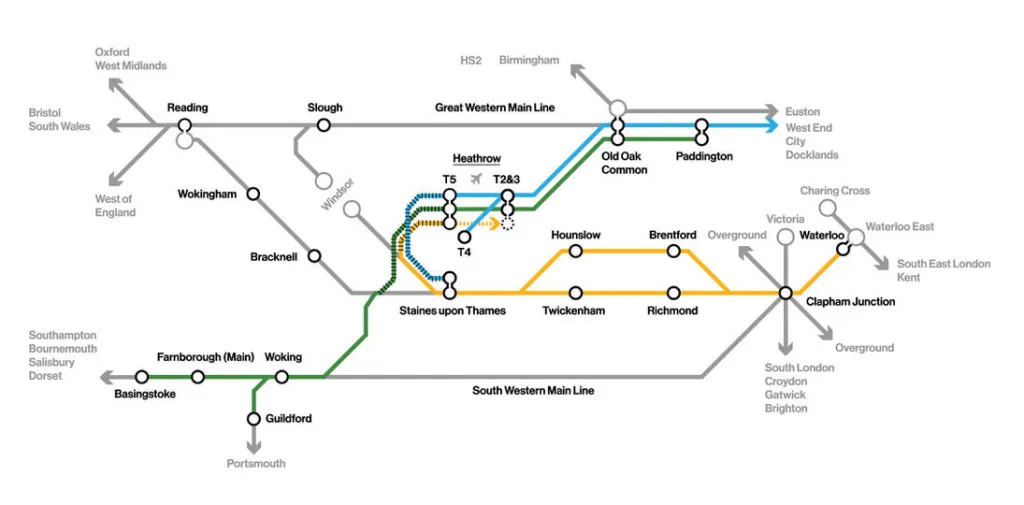
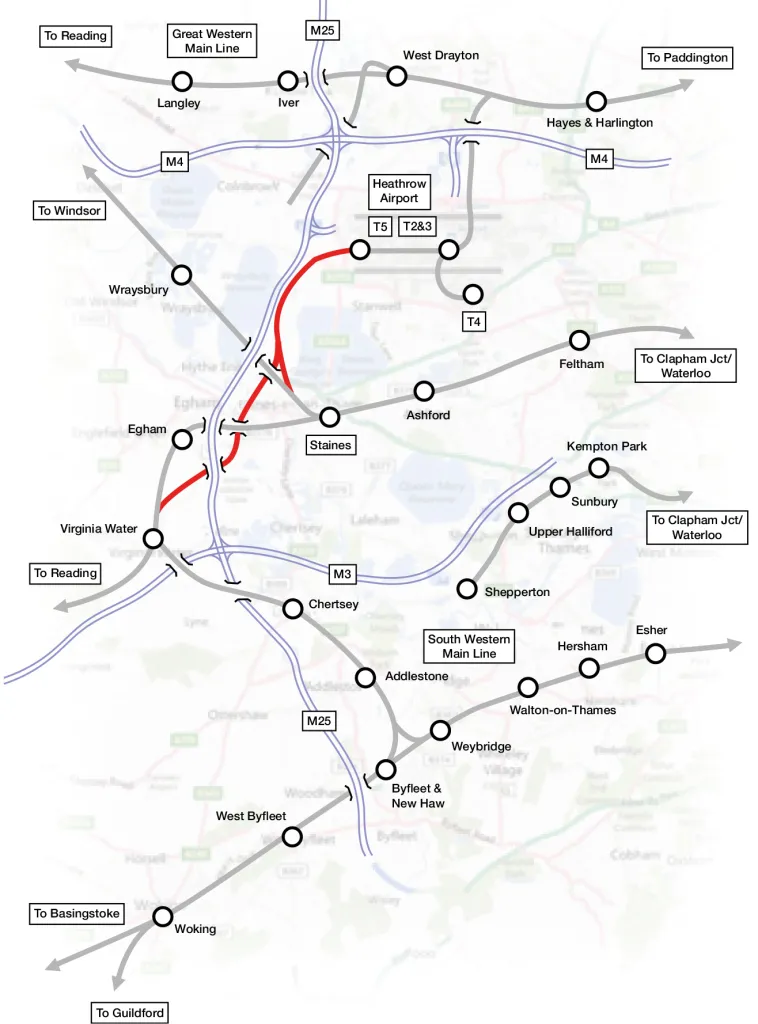
The railway Heathrow Southern Railway Limited (HSR Ltd) is proposing would involve up to eight miles of new track, mostly in tunnel, running westward from Heathrow Terminal 5 alongside the M25 corridor. It connects to the existing network at two points: at Staines, joining the Windsor-to-Waterloo line, and near Chertsey or Virginia Water, joining the Egham-to-Weybridge line. Everything beyond those connection points runs on existing South Western Railway infrastructure.
From Putney, the proposed Waterloo branch would run: Heathrow T5, then westward through the new tunnel, emerging at Staines, then along existing track through Richmond and Hounslow, through Putney, through Clapham Junction, and into London Waterloo. The journey time to T5 works out at approximately 30 minutes, derived from published HSR data showing Staines to T5 takes six minutes and current services from Putney to Staines running at 22–27 minutes. (HSR Ltd has not published an explicit Putney-to-T5 figure in text; the estimate is calculated from their route data and converges across multiple calculation methods.)
The service frequency would be four trains per hour through Putney. A second branch would connect Heathrow to Woking (19 minutes), Guildford (29 minutes), Farnborough, and Basingstoke. A third pattern would continue trains onward from Heathrow to Old Oak Common and Paddington via existing Heathrow Express infrastructure. The proposal also claims the infrastructure could enable an Elizabeth Line extension from Heathrow to Staines, if an extra platform were built there.
The key engineering advantage over the most significant predecessor scheme, Heathrow Airtrack (which collapsed in 2011 after a decade of development), is the tunnel under the M25. Airtrack required trains to cross 14 level crossings on the Waterloo-Reading line, with barrier downtime projected to increase by 25–36%. HSR’s tunnel avoids those crossings entirely. That is the single most important reason this proposal has survived where its predecessor did not.
The company behind it has serious credentials. The board includes Baroness Jo Valentine, a Crossbench peer who previously led London First for 13 years and was instrumental in Crossrail advocacy; Christopher Garnett OBE, the former GNER chief executive; and Chris Stokes, a former British Rail executive. Global engineering firm AECOM invested equity in 2017, in what was described at the time as AECOM’s first private finance infrastructure deal of this type in the UK.
Network Rail’s independent feasibility study found “a strong case” for the scheme and calculated a benefit-cost ratio of up to 3.9. Mayor Sadiq Khan gave formal written backing in September 2023, stating the scheme could play “a useful role in supporting a shift to sustainable modes.”
Why now
The project has been in development since Steven Costello incorporated Heathrow Southern Railway Limited in June 2016. So what has changed?
On 25 November 2025, the government formally selected Heathrow Airport Limited’s proposal for a £49 billion third runway as the basis for expansion: the first definitive government approval for Heathrow expansion in a generation. That decision came with binding conditions. The Airports National Policy Statement, the legal framework governing expansion, requires at least 50% of passengers to arrive at Heathrow by public transport by 2030. TfL’s own modelling, published in 2018, found that even with all committed and planned schemes (including both western and southern rail access) the combined passenger and staff mode share would reach only around 47%. The target would still be missed.
That gap turns southern rail access from a desirable upgrade into something closer to a structural requirement.
The government’s written ministerial statement accompanying the November decision confirmed that all surface access improvements must be privately financed. Transport Secretary Heidi Alexander, appearing before the Transport Committee in October 2025, put it plainly: “How people get to and from an airport is as important as the number of flights.”
The airport’s own internal thinking appears to have caught up with the arithmetic. According to documents cited in November 2025 by the Reading-on-Thames blog (which quoted from Heathrow Area Transport Forum board minutes dated September 2025) Heathrow has internally assessed the southern route to Waterloo as offering “most value to the airport, followed by Western Rail, due to larger catchment and population density of potential users.” A separate Heathrow expansion proposal summary from July 2025, also cited by that blog, recorded that the airport was exploring “the option of promoting a new rail scheme that combines the objectives of a Western Rail Link to Heathrow and Southern Rail Access to Heathrow.”
That last disclosure is the most significant complication in HSR Ltd’s position. The airport that needs the railway may end up promoting its own combined scheme rather than adopting the private company’s proposal. The question of who delivers southern access (HSR Ltd, a Heathrow-led consortium, or some combination) remains genuinely open.
The trade-off
It is worth being direct about what the third runway means for Putney, because the rail link and the noise problem are inseparable.
Putney already sits under one of Heathrow’s main approach routes. When westerly winds blow (approximately 70–75% of the year) aircraft approach from the east, lined up over Putney and Barnes at around 2,500 feet on final approach. On a typical westerly day, around 670 aircraft movements pass through this zone. Third runway approval means 57% more annual movements overall (from 480,000 to 756,000 per year).
The more immediate change for SW15 is the loss of runway alternation. Currently, Heathrow alternates between its two runways at 3pm each day, giving communities between the airport and Putney roughly half a day without aircraft overhead. Three runways make that rotation system effectively unworkable. Putney would bear concentrated flight noise for a much larger proportion of the day.
Putney MP Fleur Anderson has set out the specific impact: “Putney residents will not have any day-time respite at all from aircraft noise on half of all days that planes are operating in a westerly direction, and we would have planes flying overhead almost continually for approximately three days out of four.”
Wandsworth Council is part of a cross-party coalition of councils that formally opposes expansion. We have covered the noise dimension in detail: what the airspace redesign means for Putney’s flight paths and what the runway approval meant for residents. This is the other side of the same coin: the runway that brings noise is also the one that creates the conditions for the train.
The reality check
HSR Ltd has been developing this proposal for nearly a decade. The original aspiration, when AECOM invested in 2017, was for the railway to be operational by around 2024. The current position on the company’s website reads: “With the right support, our railway could be open by the early 2030s.” A more realistic timeline, based on the steps still required (detailed design, environmental assessment, Development Consent Order application and determination, construction) puts an opening in the mid-to-late 2030s at the earliest.
The central obstacle is a financing catch-22 the company has never fully resolved. HSR Ltd markets the scheme as privately funded at no net cost to the taxpayer. The model involves a new infrastructure company building and owning the railway, with train operators paying access charges to use it.
But investors need certainty of revenue before committing capital: specifically, guaranteed train paths contractually underwritten by the Department for Transport. The DfT classifies such guarantees as government support, and has consistently declined to provide them before the project is further advanced. The former CEO acknowledged the problem publicly. The company is not asking for construction money, but needs the DfT as franchising authority to guarantee paths. The government’s stipulation that all surface access costs be privately financed tightens rather than loosens this knot.
There are other signals worth noting. The company’s X account has 264 followers after eight years. Its last original post was on 7 January 2025, a tribute to a supporter who had died. The CEO, Mark Livock, departed in July 2025 and has not been replaced. The company registered total assets of £134,870 in its June 2024 accounts (a micro company, acting as a promotional and development vehicle rather than a construction entity).
None of that means the railway will not be built. Network Rail’s independent feasibility study confirmed the concept is sound and the capacity works. HSR’s four trains per hour would fit within the Windsor Lines’ limits by replacing existing stopping services rather than adding net train movements. The impact on existing commuters would be modest. The project has genuine and active political support in the House of Lords. And critically, the most powerful actor in the room, Heathrow Airport itself, now appears to agree that southern rail access to Waterloo is the priority.
Upgrades to the train lines going into Waterloo from Putney (for which we are about to suffer more disruption) will mean greater capacity so Heathrow trains would not clog the system.
What it means for Putney
If the scheme does get built, the implications for Putney specifically are concrete. Four trains an hour from the station residents already use, running direct to Heathrow Terminal 5 in approximately 30 minutes. Not just the airport: the scheme also creates new orbital rail connections that do not currently exist: Putney to Richmond, to Woking, to Guildford, without going into central London first. Network Rail noted in its feasibility study that accessibility upgrades at Putney station, including lifts for passengers with luggage, would likely be needed.
The next major decision point is not a ground-breaking ceremony. It is a government consultation. The Department for Transport is expected to publish a revised Airports National Policy Statement for consultation in summer 2026. That is when surface access requirements will need to be formally addressed, and when this proposal moves from a lobbying document to a live policy question. Residents can monitor developments at heathrowrail.com and via the DfT’s Southern Access to Heathrow strategic objectives page.
Thirty minutes. The platform at Putney station is already built. The question is where the tracks go from here.