


Wandsworth’s last Full Council before the May elections ran for nearly four hours on Wednesday night, stretching across two meetings and ending with Labour using a procedural vote to cut off the final Conservative speeches. The mayor had opened the evening hoping for “thoughtful and orderly” debate. He didn’t get it.
The meeting had the quality of a final exam that both sides knew was coming and had prepared different answers for. Labour’s answer was four years of delivery, a frozen council tax, and a long list of achievements. The Conservative answer was: none of that is what it appears to be, and the residents you’re telling it to are about to find out.

The leaflet and the budget
The sharpest exchange of the night came from Councillor Peter Graham, who read from the council’s own communications leaflet in the chamber. The leaflet, delivered to every household at council taxpayers’ expense, stated that Wandsworth has “some of the lowest levels of debt and highest financial reserves in London.”
Graham then read from the council’s own budget paper, approved that same evening.
“Your budget says that those reserves will be nearly halved by next April and have vanished altogether within two years,” he told the administration. “But you don’t want to tell people about that. That’s your plans. That’s what you’re voting to do tonight. But it’s not on the leaflet that you’re forcing taxpayers themselves to pay for.”
He called the council tax freeze “a fake freeze” and the overall approach “utterly dishonest.” His final verdict on the administration was unambiguous:
“You are lying to them and you will and deserve to lose.”
Cabinet Member for Finance Angela Ireland struggled to answer. When Graham pressed her to categorically rule out using the government’s referendum-free powers to raise council tax above 5% in 2027 and 2028, she said the administration had “no plans” to do so. Graham caught it immediately: her own paper uses the words “will not be using.” He asked her to confirm the stronger commitment. She did not.

The Cassandra speech
Councillor Kim Caddy, a Southfields councillor for 14 years, was making her final speech in the chamber. She used it to say what she thought the administration would not.
“I fear they have a very hard task ahead of them,” she said of the council officers. The Labour government had “hung Wandsworth residents out to dry,” slashing funding by nearly 40%. The right response, she argued, would have been a serious savings programme, launched well in advance. Instead:
“The ostrich approach. They’ve completely buried their heads in the sand.”
She described asking twice for the Environment Committee to consider a savings plan for her portfolio. Both times she was refused. “We talked about playgrounds instead,” she said.
Her question to the administration was direct: “Where’s the outcry? Where’s the public campaign? It’s a disgrace.” She urged colleagues not to support the budget. The budget passed.

The question that didn’t get an answer
Independent councillor Malcolm Grimston, who has spent four years asking the questions Labour finds most inconvenient, put a deceptively simple one to Ireland during the finances debate. If council tax is so regressive that it can only be raised by 2% a year, he asked, why can council rents be raised by 5% a year? Council tenants are, by definition, among the borough’s lowest-income residents.
Ireland’s answer covered her own experience of a leaky flat and the need to invest in housing stock. It did not address the question.
Grimston’s more significant moment came later, in the special meeting, when Labour moved a procedural guillotine under Standing Order 26 to cut off the final speeches. The motion passed 25 votes to 21. Grimston was on his feet immediately.
“This is quite outrageous that the majority power can use their majority to close down all debate,” he said.
“I do think, Mr Mayor, you have a duty to protect minorities against an elective dictatorship, and I’m not convinced that you’ve done that.”
Conservative group leader Guy Humphries was blunter: “What a dreadful end to your mayoralty, Mr Mayor. That’s shocking. It’s a partisan way to end your mayoralty.”
The mayor did not give reasons for his decision. He put it to a vote.

The housing number
Labour’s motion claimed “500+ council homes completed.” In the chamber, Councillor Matthew Corner cited the housing authority monitoring report, which shows 366 completions. Councillor Aydin Dikerdem did not dispute the figure. His explanation was that the 2022 programme inherited from the Conservatives included units originally designated for market sale, which Labour converted to council tenancies, and these are counted in the 500. Whether that conversion counts as “building” a council home is a question the administration did not offer to resolve.
Dikerdem was the most active presence at the dispatch box across both meetings, intervening repeatedly during other councillors’ speeches. When Graham was mid-way through his budget intervention, Dikerdem called out: “If he had any guts to stand up and make an intervention.” Graham had, in fact, been standing at the dispatch box for several minutes.
During Corner’s right-of-reply speech, Dikerdem interrupted so frequently that Corner addressed the chamber directly: “I’m being forced, unfairly I think, to…” before continuing.
Dikerdem’s own summary of the evening, delivered near midnight: “You are a programless opposition that has one single issue and you’ve been outmaneuvered on it and that’s why you’re so salty.”
The valedictories
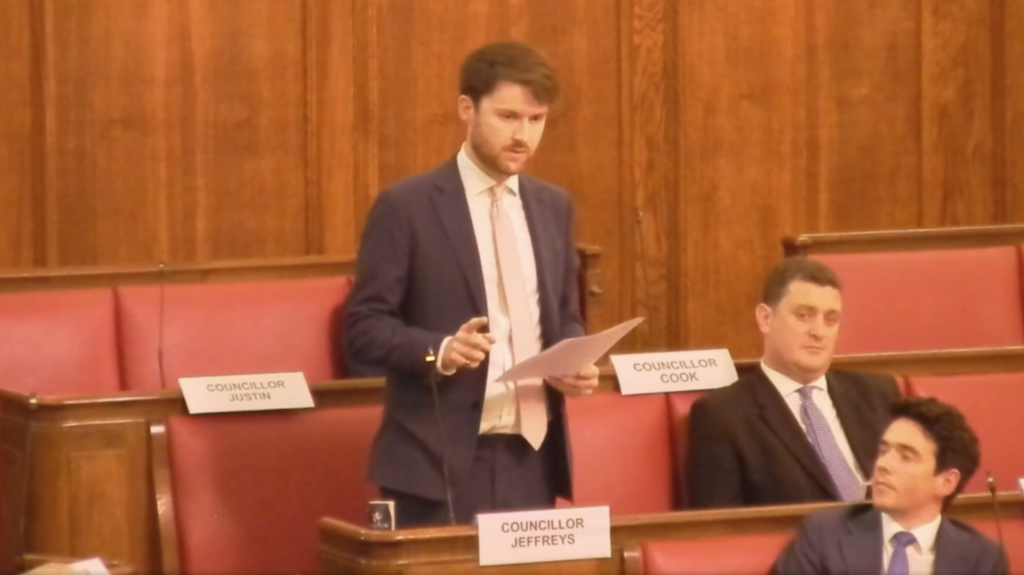
Four Conservative councillors gave farewell speeches, which added an unusual tone to what was otherwise a straight campaign opening. Councillor John Locker, who served 16 years, told both parties the same thing in his last address: “Have a vision, deliver on your promises, and above all, be honest with the electorate.”
Councillor James Jeffreys, departing after quoting Nelson, suggested the administration had undergone a “Damascene conversion” in coming to value low council tax, having spent years opposing it in opposition.
He noted, gently, that “Dolly Parton is not an efficiency saving” — a reference to Hogg citing the council’s free monthly book scheme for under-fives as an example of financial efficiency.
Councillor Rosemary Birchall ended her speech with the observation that the administration “does not expect to be in power after the election in May.” She abstained on the budget.
What the votes showed
The budget passed on a recorded vote: 28 for, 1 against, 20 abstentions. Grimston was the sole vote against. Almost all Conservatives abstained, a position that attracted sustained mockery from the Labour benches throughout the night. Hogg asked Richards Jones directly, at least four times across the two meetings, what the Conservative position on council tax would be. Richards Jones answered, once, with: “We’ll fix your budget.”
Hogg closed his final substantive speech of the evening with: “Let’s vote for hope, not division. Let’s keep Wandsworth special. Vote Labour on May the 7th.”

The election is on 7 May 2026. Eight weeks away.
What you can do
All 60 Wandsworth councillors are up for election on 7 May. You can find and contact your ward councillors at wandsworth.gov.uk/councillors. If you are not yet registered to vote, check your registration at gov.uk/register-to-vote.
The full council meeting is available to watch on the Wandsworth Council webcasting archive.
Putney.news will publish evidence-led investigations into housing delivery, the council tax trajectory, law enforcement, recycling and the reserves picture before the May elections.


was striking to read the reflections from the retiring councillors. My hope is that the next council ends up with a more mixed composition with some Greens, Lib Dems and a healthy dollop of independents alongside the main parties. Moving away from a rigid two-party, adversarial dynamic would probably lead to more constructive debate and better scrutiny.
That said, it also seems fair to acknowledge that Labour have had to learn a great deal on the job since taking control. At times there has been a noticeable lack of technical experience, which has shown up in their performance, and they can appear a bit thin-skinned and easily rattled under pressure. By contrast, the Conservatives tend to be much harder to unsettle in council debates.
More broadly, with both major parties nationally drifting to the right, there’s a sizeable political space opening up. It wouldn’t be surprising to see that gap increasingly filled by a more progressive left particularly at the local level, where voters often want practical solutions rather than entrenched party point-scoring.
Whatever way you take your politics, though, it’s important to acknowledge the hard work that most councillors do. It can be a demanding and often thankless role, and we are fortunate to live in a democracy where people are willing to step forward and serve their communities.
The Councillor who said “be honest with the electorate” had it nailed. The lack of transparency is something I find completely unacceptable.