


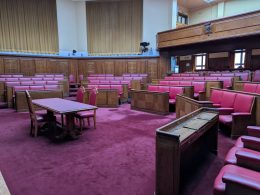
Wandsworth’s Labour administration and Conservative opposition used last night’s Full Council meeting, the last before the May 2026 local elections, to start laying out their arguments to voters.
Labour pointed to four years of delivery: council tax frozen, homes built, services improved. The Conservatives pointed to broken pledges: no police officers from developer levies, an affordable housing promise that was never met.
Putney.news has reviewed these claims against the facts, figures and official documents. Some stand up. Some are contradictory. Some require a deeper review.
We want to know what you think – so here is a first cut of what will play out between now and 7 May, with polls added throughout. Your responses will feed directly into our election coverage.
Council tax: Labour’s strongest claim, with a footnote and an asterisk
Labour’s intends – for the moment at least – to make its four-year “tax freeze” the main plank of its election campaign. Wandsworth does have the lowest council tax in England for the fourth year running; that part is true and it is confirmed by national government data. The current bill on a typical Band D property is £525 for the Wandsworth element, the lowest anywhere in the country.
But the claim of a “tax freeze” this year comes with both an asterisk and a footnote. The footnote is that it is only the part of council tax that Wandsworth Council directly controls that is frozen; about half your tax bill goes to the GLA – and its tax has gone up. So your actual tax bill – the amount of money you have to pay – will actually go up. Again. By about 2%.
The asterisk is where the political battle will be this year. What the current administration does not mention is that council tax will have to go up next year. There is no choice, no matter who wins the elections, because central government is cutting the amount of funding it will supply to Wandsworth next year by tens of millions of pounds. And it will do the same for the two years after that.
The government’s published figures project a 34% rise in 2027/28, the year after the election, and a further 26% the year after that. A typical bill will climb from £525 to £701 in a single year; and for a house in the top bracket of council tax, the annual cost will go from over £2,000 to over £3,000 by the time the next election comes around.
You won’t have a say in this: the Labour government has suspended the normal referendum requirement specifically because it considers Wandsworth’s rate “artificially and unfairly low.” So the council doesn’t need to seek your permission to increase it by a huge sum. Central government has said clearly, in writing, that it expects Wandsworth’s Council tax to go up by a flat fee of £150 next year and then an additional 5% on top of that.
This is a simple reality in the council’s own Cabinet papers. How the political parties decide to relay this information to voters during election season (or if they choose to do so at all) is something they are currently all desperately trying to figure out.
One last point on finances: Labour claims “some of the highest financial reserves in London.” That is largely true, but the trajectory tells a different story. Reserves stood at £567m at the start of this financial year, fell to £435m by December 2025, and are projected to reach £384m by April 2027. The council is drawing them down, not building them up.
There is a sharper contradiction. In its 2022 election manifesto, Labour cited Wandsworth’s reserves as evidence of Conservative failure: “Wandsworth Council has more than £700 million in its reserves.” The argument was that returns on those reserves were too low. Four years later, the same administration cites high reserves as an achievement, having reduced them from the £700m it inherited to a projected £384m. Reserves are falling, and they were higher when Labour arrived than they are now.

Housing: a 50% promise, a 35% outcome, and 1,000 homes
Labour’s 2022 manifesto carried two major housing pledges. The first was a specific affordable housing target: “We’ll set an ambitious target of 50% affordable housing on all new developments.” Four years later, the planning inspector required the council to reduce its proposed threshold from 45% to 35%, the London Plan baseline, and the same position the previous Conservative administration held when Labour took office.
The inspector’s report did not describe this as a success. It found the plan had “a number of deficiencies in respect of soundness,” required 21 mandatory modifications before it could proceed legally, and recommended “non-adoption” of the plan as originally submitted. The council’s proposed 45% threshold was found to be “not justified and would be counterproductive, materially impacting on the delivery of much needed homes.” The council put out a press release claiming its plans had in fact been “boosted” by the rejection and the inspector had “supported” its approach.
The second pledge was the centrepiece of Labour’s housing offer: “Our first act will be to build 1,000 new council homes, guaranteed for local people and their sons and daughters.” At last night’s council meeting, the administration claimed that over 500 have been delivered to date (in reality, it is 366), with the full 1,000 now targeted by 2029. The original manifesto set no completion date; framing the pledge as an immediate priority and a first act. We will be investigating housing delivery in depth before May.
With 13,000 households on Wandsworth’s housing waiting list, both pledges matter. We want to know what you thought the pledge meant:

Law enforcement: a pledge, a reframe, and a disputed comparison
Labour’s 2022 manifesto promised to “put more law enforcement officers on the streets, double domestic violence support, install more CCTV and fund more youth workers”, with all four commitments paid for by levies on property developers. The Conservatives say the law enforcement officers element has never been delivered.
Labour can legitimately point to doubled domestic abuse support and expanded CCTV, both included in that bundled pledge and both claimed as delivered. What Labour cannot point to is law enforcement officers funded by developer levies.
When challenged directly at the October 2025 Full Council, council leader Cllr Simon Hogg argued that community safety officers funded by developer contributions already satisfy the pledge: “If we meant to say police officers, we would say police officers.” The Conservatives are factually correct that community safety officers are council employees with no powers of arrest, detention, or law enforcement. But Hogg’s position is that the pledge was always about community safety officers, not police. It is a contested interpretation, not a flat refusal. Tell us what you think:
The Conservative motion goes further. It claims that Labour-run Westminster Council has directly funded nine dedicated police officers from developer levies to combat antisocial behaviour, doing in a neighbouring borough what Wandsworth Labour promised but has not delivered. The motion also cites shoplifting rising from around 80 to 300 offences per month since 2022, and quotes Hogg as having “mocked” residents who raised crime concerns by suggesting they wanted to compare Wandsworth to “Gotham City.”
Domestic abuse: a badge-level pledge, a delivery claim, and a new agenda
The 2022 manifesto carried six formal pledge badges, the equivalent of headline commitments. One was “Domestic Abuse Support Doubled.” At yesterday’s council meeting, it claimed it has been delivered. We will be digging into whether that is true between now and the election.
Last night also saw a separate Labour motion welcoming the work of Wandsworth’s Violence Against Women and Girls Task and Finish Group, which heard from more than 340 residents. That motion is not a delivery claim; it is a commitment to ongoing prevention work across housing, health, education and the voluntary sector. The two are related but distinct.
What we cannot yet verify
Several claims from Wednesday’s motions will need independent data. Labour asserts a 25% recycling rate improvement and a 20% decrease in fly-tipping. It also claims best-ever air quality, one of the lowest debt levels in London, and an extension of the interest-free repayment period for leaseholders facing major works from 10 months to four years. All may be accurate, but council motions are not primary sources.
Context matters on recycling. Putney.news has been investigating Wandsworth’s waste service since it collapsed in June 2024. The service has now stabilised, but the borough’s recycling rate of 29% remains below the London average of 33%, and the 18-month crisis required sustained FOI requests to document. On waste collection, the Conservative motion describes persistent missed collections and an “error strewn reorganisation.” Our own reporting supports that characterisation.
What comes next
The election campaign starts now. So does our coverage of it.
Over the coming weeks, Putney.news will publish evidence-led investigations into each of these areas: housing delivery, the council tax trajectory and reserves history, the law enforcement pledge, domestic abuse and VAWG, recycling and waste, and the financial picture. We will publish our findings before the May elections.
If you have information on any of these topics, contact us at news@putney.news.
This story reports documented public claims, made in council motions tabled before Full Council, tested against documented public evidence from the council’s own primary papers. No pre-publication comment was sought from either party.

What I am hearing in everyday conversations locally feels very different from a few years ago. There is a noticeable frustration with the national Labour leadership who are a busted flush ideologically.
Locally issues like the ongoing cost-of-living pressure, the two-child benefit cap and the party’s stance on Gaza come up repeatedly in chats I have. Labour tacit support on another war in the Middle East again is something people are very annoyed about.
In areas such as Tooting, where there is a large Muslim community, some residents I know say they feel particularly alienated and that the party no longer reflects their concerns. Comments such as “island of strangers” have also been widely discussed locally and, for some voters, reinforced a sense of distance from the current leadership.
There is a consensus that Labour has underperformed locally. Some first-time councillors in key wards have had very poor performances over the last four years. They simply haven’t built strong relationships with residents. There is also a lot of criticism of Simon Hogg’s leadership style, which many people who have seen this up close describe as overly controlling. Very like Starmer – he simply lacks relatability.
In hindsight, many Labour members and voters feel the party should have moved on from Hogg last year when they had the chance. Kate Stock is well liked and seen as a leader-in-waiting who may have been able to reset things should the axe fall post the election.
With traditional Labour voters drifting to the Greens and the Conservatives retaining a core vote in more affluent wards, my current assessment is that the council could be heading toward No Overall Control, with a possible outcome of around 27 Conservatives, 25 Labour, 3 Greens, 1 Liberal Democrat and 2 Independents.
If that outcome does materialise, it will make the post-election dynamics particularly interesting. With no party holding a majority, the focus would quickly turn to potential horse-trading and informal power-sharing arrangements to form a workable administration.
Even a small group of a councillor coalition from Greens, Liberal Democrats or Independents could suddenly find themselves holding the balance of power and influencing who ultimately leads the council.
In that scenario, negotiations would likely revolve around policy concessions, committee positions and leadership arrangements. Labour might try to remain in control by seeking support from Greens or Independents, while the Conservatives could attempt to assemble a loose coalition around shared priorities with smaller groups. Local politics often becomes much more fluid in a No Overall Control council, and the conversations happening in the days after the election can be just as decisive as the campaign itself.
In many ways, that kind of outcome could also bring a much-needed freshening up of local politics. The two-party dynamic that dominates the council chamber can sometimes become predictable and overly adversarial something that felt particularly apparent in last night’s meeting.
A more balanced chamber, where different groups have to work together and negotiate, might encourage a more constructive style of politics and better reflect the range of views that exist across the borough.
The comment I would add to what is written above is that voters are simply not well informed enough to make good choices. Shortly after the election of the new Green Party MP, individuals were interviewed and asked why they voted as they did. Muslims in particular were horrified when they were told of some of the manifesto promises of the Green Party and said that they would have voted Labour had they known before they voted. Without Putney News I would never have been aware of some of the financial aspects of this particular administration. Luckily one of my local councillors is taking an active interest in the financial aspects and keeping me informed about what he is finding out, but how many other councillors are doing the same ? How many Newsletters provide any fact and figures? How many people in the Borough know anything about the Access For All scheme, how much it costs, and more importantly WHO is paying for it, given that the claim I read was that it was not costing the tax payer a penny?
The comment I would add to what is written above is that voters are simply not well informed enough to make good choices. Shortly after the election of the new Green Party MP, individuals were interviewed and asked why they voted as they did. Muslims in particular were horrified when they were told of some of the manifesto promises of the Green Party and said that they would have voted Labour had they known before they voted. Without Putney News I would never have been aware of some of the financial aspects of this particular administration. Luckily one of my local councillors is taking an active interest in the financial aspects and keeping me informed about what he is finding out, but how many other councillors are doing the same ?