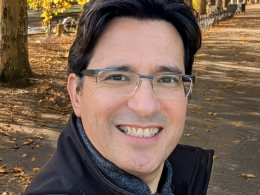
OBITUARY Martin Johnson discovered his most enduring legacy during a routine walkabout of a Wandsworth housing estate. Noticing boarded-up storage sheds and abandoned boiler rooms, he saw what others had overlooked: potential homes in forgotten spaces. That observation launched the Hidden Homes Programme, an initiative that created 250 affordable council homes at a time when his own Conservative party’s flagship borough was aggressively selling off housing stock.
Johnson, who died in December aged 78, spent 50 years on Wandsworth Council navigating a paradox. He was a lifelong Conservative serving through the height of Thatcherism, yet his signature achievement was building council housing when the prevailing ideology demanded its dismantlement. His ability to deliver progressive policy outcomes while maintaining party loyalty marked him as what long-serving Councillor Tony Belton called “the wettest of wet Tories.”
His remarks were just one of several tributes given to Johnson at the opening of a meeting of the full council last night.
The Hidden Homes Programme launched in November 2002 when Johnson held the housing portfolio. The concept was straightforward: convert disused estate spaces – old laundry rooms, defunct boiler houses, storage sheds, underground garages – into modern affordable homes. Because the council already owned these sites, no land purchase was required, reducing costs to between £60,000 and £200,000 per unit.
Council officers initially opposed the idea. “All the officers opposed. He didn’t have any support for it at all, as being a kind of wacky idea,” Belton reflected, noting that when Johnson took over the housing portfolio, morale “was rock bottom” after years of aggressive council house sales. “Within weeks of him taking over, the morale had completely changed,” Belton reported.

The programme delivered 250 homes across multiple estates. The Rollo Estate in Battersea saw 38 family homes built as lateral extensions to existing blocks, costing £7.5 million with support from the Homes and Communities Agency. St James’ Grove Estate gained 15 homes from a £9 million investment that transformed what officials described as “a stark concrete structure with dark walkways.” Ten homes for first-time buyers emerged from a former underground car park at Cambalt Road in Putney. The 250th milestone came at Abbott House on Nightingale Lane, where six homes including five rooftop units with balconies overlooking Wandsworth Common marked the programme’s completion.
In November 2012, Communities Secretary Eric Pickles visited to unveil the Rollo development, calling it “a lesson to other councils” for delivering affordable housing despite tough economic circumstances. The Mayor of London’s Housing Strategy endorsed the programme, and Southwark, Harrow, and other boroughs launched their own versions. Wandsworth estimated similar approaches across London could create 10,000 homes.
The programme achieved something rare for Wandsworth: cross-party support in a council defined by partisan warfare. The Hidden Homes concept continues today as “Homes for Wandsworth,” targeting 1,000 council homes by 2029. By October 2025, weeks before Johnson’s death, 500 homes had been completed under the successor programme.
The moderate in the “cradle of privatisation”
To understand Johnson’s achievement requires grasping how exceptional Wandsworth Council was in British local government. Academic historians have called it “the cradle of privatisation” – the laboratory where Thatcherite local government policy was tested before national implementation. Under leaders Christopher “Chopper” Chope, Paul Beresford, and Edward Lister, Wandsworth pioneered competitive tendering, slashed 1,000 council posts, and sold off housing stock so aggressively that the Bishop of Southwark reportedly declared it “a borough to avoid at all costs if one is homeless.”
Johnson served throughout this entire transformation, holding senior positions including Deputy Leader, Cabinet Member for Housing, Technical Services Committee Chairman, and Licensing Committee Chairman, plus two terms as Mayor in 1980-81 and 1993-94. That he survived and thrived for half a century while maintaining moderate instincts suggests considerable political skill in navigating factional waters without fully joining the dominant current.
“He was wet because he was so caring in a council which was actually… fairly brutal in quite a lot of its attitudes,” Belton explained. The characterisation as “wettest of wet Tories” placed Johnson in the One Nation tradition – favouring social responsibility, preserving council housing, and maintaining services rather than privatising them. Yet as Belton emphasised, “he was absolutely a Tory. There was no way that he was going to be sympathetic to Labour positions at all.”

Fighting the motorways
Johnson’s involvement in opposing London motorway plans dates to the early 1970s, when the Greater London Council’s Ringway proposals threatened to carve urban motorways through South London. In February 1972, a coalition of five South London councils – Lambeth, Lewisham, Merton, Southwark, and Wandsworth – formed to fight what one councillor called “monstrous motorway madness.” The joint campaign contributed to the Ringways’ defeat when Labour won the 1973 GLC elections partly on anti-motorway sentiment.
The threat revived in the late 1980s when the Department of Transport commissioned studies proposing new road schemes, including a four-mile tunnel from Chiswick to Wandsworth. These plans would have demolished approximately 2,500 homes across London. Belton recalls Martin Johnson leading “a union of four councils” in opposition, producing an alternative plan that reframed the approach from “people’s plan” – too redolent of Soviet Union planning for Margaret Thatcher’s government – to the more palatable “Wandsworth Alternative.”
Transport Secretary Cecil Parkinson cancelled all schemes on 27 March 1990, one month before local elections, in what The Guardian called “a big political climbdown.”
“Proud, strong-willed, never afraid to stand”
At a 2008 ceremony honouring both Johnson and Labour’s Tony Belton for 40 years of service, Mayor Jane Cooper offered a revealing description: “Both have been proud, strong-willed individuals, never afraid to take a stand for their views.”
That Johnson shared this tribute with Belton, who led the Labour opposition for much of his 54-year council career, illustrates an unusual capacity for cross-party respect. The 2008 ceremony noted Johnson had served as “cabinet member for major services such as technical services and housing” as well as Deputy Leader – positions of genuine influence. Yet the description of him as not “commanding the chamber” despite five decades of experience suggests someone who exercised power through committee work, relationship-building, and policy development rather than rhetorical dominance.
Former council Leader Ravi Govindia, speaking at Wednesday’s tribute, captured this unusual quality:
“That style of being a counselor… You won’t see it again here or elsewhere. I think Martin was just one of those one-offs.”
“I think we’ve always underrated him a bit,” Belton told councillors on Wednesday. The mayor, who served alongside Johnson from 2014 to 2018, remembered him as “most helpful and welcoming to me as a new councillor.”
Councillor Aled Richards-Jones, Johnson’s successor in Northcote Ward, shared words from Johnson’s daughter at his funeral: “Despite the demands and the tolls of those tumultuous 44 years on the council, he never missed a school pickup, he never missed a parents’ evening, and he never missed a school performance.”
Johnson’s formal honours included an MBE in the 2016 New Year Honours “for Services to Local Government” and appointment as Honorary Alderman upon his retirement in 2018. Council Leader Ravi Govindia praised him for making “a profound difference to so many of our residents’ lives.”
His funeral, attended by senior council officers spanning multiple decades, confirmed the institutional respect he commanded. It was an unusual tribute for a councillor who never led the council, never dominated debates, but quietly changed the physical landscape of Wandsworth through pragmatic innovation rather than ideological confrontation.
Sorely missed, and badly needed
After the tributes to Johnson were delivered to the full council meeting last night, the rest of the meeting was intended to be about new housing in Wandsworth, delivered this time by the current Labour administration. It wasn’t to be.
Labour refused to put discussion of next year’s budget – which is traditional at the February meeting – on the agenda in part because the Conservatives planned to use it to highlight the fact that central government is slashing contributions to Wandsworth Council which will require significant increases in council tax in future years. There is an election in May.
The result was three hours of political games, with both sides refusing to back down, and instead trading insults and political jibes. Nothing was achieved.
Speaking at Wednesday’s tribute, and before the rest of the evening’s events, Richards-Jones revealed that even after poor health left him stuck at home, the retired councillor would follow events live online and send occasional notes. He offered a fitting close to Councillor Martin Johnson’s life: “I’m very sure that he is still watching us tonight on the broadcast.”
Fortunately, he wasn’t.
Martin Johnson was first elected to Wandsworth Council in 1968 at age 21, representing St John’s ward. After a brief gap when he lost his seat to Belton in 1974, he returned to represent Northcote ward in Battersea for the remainder of his career until retirement in 2018. He is survived by the 250 homes he created, the motorways he helped defeat, and the evidence that moderate conservatism could achieve progressive housing outcomes even in Britain’s most ideologically radical council.