

Wandsworth Council systematically undermined a 14-year accountability programme when resident satisfaction turned negative, burying survey results that cost £33,000 and hiding evidence of trust erosion from the public, a Putney.news investigation has revealed.
For 14 years, the council published biennial resident surveys prominently, trumpeting good results. When the 2023 survey – the first under the new Labour administration – showed overall satisfaction plummeting 11 points (85% to 74%), value for money down 9 points (79% to 70%), and residents feeling informed dropping 11 points (66% to 55%), the council hid the 163-page report on a third-party website and failed to announce its existence.
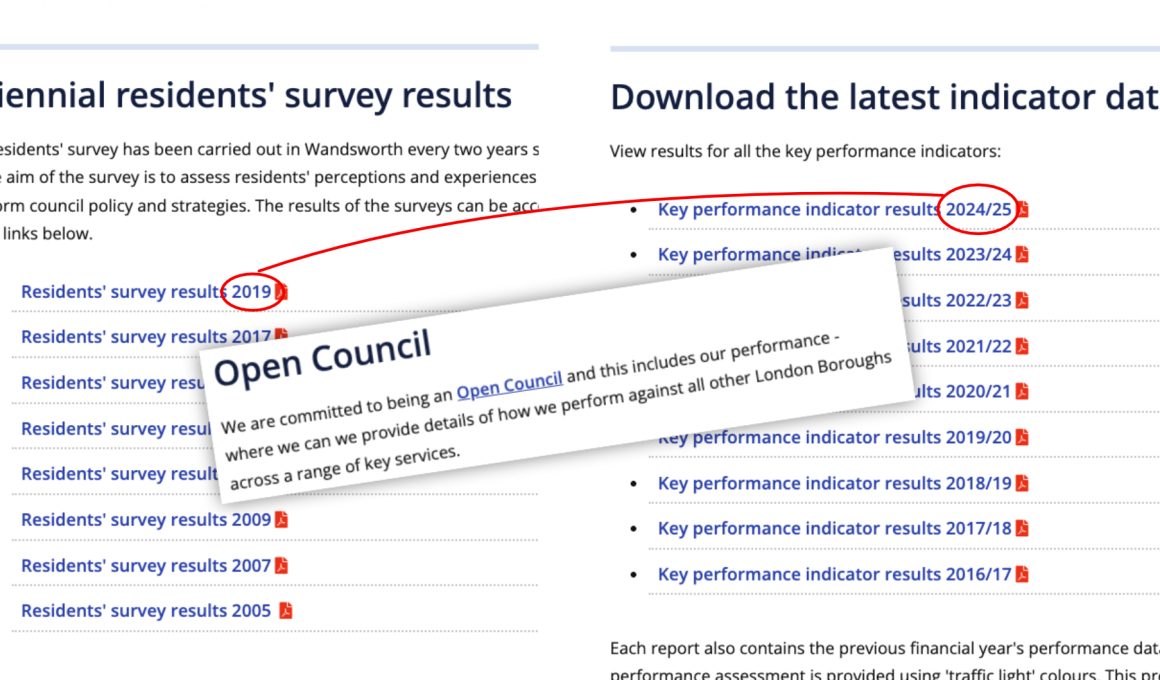
The council’s official Performance Indicators page still lists every survey from 2005 to 2019, but excludes the 2023 results. The page currently claims “the next survey is due to be conducted in 2021.” The webpage is still in use and the council updates it regularly.
The manipulation extends beyond surveys. Complaints against the council’s Chief Executive Group surged 253% (15 to 53) last year, yet the report was “noted” without discussion. When challenged, Council Leader Simon Hogg gave false information to Full Council, claiming complaints had fallen when his own data showed they had risen.
Housing Ombudsman findings against Wandsworth increased nine-fold between 2020-21 and 2023-24 (growing at three times the national average), yet when independent councillor Malcolm Grimston tried to raise this at Full Council, he was blocked by procedural rules that Hogg himself had introduced claiming they would make the council “more open.”
When Putney.news asked whether the council had conducted another resident survey in 2025, it failed to answer, raising questions about whether results are being withheld ahead of May’s local elections. The council has yet to respond to a further request for comment sent two days ago.
A 14-year pattern broken when results turned negative
Between 2005 and 2019, Wandsworth Council conducted residents’ surveys every two years like clockwork, publishing results on its Performance Indicators page. Each survey costs tens of thousands of pounds to run and involves face-to-face interviews with about 1,500 residents by independent researchers BMG Research.
For 12 years (2005-2017), survey results were formally presented to the Finance and Corporate Resources Overview and Scrutiny Committee for democratic oversight, typically in November. The 2019 survey results were downgraded to a presentation in January 2020 with no formal committee paper. The 2023 results were not presented to any committee at all.
The old surveys showed consistently strong performance: 85% satisfaction with how the council runs the local area in 2019, 79% agreeing it provides value for money, 84% trusting the council.
Then the pattern broke. The Performance Indicators page promised “the next survey is due to be conducted in 2021” but that survey never happened – or if it did, the council is hiding those results too.
The buried survey showing decline – but still strong performance
The 2023 residents’ survey [pdf] was conducted in October-November 2023, 18 months after Labour took control of the council in May 2022. Using identical methodology to previous years, the results showed significant declines: overall satisfaction dropped 11 points (85% to 74%), value for money fell 9 points (79% to 70%), feeling informed dropped 11 points (66% to 55%), and Brightside magazine readership fell 16 points (46% to 30%).
| Measure | 2019(Conservative) | 2023(Labour) | Change |
|---|---|---|---|
| Overall satisfaction | 85% | 74% | -11 |
| Value for money | 79% | 70% | -9 |
| Feel informed | 66% | 55% | -11 |
| Trust in council | 84% | 80% | -4 |
| Council acts on concerns | 78% | 73% | -5 |
| Brightside readership | 46% | 30% | -16 |
| Library satisfaction | 65% | 77% | +12 |
| Parks satisfaction | 87% | 87% | 0 |
| Local area satisfaction | 93% | 92% | -1 |
Note: The 2019 survey was conducted under Conservative administration (1978-2022). The 2023 survey was conducted in October-November 2023, 18 months after Labour took control in May 2022. Survey methodology remained identical across both years, enabling direct comparison.
Yet Wandsworth’s 74% satisfaction still significantly outperformed the 60% national average recorded by the Local Government Association’s June 2023 polling. Trust in the council (80%) remained well above the national 56%. The results were not disastrous; they showed a council performing better than most, but declining from high baselines.
Not everything declined. Library services jumped 12 points (65% to 77%), the biggest improvement measured. Parks remained stable at 87%. Local area satisfaction stayed at 92%.
The council published none of this prominently. The 163-page report was uploaded to citizenspace.com, a third-party consultation platform, with no context, no announcement, and no date stamp. The Performance Indicators page was not updated.
A search of over 1,500 council news articles published between 2022 and 2026 found zero announcements about the 2023 survey. Putney.news only discovered it through a Freedom of Information request filed in December 2025. The council responded on 26 January 2026: 30 working days late.
Evasive about 2021 and silent on 2025
The FOI request explicitly asked whether surveys were conducted in 2021, 2023, and 2025. The council answered only the middle question, stating “surveys were carried out in 2019 and 2023.”
This evasion matters. The pandemic did not stop other councils from surveying residents. Neighbouring Merton conducted surveys in both 2020 and 2021 despite COVID restrictions, switching to telephone interviews. Cornwall published multiple pandemic-era surveys. The LGA’s national polling continued throughout 2021.
Either Wandsworth failed to survey residents as its website promised, breaking a 14-year pattern, or it conducted surveys but is actively concealing the results. Both scenarios represent accountability failures, but the latter would be worse: spending public money on surveys then hiding findings from residents.
The silence on 2025 is also concerning. Surveys typically run October-November. It is now late January 2026. Any 2025 survey would be complete. Local elections are scheduled for 8 May. If a 2025 survey was conducted showing further declines, withholding results until after voting would be a profound democratic failure.
When asked whether the Corporate Leadership Team or Cabinet had discussed the survey programme since January 2021, the council replied “information not held.” This seems implausible for a £33,000 programme with a 14-year track record.
Putney.news has submitted a clarification request demanding direct answers. The council has until 26 February to respond.
A pattern of concealing negative data
The buried survey is part of a systematic pattern. The council’s Annual Corporate Complaints Report shows complaints against the Chief Executive’s Group increased 253% (15 to 53), yet was “noted” without discussion at the Finance Committee on 3 December 2025. The report contained a significant error, claiming a “61% increase” while the data table showed 253%.
When Hogg told Full Council that complaints had fallen, councillors challenged him with the council’s own data showing they had risen. Even his narrower claim about “Stage 2” complaints was false.
The Place Division – planning and building control services – saw 29 complaints with a 53% escalation rate to Stage 2, compared to roughly 20% across other services. Electoral Services generated 17 complaints in an election year marked by the July 2024 count error in Putney.
Independent councillor Malcolm Grimston revealed Housing Ombudsman findings against Wandsworth increased nine-fold between 2020-21 and 2023-24, growing at three times the sectoral average. Officers claimed this was “reflected across the sector,” but the data showed Wandsworth’s deterioration far exceeded national trends. When Grimston tried to raise this at Full Council, he was blocked.
On a recent ward visit to a council estate with 167 properties, Grimston collected 22 pieces of casework requiring follow-up. “This is way above what I would have expected two or three years ago and clearly unacceptable,” he said.
Most recently, the council admitted it had failed to implement key fire safety reforms following Grenfell Tower, reforms legally required for years. The admission came only after sustained questioning—the council had not proactively disclosed the failure.
Reactive disclosure replaces accountability
The pattern is consistent: share performance data when positive; conceal or misrepresent when negative. Satisfaction declines, so the survey is buried. Complaints surge 253%, so the report is “noted” and the Leader gives false information. Ombudsman findings increase nine-fold at three times the national rate, so the councillor raising it is told it is “sector-wide” then blocked from questioning. Grenfell reforms are ignored for years, so the failure is admitted only when directly challenged.
The common thread is reactive disclosure. The council releases bad news only when forced to through FOI requests, sustained questioning or media investigation.
This undermines the transparency the council claims to value. The Performance Indicators page exists to enable scrutiny. By maintaining a page listing surveys from 2005 to 2019 while excluding the 2023 survey showing declining performance, the council defeats its purpose.
The 2023 results are not disastrous: Wandsworth still outperforms most councils. But the declines matter. Residents feeling less informed (down 11 points) while readership of thre council magazine Brightside falls (down 16 points) suggests communication breakdown. Satisfaction falling (down 11 points) while complaints surge (up 253%) suggests service quality problems in specific areas.
A council serious about accountability would discuss these issues openly. The decision to bury the survey suggests a preference for managing information rather than learning from it.
Accountability Statement
We contacted: Wandsworth Council through its Freedom of Information team, and Press Office.
Request sent: 27 & 28 January 2026
Wandsworth Council
Press Office
Status: No response received.
Questions asked (click to expand)
Were the 2023 survey results added to the Performance Indicators page alongside previous surveys from 2005-2019? If not, why not?
Were the 2023 results announced via the council’s usual communications channels (press releases, Brightside, social media)? If not, why not?
For 12 years (2005-2017), survey results were presented to the Finance and Corporate Resources Overview and Scrutiny Committee. Were the 2023 results presented to any committee for democratic oversight? If not, why not?
Was a residents’ survey conducted in 2021? If not, why was the biennial pattern broken?
Was a residents’ survey conducted in 2025? If so, when will results be published?
Wandsworth Council
Freedom of Information team
Status: No response yet.
Questions asked (click to expand)
A Freedom of Information clarification request was submitted on 27 January 2026 asking the council to confirm whether surveys were conducted in 2021 and 2025. The council has until 26 February 2026 to respond.
About the surveys
The residents’ surveys were conducted by BMG Research using face-to-face interviews with approximately 1,500 residents. Samples were stratified by ward and weighted by age, gender and ethnicity to ensure they accurately reflected Wandsworth’s population. The methodology remained consistent across all surveys from 2005 to 2023, enabling direct comparison. Questions focused on satisfaction with the local area, council performance, service quality and community cohesion.
Correction: In an earlier version of this story, the second time we mentioned Cllr Malcolm Grimston, we incorrectly identified him as a Conservative councillor. He has in fact been independent for the past two terms – 2018 and 2022 – and is standing again as an independent this year, 2026.



Any survey conducted now would show a significant level of disappointment with Labour’s performance after four years in control of the council. This is felt particularly strongly among community and voluntary sector leaders, many of whom are frankly exasperated by the council’s failure to deliver any meaningful change or improvement in support for the voluntary and community sector.
The leadership has shown itself to be extraordinarily thin-skinned, and after four years it is clear that there is a serious deficit in skills and experience, with only a few notable exceptions. In my view, Simon Hogg is deeply unpopular, including among a substantial section of his own party.
This dissatisfaction will inevitably play out in the local elections. Those residents who will bother to vote are likely to use their ballots to vent anger not only at Labour nationally, but also at what many see as poor and underwhelming performance locally. The combined talents of 3 strong local MP’s may get them out of jail but it looks like we are towards a minority administration post May 26 …
interesting that the survey doesn’t measure satisfaction with refuse collection or roads: the 2 WBC issues that most concern the most residents
Isn’t Malcolm Grimston an Independent rather than a Conservative Councillor? Otherwise an excellent piece of journalism
Yes, he is. We’ve changed it and added a correction at the bottom. Bit insulting really seeing as Cllr Grimston has twice stood as an independent and won – and the reason why is clearly illustrated in his willingness to doing solid local councillor work, including keeping the council itself accountable.