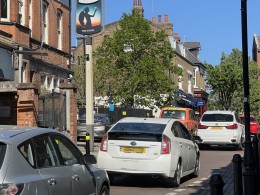
Roehampton Lane is facing traffic disruption from a burst water main for the second time in two weeks, as Thames Water’s aging infrastructure continues to fail across Putney.
The latest burst, further down the hill from the previous incident, was first noticed in the early hours of Monday morning. By the afternoon, one lane had been closed with temporary traffic lights in place. On Tuesday, the lights remained, causing significant congestion in both directions.
Thames Water crews have dug a large hole in the road and turned off the water supply to the affected section. There have been no workmen on site over Tuesday so, based on the company’s recent activity in the area, and assuming the pipe has been fixed, the hole should be filled tomorrow with the road likely reopened late Wednesday or Thursday. The permit gives Thames Water until Friday 23 January to complete the work.
This is at least the fifth burst water main in the Putney area in the past three weeks.

A pattern of failures
The first Roehampton Lane burst, near Clarence Lane, was identified on 5 January and caused three days of gridlock when the complete road closure forced six bus routes onto Dover House Road, where gas works had already created a bottleneck. Around 350 properties lost water supply before repairs were completed on 8 January.
Crews then discovered a connected leak on Carslake Road, which cut supply to residents at Woodcoot House. On New Year’s Eve, another burst main on West Hill forced road closures during the evening.
Meanwhile, a leak on Olivette Street in Putney bubbled water onto the pavement for more than ten days before Thames Water finally began repairs on Friday 16 January. The work was patched over the weekend.
The pattern suggests Thames Water is prioritising major roads and routes with heavy traffic, while smaller residential streets wait.

‘Oldest and most complex’ network
Thames Water has acknowledged the underlying problem. In a statement to Putney.news, the company’s media team said: “Thames Water has the oldest and most complex assets in the country: the average age of our assets is 79 years, compared to the industry average of 56 years.”
The company added: “We are also the only company in the industry where almost 40% of our assets are over 100 years old, and 3,700km of our London network will be over 150 years old by 2030. Pipe failures are strongly correlated with age and ground material type.”
Thames Water says it has “embarked upon the biggest upgrade of its network in 150 years” and is investing more than £20 billion between 2025 and 2030.
But the question for Putney residents is whether this level of disruption will now become routine every time temperatures drop. The recent cold snap, with freezing conditions over the Christmas and New Year period, appears to have exposed the fragility of the local network. Thames Water reported in December that it was experiencing “twice the usual bursts” due to the weather.
If pipes across SW15 are among those approaching 100 or 150 years old, residents may face repeated burst mains, road closures and water supply interruptions whenever winter weather puts the system under stress.