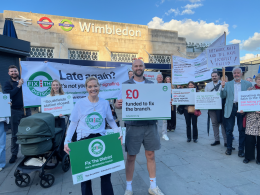
They met at Southfields tube station before 8am yesterday, dressed for the weather and holding small signs of protest. Save Our Park. Green not Greed.
The mood among Save Wimbledon Park supporters was hopeful but nervous as they prepared to set off for the Royal Courts of Justice for a second time to hear the Wimbledon court case they have been fighting for years finally begin.
Then key organiser Simon Wright arrived with an armful of protest signs on sticks, retained from previous battles with the All England Club. Some pictures and then down the Tube steps to make their way across London together, the cold January morning doing nothing to dampen their focus on the task ahead.

An hour later, outside the Royal Courts, the transformation was complete. Out came the costumes that had been transported in backpacks: two supporters climbed into giant wearable tennis balls – “Balls to AELTC” – while Wright emerged as a strawberry complete with “Berry Angry” placard.
It was a calculated move by residents who have don’t have the resources to compete with the tennis club in the PR game. Instead, they’ve become skilled at grabbing the moment, guaranteeing coverage while simultaneously getting their message across.
They have also learned to deflect the inevitable accusations of NIMBYism, insisting they are defending a public park against a powerful private club, not simply protecting their back gardens.
Inside, barristers presented starkly opposing interpretations of whether the former golf course is protected by a 150-year-old statutory trust.
Jonathan Karas KC, representing the All England Club, told the High Court that treating the golf course as protected public land would be “anomalous” and represent “a substantive change in the status of the land”.
“The golf course land has at all times been treated in practice as private land let to a private club,” Karas said in written submissions. “It was sold to [the All England Club] on that basis. It has never been laid out as a public park, nor have the public been permitted to access it for the purposes of public recreation.”
The AELTC’s argument centres on the claim that while Wimbledon Park itself became subject to the statutory trust in 1920s, the golf course remained privately leased throughout and was never included.
Crucially, Karas said documents from the 1993 purchase “repeatedly asserted that the London Borough of Merton was free to dispose of [the land] as it wished” and that the golf course “was not burdened with a statutory trust”.
Caroline Shea KC, representing Save Wimbledon Park, rejected this interpretation. The golf course land “remains an open space” and the club’s case is “flawed”, she told the court.
“The evidence does not support the sort of differential treatment between the two elements of the park that would be required to raise an inference that the golf course land was not appropriated [as public land] and the park was,” Shea argued.
“At its highest, all it does is show that different recreational activities were undertaken by different groups over different areas of the park.”
The hearing before Mr Justice Thompsell continues until Thursday 23 January, with a written judgment expected within two to three months.
The tennis club has previously conceded that if the statutory trust is found to exist and bind them, the proposed development cannot proceed.
The case continues.