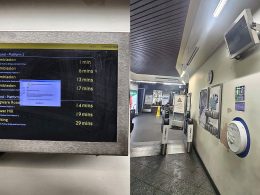
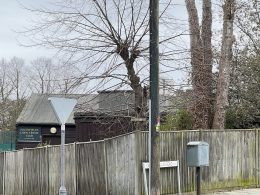
East Putney’s grimy railway bridge is finally getting a facelift, more than eight years after councillors first backed plans to smarten up the “damp, dirty and unattractive” structure.
Network Rail has agreed a design for the bridge over Upper Richmond Road, one of the area’s busiest pedestrian and traffic routes. Work is expected to start this month, though night-time road closures still need to be agreed with Transport for London (TfL).
The news comes from local councillors who raised the bridge condition during a walkabout with the Council’s chief executive back in November.
A long time coming
The announcement ends a wait that stretches back to October 2016, when Wandsworth Council’s cabinet first backed plans for environmental improvements along Upper Richmond Road.
At the time, cabinet member Kim Caddy acknowledged the area around the two bridges was “tired and unattractive” and promised a masterplan. She specifically suggested the council could install artwork “similar to the solution recently employed near Balham station where a really striking and attractive piece of artwork was fixed to the wall.”
That Balham artwork, “Impressions of Balham,” comprises four cold cast bronze relief sculptures depicting local scenes, commissioned by the council and installed in 1991. It remains a local landmark over 30 years later.

“There is money available to fund some improvements here,” Cllr Caddy said in 2016.
Three years later, in June 2019, the council announced plans had “moved a step closer.” Officials again acknowledged the bridges were “damp, dirty and unattractive” and again floated the idea of Balham-style artwork. Since then, nothing visible happened until now.
The council’s original announcements from 2016 and 2019 have been removed from its website. The only surviving records are on community sites putneysw15.com and wandsworthsw18.com.
What East Putney is getting versus elsewhere
The contrast with other recent bridge projects in the borough is striking.
Last month, the council unveiled a £5m transformation of the Falcon Road underpass at Clapham Junction, in the ward represented by leader of the council Simon Hogg, another Network Rail bridge that had been dark, damp and unwelcoming for years. That project included new artwork panels designed through community workshops with the London Festival of Architecture, enhanced lighting, CCTV, pigeon-proofing, and fresh paint throughout the 100-metre underpass. Local schoolchildren and marching bands celebrated the launch.
East Putney, eight years after the council promised Balham-style bronze artwork, is getting a new coat of paint. What the design looks like, whether it includes any artwork, and whether the council is contributing any funding remains unclear.

Why a bridge painting needs two organisations to agree
The long delay illustrates a peculiarity of East Putney’s infrastructure that causes far bigger problems than peeling paint.
Network Rail owns the bridge structure and controls the signalling at the junction. But the road beneath, Upper Richmond Road, is part of TfL’s Strategic Road Network. So Network Rail cannot simply close lanes to erect scaffolding without TfL’s approval for traffic management.
This split ownership is the same arrangement that makes East Putney’s District Line service so unreliable. Network Rail controls Signal W361, a piece of Victorian-era infrastructure that has become the single biggest transport headache in southwest London. When it fails, every District Line train requires individual authorisation from a Network Rail signaller to pass. TfL operates the trains but cannot fix the signal.
The absurdity becomes clear when you look at the numbers.
The District Line serves 6.2 million passengers annually at East Putney, with over 200 trains passing through daily. Network Rail’s own line through the station carries precisely three trains per day, running in the early hours without stopping to pick up passengers. These “ghost services” exist solely to maintain crew route knowledge for theoretical diversions that almost never happen.
So Network Rail controls signalling that affects millions of commuters, while their own infrastructure sees three empty trains per day. And it took eight years to agree to paint a bridge.
What happens next
Network Rail and TfL now need to finalise night-time road closure arrangements before work can begin. Given the A205 is a major through-route, closures will likely be scheduled for late evening or overnight to minimise disruption.
Putney.news has contacted Network Rail and TfL for confirmation of the timeline and details of the planned works.