


Putney ground to a complete halt on Saturday afternoon, with traffic gridlock lasting nearly five hours and affecting every major route through SW15.
The chaos began around 1pm, with some routes finally clearing by 5.45pm though Putney Bridge Road and Lower Richmond Road remained severely congested. Queues stretched from Lower Richmond Road through residential side streets and all the way back towards Wandsworth Park. Residents trying to cross the river to reach the rest of London combined with locals running errands created what would normally be a manageable Saturday traffic increase – but the junction turned it into wholesale gridlock.
Residents initially hunted for explanations. Some pointed to roadworks at the New Kings Road junction in Fulham. Others referenced reports of central London demonstrations causing spillover congestion. A few mentioned Low Traffic Neighbourhoods, though Wandsworth has implemented few such schemes.
The reality was simpler and more damning: an uptick in traffic from people doing Xmas shopping was enough to bring Putney’s road network to a complete standstill, exposing once again the fundamental fragility of the £1 million Putney Bridge junction redesign.

The scale of the gridlock
Google Maps showed the entire area coloured red and orange by mid-afternoon, with congestion stretching from Putney Bridge back through residential streets that residents described as “total gridlock” and “impossible to get out of.”
Alison reported complete gridlock on Lower Richmond Road around 1.30pm. “I just abandoned the 485 bus from Barnes and after five minutes walked past the one that had left 30 minutes earlier,” she wrote in a local WhatsApp group.
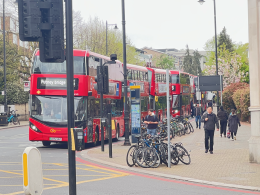
Emily shared a photo of Upper Richmond Road at 12.58pm showing traffic at a standstill, with buses unable to move. “URR also gridlocked. Not sure how far it backed up but no one is moving anywhere,” she reported.
Robert Linton, a Charlwood Road resident, described Saturday’s congestion as “the worst I have seen,” adding: “The reconfiguration of the Putney Bridge approach roads has been a costly disaster, increasing pollution and wasting a phenomenal amount of time,” he wrote.
Philip Evans found the traffic so impossible he abandoned his car by the Common and walked home.
The gridlock wasn’t confined to main roads. Felsham Road, Hotham Road, Charlwood Road and other residential streets became car parks as drivers sought alternative routes. One resident reported Putney Bridge Road had backed up “all the way to Wandsworth Park.”
By 5.45pm, nearly five hours after the gridlock began, some routes were finally clearing. Upper Richmond Road and Chelverton Road traffic had mostly dissipated. But Lower Richmond Road remained heavily backed up, Putney Bridge Road was described as “terrible,” and queues persisted on Putney High Street and Werter Road.

Hunting for explanations
Residents searched for explanations: roadworks at the New Kings Road junction, faulty traffic lights at Chelverton Road, central London demonstrations causing spillover congestion. But the underlying issue remained constant: Putney Bridge junction cannot handle even modest increases in traffic volume without triggering cascading gridlock across the entire area.
The junction that can’t cope
The £835,000 junction redesign, completed in December 2024, has required an additional £169,000 in emergency fixes after traffic signals were implemented with different timings than originally approved.
Lower Richmond Road lost 10-12 seconds of green time compared to the approved model, while Putney Bridge Road lost 12-21 seconds. These reductions in traffic capacity mean the junction operates near saturation under normal conditions, with no margin for even slight increases in volume.
The council has acknowledged the implementation failures and promised improvements by February 2026. But Saturday’s gridlock demonstrates how vulnerable Putney’s road network has become: Christmas shopping traffic that should be manageable instead triggers hours of complete standstill.

A comprehensive survey of 763 residents in November found 90.5% report worse journeys since the junction changes, with 97% of car drivers saying traffic has deteriorated.
The junction redesign was based on traffic data collected in October 2019 (six months after Hammersmith Bridge closed) and July 2021 (just before Freedom Day lifted pandemic restrictions) – both snapshots of abnormal traffic patterns rather than typical conditions. The modelling assumed Hammersmith Bridge would reopen by 2026. Even with lower traffic volumes than anticipated, the junction has created severe congestion that residents say has made daily life increasingly difficult.
Saturday’s gridlock follows a pattern of traffic failures documented throughout 2025, with residents reporting extended queues during rush hours, on weekends, and increasingly at unpredictable times when any minor disruption triggers widespread gridlock.
A resident petition calling for urgent action during the roadworks was formally investigated and dismissed by Wandsworth Council, with officials stating that “existing traffic management measures were deemed sufficient.”
The council’s position remains that reverting to the old junction layout is not an option because it would not meet current safety standards, though many residents argue the current design has created different but equally serious problems.
As Christmas approaches and more shoppers take to the roads, Saturday’s gridlock may be a preview of what lies ahead before the promised February fixes arrive.

The roadworks on Fulhan side of the bridge were the major cause alongside Chelsea playing at home.
A lot of opinions, not so many facts. Are we seriously meant to believe that the rat-running congestion seen in the photos are of ‘residents running errands’?
As long as 1 in 3 car journeys in London are of <1.2 miles and 2 out of 3 are no more than 3 miles, you will see this type of congestion which is more about people's choices than 10-12 seconds of green time at one set of traffic lights. Choosing to be in a car does not bestow a priority over pedestrians & cyclists.
With respect, these traffic articles are clearly politically motivated and extremely car-centric. This particular one actually illustrates why a clean air neighbourhood, as implemented in South Fulham, would benefit the residential area between Upper and Lower Richmond Roads in Putney! A survey of barely 1% of SW15 residents is not an accurate representation of public opinion btw.
Gerry – let’s be specific:
“Not so many facts” – the article contains timestamped resident accounts from five named individuals, photographic evidence, Google Maps data, time-lapse video, TfL technical data on signal timing changes (10-12 and 12-21 seconds lost), council acknowledgment of implementation failures, and references the 763-person survey. Which facts are missing?
The survey point: 763 verified SW15 residents is a substantial sample – larger than most professional polling uses for local issues. You’re welcome to disagree with their conclusions, but dismissing it as “barely 1%” doesn’t address what those 763 people actually reported experiencing.
On your broader transport policy views: you’re entitled to them, but this article reports what happened on Saturday and why the junction couldn’t cope. If you think the evidence presented is wrong or the analysis flawed, make that case. Calling our reporting “clearly politically motivated” isn’t a substantive argument.
Different perspectives welcome – just keep them focused on the substance.
I understand that the fire gate at Charlwood Rd stopping traffic cutting through from the URRd had been unlocked and that’s adding to volume on Charlwood down to Weiss Rd!
“But the underlying issue remained constant: Putney Bridge junction cannot handle even modest increases in traffic volume without triggering cascading gridlock across the entire area.”
That doesn’t make sense. There is traffic backed up all the way from Fulham, on Fulham High Street and on Putney Bridge. Even if the Putney Bridge junction were perfectly optimised, there was nowhere for the excessive volume of traffic to go, surely??
The traffic was only excessive for the current design – which is the point. A properly functioning junction would allow traffic to continue to flow. Not all traffic at Putney Bridge junction is going northbound over Putney Bridge.
Still making no sense. With the traffic backed up all the way from Fulham High Street and on Putney Bridge, the consequence would have been the same even if the traffic lights had been switched off at the Putney Bridge Junction!!
That said, the main issue appears to be the signal timings, as you’ve reported. Who is responsible for deviating from the agreed timings as modelled by AECOM?
“That said, the main issue appears to be the signal timings, as you’ve reported. Who is responsible for deviating from the agreed timings as modelled by AECOM?”
Well that is the key question. We have been trying to find out and all the authorities appear very keen not to say. There not only needs to be some accountability here but if no one is going to be honest about these failures happen, what’s to prevent it happening again in future? We have some work cultures in place that will continue to cause problems across a whole range of issues – and then fail to address them.