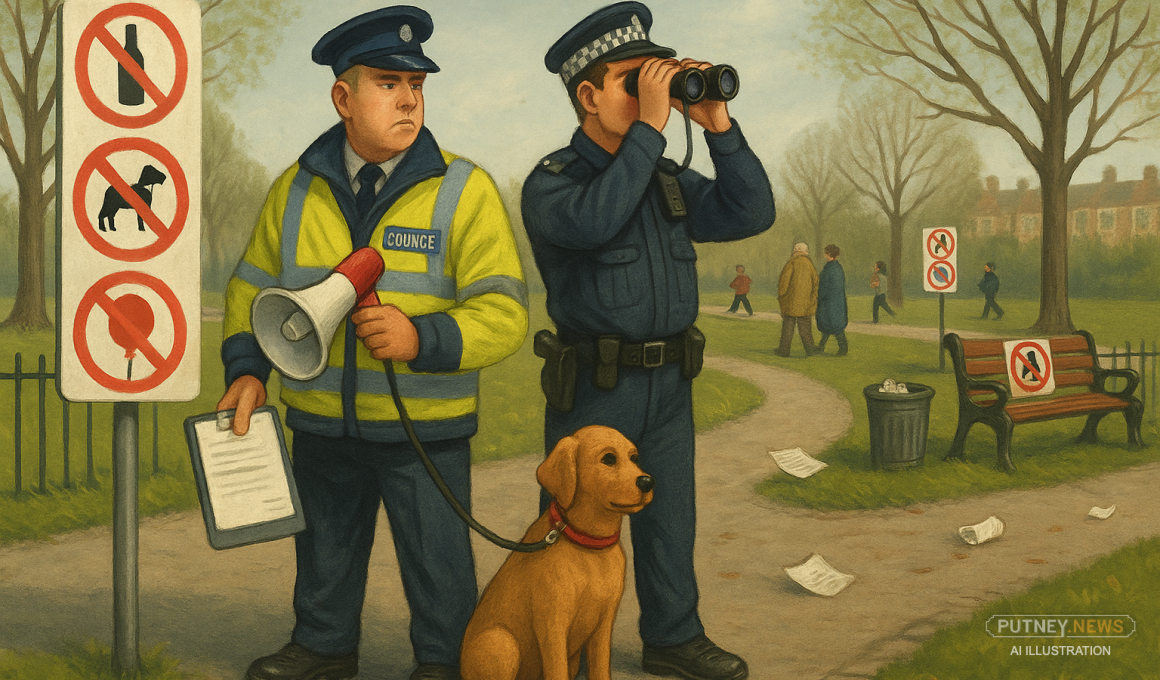
Wandsworth Council is preparing to renew one of the more theatrical pieces of local law-making in recent memory: a Public Space Protection Order (PSPO) that has waged successful war on badly behaved dogs while failing to locate a single street drinker or laughing-gas user worth warning.
The enforcement statistics, buried in the council’s own report, tell a remarkable story. Since October 2023, the borough’s crackdown on alcohol and drug-related antisocial behaviour has produced precisely zero warnings, zero fines, and zero prosecutions. Meanwhile, dog owners have felt the full force of municipal justice: 731 warnings and 61 fixed-penalty notices for crimes ranging from fouling to walking one too many poodles.
Yet rather than quietly retire the unused powers, the council plans to extend both sets for another three years — at a cost of £3,500 for new stickers on existing signs.
The curious case of the missing miscreants
According to the council’s report, the PSPO was introduced to tackle two distinct menaces: antisocial behaviour linked to street drinking and psychoactive substances, and the more tangible problem of dog mess and off-leash chaos.
The enforcement record after two years:
- Alcohol-related ASB: 0 warnings, 0 Fixed Penalty Notices
- Psychoactive substances: 0 warnings, 0 Fixed Penalty Notices
- Dog control breaches: 731 warnings, 61 Fixed Penalty Notices
Either Wandsworth has achieved something miraculous – the complete elimination of public drinking problems through sheer legislative willpower – or the council’s approach to policing a problem has been an abject failure – that it wants to renew.
A masterclass in public engagement
The consultation that preceded this renewal decision was a democratic triumph: 144 responses from approximately 320,000 residents, a 0.045% response rate that would make even the most apathetic parish council blush.
Among this select group of civic enthusiasts, confusion reigned supreme:
- 44% had no idea if the alcohol PSPO had worked (only 19% thought it had)
- 45% couldn’t say if the drug PSPO achieved anything (only 16% thought it had)
- 47% were stumped about dog control effectiveness (only 17% thought it worked)
Yet in a twist worthy of municipal theatre, 85% supported renewing alcohol controls and 84% backed continuing drug controls, essentially voting to extend policies they couldn’t evaluate. It’s rather like asking someone if they enjoyed a film they slept through, then booking tickets for the sequel based on their enthusiastic shrug.
The Putney Vale Estate Resident Association offered perhaps the most honest assessment: “the previous PSPO had little to no impact over anti-social behaviour on our estate, we believe this to be due to a lack of knowledge regarding the PSPO.”
The Wandsworth way
This isn’t the council’s first dance with phantom policymaking. Earlier this year, Wandsworth introduced tough new licensing restrictions for Putney High Street based on the passionate views of 20 whole people. That policy promptly descended into confusion when its first test case — a shop seeking late-night alcohol hours — succeeded despite the new restrictions, leaving everyone wondering what exactly had been restricted.
The pattern is becoming clear: Wandsworth excels at creating impressive-sounding policies backed by microscopic consultations that produce either no enforcement (PSPOs) or confused enforcement (licensing). It’s governance by gesture, regulation as performance art.
Section 3.18 of the council report deploys the classic bureaucratic escape hatch: the PSPO works through its “deterrent effect.”
If the deterrent effect is so powerful, one might ask why it failed to deter 61 dog owners from committing fine-worthy offences. Perhaps dogs and their owners are made of sterner stuff than street drinkers, or perhaps — and this is just speculation — the enforcement officers find it easier to spot and report dog mess.
The renewal shuffle
Rather than admit the emperor’s partial nakedness, the council is performing an administrative shuffle:
- A “community safety” PSPO will maintain the unused alcohol and drug powers
- A dog control PSPO will continue the actual enforcement work, slightly expanded to terrorise dog walkers in a few more pocket parks
The legal mechanics are simple: PSPOs expire after three years and must be renewed or allowed to die. But the decision to renew powers that have never been used, based on a consultation that drew the population equivalent of a poorly attended book club, suggests the council prefers the comfort of unused tools to the discomfort of admitting they have failed or were unnecessary.
The punchline approaches
The council will vote on the extension at full Council on Wednesday 22 October. Based on the consultation, it will likely pass overwhelmingly: 144 people have spoken (sort of), and 85% of them want to keep rules that 44% of them can’t evaluate for problems that produce 0% enforcement.
It’s democracy in action, Wandsworth style: a policy renewed not because it works, but because almost nobody objected, mainly because almost nobody knew to object, or knew what they were objecting about, or could be bothered to object even if they did know.
The real winners? The dogs of Wandsworth, who at least know where they stand. The phantom street drinkers, meanwhile, remain at large, either perfectly deterred, entirely untouched or simply imaginary.