

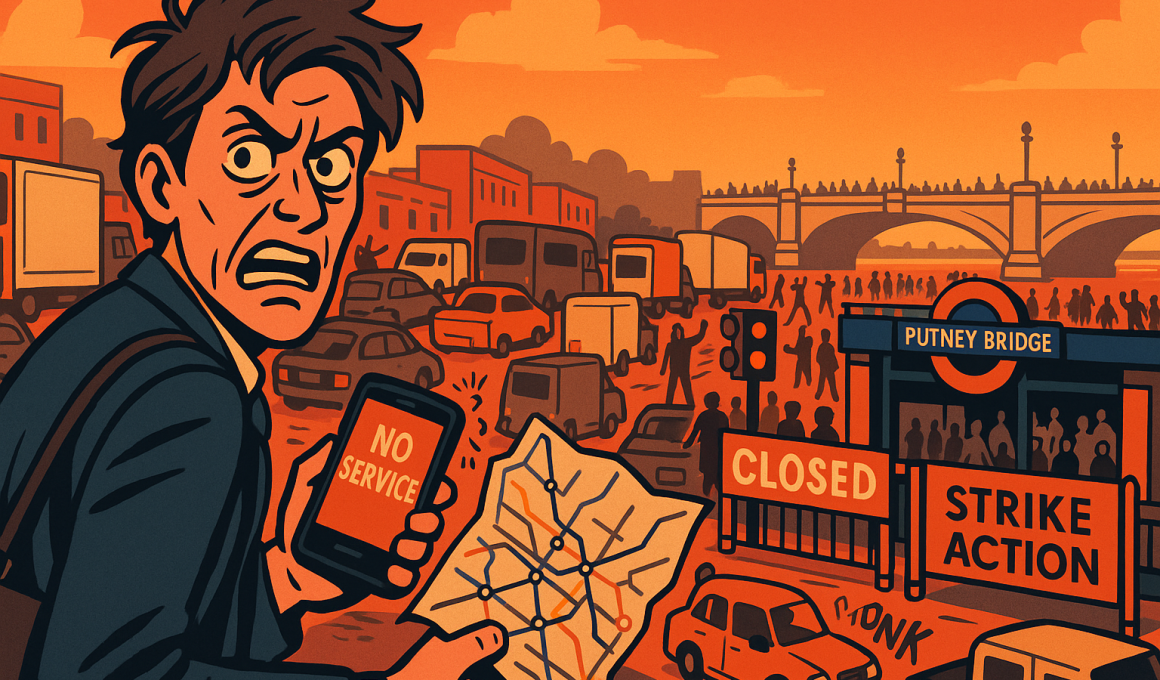
Just when you thought Putney’s transport couldn’t get any more dysfunctional, the universe has conspired to prove us wrong. In what can only be described as a perfect storm of industrial action, virtually every form of public transport in Putney is preparing to grind to a halt next month.
The RMT union dropped a bombshell yesterday, announcing seven consecutive days of rolling strikes across the entire London Underground network starting Friday 5 September. It’s not just the Tube. Bus workers are also walking out, DLR staff are downing tools, and if you’re thinking of escaping via any other route, think again.
The tube strikes will see different staff groups walking out each day from September 5-11, effectively paralysing the District line that serves Putney Bridge, East Putney and Southfields stations. Track controllers, signallers, station staff, and train operators will take turns ensuring that getting anywhere becomes an exercise in creative problem-solving.
“Almost every line would be impacted by the walkouts,” confirmed transport sources, which in plain English means: forget about using the tube to get to work, school, or that important meeting in central London.
But wait – there’s more.
The Bus strike double-whammy
Nearly 2,000 bus workers are staging their own strikes on August 29 and September 1. The timing is cruel, targeting the exact moment when families are trying to get children back to school after the summer holidays.
The strikes will hammer crucial Putney routes including the 85 bus that connects Putney Bridge to Kingston – one of the few reliable links many residents depend on when the tube inevitably fails them.
This is particularly galling for an area already plagued by what can generously be described as London’s most spectacularly unreliable bus services. Three of the capital’s five worst-rated routes – the 14, 265, and 93 – serve Putney. The 14, crawling from Putney Heath to Russell Square at a blistering 5.3mph during rush hour, holds the dubious honour of being London’s second most complained-about route.
The 265, affectionately dubbed the “ghost bus” by passengers who’ve given up expecting it to actually materialise, isn’t far behind in the misery stakes.
And all this comes before baseline level of transport dysfunction Putney residents endure daily is taken into account.
This week, Thames Water decided to dig up Putney High Street at a crucial intersection making an already dire situation worse.
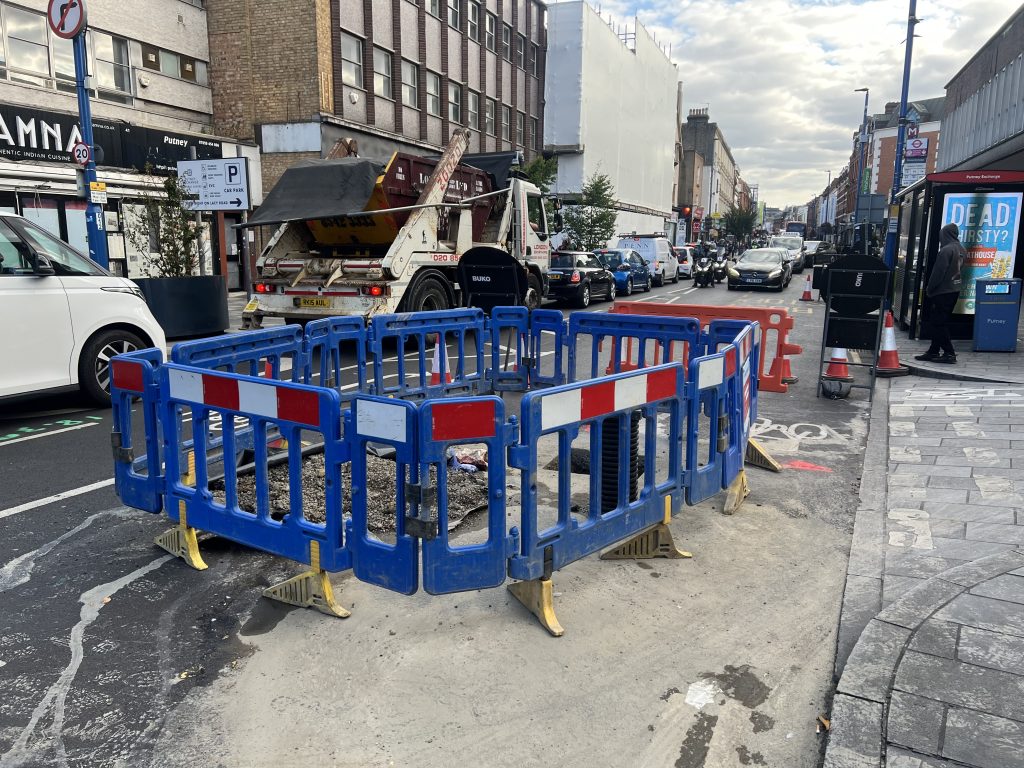
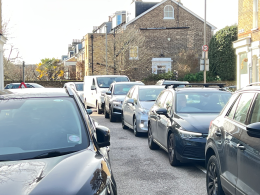
Hammersmith Bridge remains closed after six years, pushing traffic towards Putney; a bodged junction update at the intersection of Putney High Street, Lower Richmond Road and Putney Bridge Road is causing tailbacks in every direction; road works on Wandsworth Bridge Road for the next week will add yet more traffic; and since being the first train service to be nationalised in June, South Western Railway has reported more delays and more cancellations than at any time since the last train strike.
When everyone strikes at once
The September strikes represent an unprecedented convergence of industrial action. The tube workers’ dispute centres on pay, fatigue management, and what the union describes as “extreme shift patterns.” Management’s refusal to engage seriously with these demands has prompted the first tube strike action in 19 months.
Meanwhile, DLR workers will join the chaos with their own separate strike action during the week beginning September 7, ensuring that even alternative routes into central London become impassable. RMT General Secretary Eddie Dempsey had his own take:
“Our members are doing a fantastic job to keep our capital moving and work strenuous shift patterns to make sure Londoners get to their destinations around the clock.”
Transport for London is urging passengers to consider “alternative routes,” but for Putney residents, the alternatives are limited and largely theoretical. Walking to central London isn’t practical, cycling infrastructure remains patchy, and the few remaining bus routes will be overwhelmed by displaced tube passengers.
In practical terms, it means longer travel times – likely double; the need to create contingency plans to get kids to schools on time; packed buses; and another bout of economic damage. In conversations with local businesses this week, Putney.news heard repeatedly that revenue was down due to people avoiding Putney because of the traffic; even Uber drivers are turning down fares that start or end or even pass through Putney because the delays are so long it eats into their profit.
TfL has also suggested using Santander Cycles and rental e-scooters, though quite how useful these will be for a family trying to get from Putney to central London remains unclear.
The message is clear: if you live in Putney and need to travel anywhere, you’re on your own.



It would be interesting to compare wage levels of the strikers with London averages, or perhaps with other sectors such as nursing, care home workers, council officials etc. There is an increasing belief that unionised transport workers are exploiting their position to gain unfair advantage.
The point of the article is the impact on residents and businesses of a total lack of planning by all people involved in transport in London. I do drive in Europe and have not experienced anything like the traffic jams due to new road layouts, inconsiderate roadworks, crumbling infrastructure and a focus on tax revenue generation rather than improving the living conditions of the communities authorities are supposed to care for.
Even much criticised socialist Paris handles transport more efficiently and consistently than fragmented London.