Putney residents have one week left to respond to Thames Water’s controversial plan to pump treated sewage into the River Thames near Teddington: a proposal campaigners say could set a dangerous precedent for how the river is used, regulated, and polluted.
The statutory consultation on the Teddington Direct River Abstraction (TDRA) scheme closes on Tuesday 26 August, and opposition is mounting across south west London, with MPs, scientists, local swimmers, and environmental groups urging residents to send formal objections.
Critics are calling it the “Thames Sewage Pump.” Thames Water insists it’s a vital drought resilience measure. And Putney — sitting just downstream from the proposed outfall — is caught in the middle.
What Thames Water wants to do
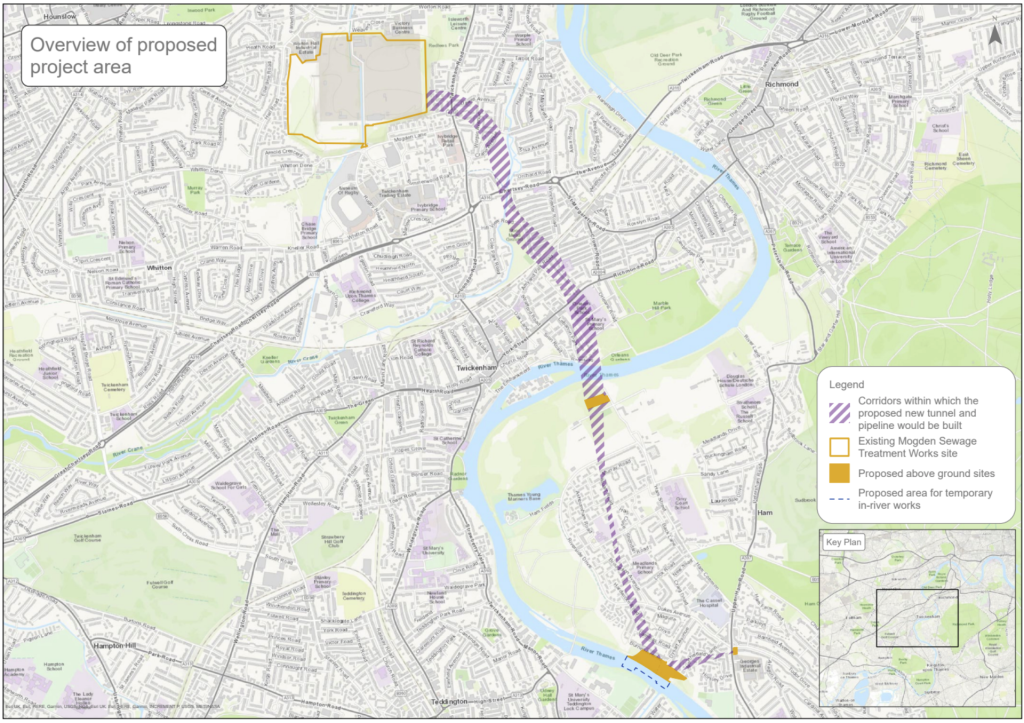
The TDRA scheme would allow Thames Water to extract up to 75 million litres of water per day from the Thames just upstream of Teddington Lock during future droughts. That water would then be replaced with treated sewage effluent from Mogden Sewage Treatment Works. The two points would be linked by a new 4.2-kilometre underground tunnel, running beneath homes, parks and schools in Twickenham, Teddington, Ham and Kingston.
Although the company says it would only operate the system intermittently — typically during late summer or autumn — a continuous “maintenance flow” of treated sewage would still be released into the river year-round, even outside of drought periods.
Thames Water argues the project is essential to avert a long-term water shortage in London, with demand projected to exceed supply by one billion litres per day by 2050. It claims the recycled wastewater will meet all environmental standards and that the scheme will help preserve the health of the river by ensuring abstraction does not lower water levels.
Why opponents say the plan is flawed
Opponents argue the scheme is expensive, risky, and unnecessary — and could introduce chemical pollutants into the river, disrupt sensitive habitats, and damage public trust in both Thames Water and the regulatory system.
Liberal Democrat MPs Munira Wilson (Twickenham) and Sarah Olney (Richmond Park) have both submitted detailed objection letters. Wilson’s letter [pdf] raises concerns about the presence of PFAS “forever chemicals,” pharmaceuticals, and microplastics in the effluent. She also questions the company’s decision to rely on tertiary treatment standards, rather than the higher quaternary treatment now being adopted in the EU. She describes the scheme as “the wrong answer to the right question,” arguing that alternatives such as fixing leaks, investing in greywater reuse, and increasing household metering would deliver better outcomes with lower risk.
Olney, meanwhile, has criticised [pdf] the design of the consultation itself, which she says assumes the project will go ahead. She warns that the scheme could cause significant disruption during its multi-year construction phase, with tunnelling under residential neighbourhoods and HGV movements concentrated near schools and parks. She also questions the credibility of Thames Water as the scheme’s promoter, citing ongoing financial instability, a record of sewage discharges, and lack of transparency around costs.
The campaign group Save Our Lands and River (SOLAR) has taken the lead in mobilising public opposition. It says Thames Water’s own figures show the scheme would result in up to 2.5 times more treated sewage being pumped into the river than clean water taken out, and that this poses a serious threat to river health. At a public meeting last month, campaigner and former Olympic rower Ian McNuff called the project a “billion-pound blunder.” Thames Water declined to attend the meeting, citing an “unconstructive environment” — a decision met with widespread booing.

Why this matters for Putney
Although the proposed discharge point lies near Teddington, Putney is just six miles downstream and sits directly in the path of any river changes resulting from the scheme.
Campaigners warn that because the Thames is tidal, pollutants released at Teddington can move both upstream and downstream depending on flow. Putney, home to a dense rowing community, riverside events, and local swimmers, could be directly affected. Any deterioration in water quality would not only impact public health and river users, but also undermine efforts to clean up the Thames, including those made following high-profile discharges into the river at Putney Bridge and Barnes.
There are also wider concerns about what the scheme represents. Critics fear that if this model of sewage recycling is approved in one location, it could pave the way for similar projects elsewhere on the Thames, shifting the environmental baseline and lowering expectations for river protection.

A note of caution on Thames Water’s online form
Campaigners have also raised concerns about the way Thames Water is conducting the consultation. The company has encouraged residents to use an official online response form. However, critics say the form is designed to frame questions around implementation details — such as route alignments and tunnel shafts — rather than whether the project should go ahead at all.
As a result, residents are being advised not to use the online form. Instead, campaigners recommend sending freeform objections via email or post, making clear your opposition to the project and including your name and postcode. Postcards are being distributed across south west London cafes and community hubs, with suggested wording that states: “TDRA will cause permanent damage to the local environment and the water quality of the River Thames. There are many better alternative schemes Thames Water has failed to consider properly.”
How to respond
Residents can submit their objections until 11:59pm on Tuesday 26 August. Letters can be emailed to TDRA@ipsos.com or sent by post to FREEPOST TDRA CONSULTATION — no stamp is required. Be sure to include your name and postcode.