

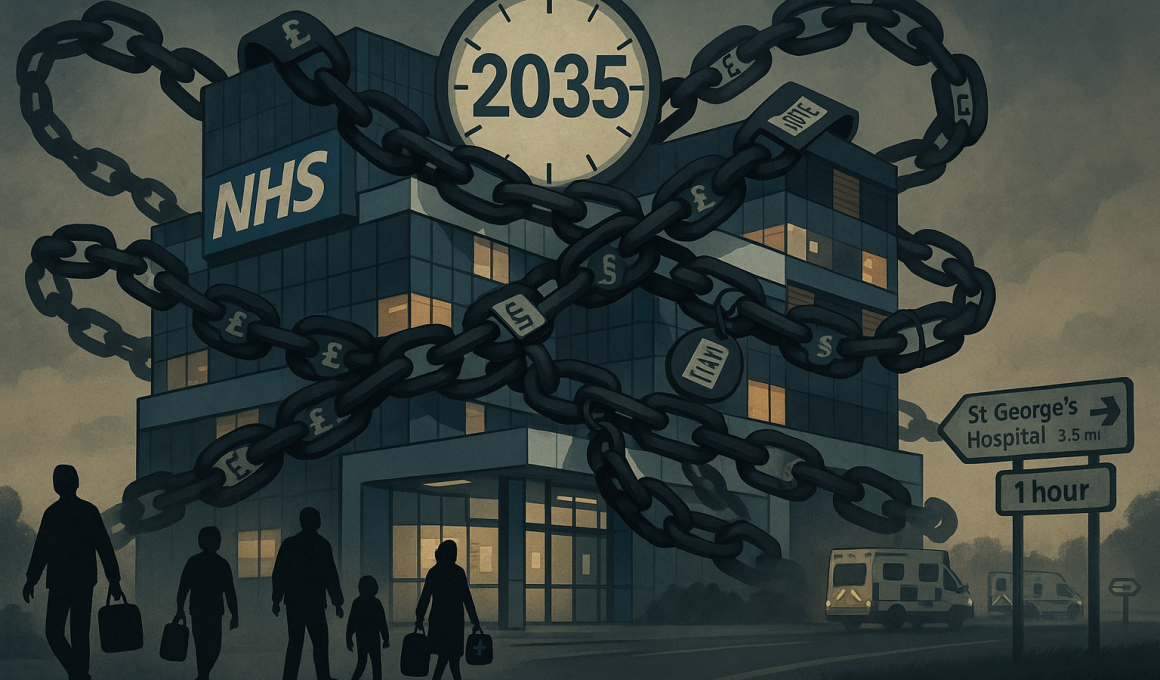
IN BRIEF: A 2004 private finance deal that will cost the NHS £460 million for a £55 million hospital is driving the closure of vital local services. Unless the government acts to break PFI contracts, Queen Mary’s faces being reduced to a shell – despite being a purpose-built, modern hospital that patients love.
LONG READ The decision this month to shut down four temporary operating theatres and close the Minor Injuries Unit (MIU) at Queen Mary’s Hospital in Roehampton has shocked local residents. These closures mean thousands of local people will have to travel much further – to St George’s Hospital in Tooting – for treatment they could previously get close to home.
The surgical theatres had been granted permission to operate until 2029. The Minor Injuries Unit, meanwhile, served as a critical bridge between general practice and emergency care, was able to see up to 80 patients a day, and consistently receives five-star feedback.
So why close them now? According to officials, it’s about long-term strategy and system efficiency. But the real reason is money, and more specifically, the enduring burden of a Private Finance Initiative (PFI) contract that was used to build the hospital and which continues to lock the NHS into millions of pounds of annual repayments for the next decade.
A valuable service cut without a clear alternative
The closures were decided by St George’s University Hospitals NHS Foundation Trust, which manages Queen Mary’s. The hospital trust, which is over £100 million in debt and under pressure to cut costs, hasn’t publicly announced either closure.
The timing is telling. These closures come as the NHS undergoes its most significant restructuring in years. In May, NHS England published the ‘Model ICB Blueprint‘ requiring all Integrated Care Boards to reduce running costs by around 50% by the end of 2025. The same month, the South West London ICB Board was discussing constitutional amendments [pdf] to reduce its membership from 22 to 13 members and move from monthly to quarterly public meetings – clear signs of an organisation under severe financial pressure.
The decision has been met with frustration in Putney and Roehampton. Not only is Queen Mary’s easier to reach than St George’s for many residents, but wait times at Tooting’s A&E can stretch for hours. As a walk-in unit, the minor injuries unit only reached two-hour waits – as opposed to four or six hours common in other hospitals. The temporary surgical theatres also helped reduce backlogs from COVID-19 and improve elective care performance.
The hidden financial crisis behind the closures
The broader context for these closures is a deepening financial crisis across the NHS. More than 40% of NHS trusts in England had an operating deficit in the fiscal year ended March 2023, a dramatic deterioration from the previous year when less than 20% were losing money. Operating losses among trusts in deficit amounted to roughly £1.3 billion.
NHS England’s latest planning round reveals a “very significant financial deficit” of £6.6 billion across the system when deficit support is stripped out. This has forced a “fundamental reset of the financial regime” as NHS leaders struggle to balance books while maintaining services.
St George’s Trust is particularly hard hit. While the trust was placed into financial special measures in 2017 with a £71 million deficit, the financial pressures have intensified. The trust is now over £100 million in debt and looking to cut services.
So why is it really happening?
The answer lies in both local NHS strategy and a decades-old PFI contract that still casts a long shadow.
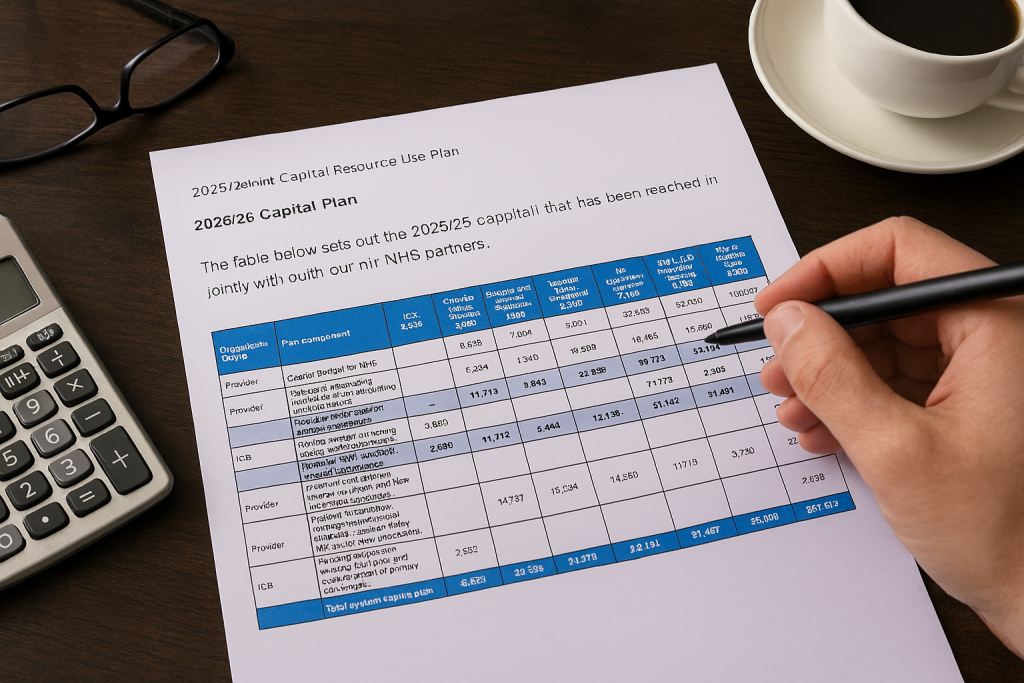
Decisions about Queen Mary’s are ultimately decided by the South West London ICB and its recent 2025/26 Capital Resources plan [pdf] explicitly acknowledges what many suspected:
“The system infrastructure includes estate which is managed by PFI providers, there are risks that changes to the buildings or in the PFI contract arrangements are not affordable for the health system.”
This is more than financial jargon – it’s an admission that PFI contracts are directly constraining the NHS’s ability to adapt and invest. The financial constraints are intensifying. The 2025/26 plan reveals that trusts must now accommodate “technical adjustments for the way that leases are accounted for” within existing budgets, meaning “less funding is available to support backlog maintenance and other critical infrastructure investment.”
The system is being forced to make impossible choices. The South West London ICB’s operational plan for 2025/26 shows a £329.3 million efficiency requirement across all trusts, with an ambitious 7.3% efficiency target. The plan warns that “if we are not able to maintain the financial performance against our plan in-year, and/or the London Region are not assured that there is credible plan for delivery; the deficit funding of £104m could be withheld, resulting in a deterioration of the financial position.”
The 2025/26 capital allocation table reveals the stark reality: Queen Mary’s receives no specific capital investment, while St George’s Hospital is allocated £73.6 million. The ICB’s strategic priorities are clear – investment goes to “day-to-day operations,” “modernisation of the mental health estate,” “IT infrastructure and cyber security,” and “financial recovery of the system.” Services at Queen Mary’s simply don’t feature.
The capital plan reveals a system under extraordinary pressure. The total budget of £257.6 million must cover seven major trusts, but 70% goes to basic “backlog maintenance and other critical investment in estates, IT and medical equipment” just to keep buildings safe and operational. The long-awaited Specialist Emergency Care Hospital in Sutton has been pushed back to 2032-2034, while trusts struggle with “rising inflation that has materially changed estimated costs” and the risk that “the system will no longer be able to afford all of the schemes it previously anticipated.”
The PFI trap: £460 Million for a £55 Million hospital
The long-term plan to downgrade Queen Mary’s makes sense when viewed from a balance sheet. But it doesn’t from a community perspective. And the financial constraints driving this strategy start with the 2004 PFI deal that rebuilt the hospital.
That deal, signed by the former Wandsworth Primary Care Trust, outsourced the design, construction, and maintenance of the hospital to Catalyst Healthcare, a consortium led by Bovis Lend Lease, HBOS, and Sodexo. The initial construction cost was £55 million, with a further £18.6 million in financial charges, bringing the total to £73.6 million.
The contract commits the NHS to 28.75 years of unitary payments, adjusted annually by the Retail Price Index (RPI). The NHS now pays over £12 million a year, rising toward £22 million by 2035, when the contract ends. In total, the NHS is expected to pay over £460 million for the use of a hospital that cost just £55 million to build.
This is over eight times what it cost to redevelop Queen Mary’s Hospital. In other words, for the amount of money to be received by Catalyst Healthcare during the term of the contract, the NHS could have had eight hospital renovations.
This arrangement is binding. The NHS cannot easily close or repurpose the building without continuing to pay the charges. Even unused space still incurs costs.
The national PFI crisis
Queen Mary’s is far from alone in this predicament. Across the NHS, there are 127 PFI schemes costing trusts £2.1 billion this year, rising to over £2.5 billion in 2030. For just £13 billion of investment, the NHS has been landed with an £80 billion bill.
The impact is uneven, with some areas spending up to a fifth of their budget on PFI payments. The worst affected trusts are North West Anglia, Sherwood Forest, University Hospitals Coventry and St Helens and Knowsley.
Sherwood Forest Hospitals NHS Foundation Trust paid 16 per cent of its total income in 2016/17 on its PFI charges, while Barts Health NHS Trust’s annual repayments amount to around 10 per cent of its income.
The timeline is crucial: total repayments will reach a peak in 2029 and as older schemes come to an end, total repayments will start to fall as they approach 2049. But that’s still more than two decades of punishing payments that divert money from patient care.
Queen Mary’s hospital: key financial figures
| Financial Component | Amount | Source/Context |
|---|---|---|
| Original Hospital Build Cost | £55 million | 2004 PFI contract construction cost |
| Total PFI Contract Value | £73.6 million | Build cost + fees and charges |
| Current Annual Payment (2025) | £12+ million | Indexed to RPI, rising annually |
| Projected Final Annual Payment | £22 million | Expected by contract end (2035) |
| Total Cost Over Contract Life | £460 million | NHS payments 2004–2035 |
| Cost Multiplier | 8.4x | Total payments vs original build cost |
| Annual Payment Increase | 26% | Rise from £9.987m to £12.6m (2017–2024) |
| Contract End Date | 2035 | When NHS regains full control |
| Years Remaining | 10 years | Time left on PFI contract |
System-wide financial context
| Component | Amount | Context |
|---|---|---|
| SWL System Deficit | £6.6 billion | When deficit support stripped out |
| St George’s Trust Debt | £100+ million | Trust managing Queen Mary’s |
| Required System Efficiency | £329.3 million | 2025/26 across all SWL trusts |
| Staff Reduction Target | 1,696 WTE | Workforce cuts required |
| Queen Mary’s Capital Allocation | £0 | 2025/26 investment plan |
| St George’s Capital Allocation | £73.6 million | 2025/26 investment plan |
| Deficit Support at Risk | £104 million | Could be withheld if plans fail |
The bottom line
For every £1 spent building Queen Mary’s Hospital, the NHS will pay £8.40 over the contract lifetime.
Source: BMJ analysis, SWL ICB planning documents, Treasury PFI data
2035: Ownership returns — but at what cost?
Under the terms of the contract, ownership of the Queen Mary’s buildings will revert to the NHS in 2035. The land is almost certainly still held by the public sector — likely via NHS Property Services — but operational control remains with the private consortium until the contract ends.
That date is still ten years away. In the meantime, NHS planners are reluctant to invest in or expand services at Queen Mary’s. With an inflexible and expensive lease, any upgrades risk wasting taxpayer money or duplicating facilities elsewhere.
That’s the bind: the NHS is still paying full price, even as it dismantles services. And once services go, they are hard to restore — even after the contract ends. The annual repayment figure has already increased from £9.987 million to £12.6 million over seven years, representing an increase of 26%.
The strategic direction: bigger hospitals, fewer sites
The meeting papers from the South West London ICB Board in May 2025 reveal a health system in crisis. The system faces a “very significant financial deficit” of £6.6 billion when deficit support is stripped out, forcing a “fundamental reset of the financial regime” as NHS leaders struggle to balance books while maintaining services.
The human cost is stark. The 2025/26 financial plan requires a reduction of 1,696 whole time equivalent staff across the system. The plan assumes “significant productivity improvements including a reduction in G&A beds in line with NHSE productivity packs, a reduction in temporary staffing (agency and bank) in line with the national targets and realisation of corporate services savings.”
At the same time, the ICB itself is being drastically restructured. Board membership and meetings are being cut and the organisation is refocusing on “strategic commissioning.” This isn’t just efficiency – it’s managed decline of local NHS oversight.
With Queen Mary’s sitting outside the ICB’s core investment priorities — and under an expensive PFI — its future as a full-service local hospital is all but written off.
What is the NHS trying to do instead?
Queen Mary’s currently has 88 beds; 46 for people who have had limb amputations and require neurorehabilitation and 42 for care, treatment and rehabilitation of older people. It does not have an accident and emergency (A&E) department. The site already hosts a Community Diagnostic Centre, part of the NHS’s plan to separate tests from hospital bottlenecks.
The government’s new 10-year NHS plan focuses on “three shifts” – from hospital to community, from analogue to digital, and from treatment to prevention – aiming to “personalise care, give more power to patients, and ensure that the best of the NHS is available to all.”
This reflects a broader shift in NHS care models:
- Primary care: GP surgeries and health centres
- Urgent care: Urgent Treatment Centres and A&E (centralised)
- Elective care: Surgery increasingly focused at larger hubs
- Diagnostics: Moved to CDCs, often in community sites
- Community services: Nursing, rehab, and care coordination delivered closer to home
These changes are often clinically sound — but they depend on accessibility, availability, and investment, all of which are in short supply in Roehampton.
The broader story of PFI: how we got here
The Private Finance Initiative (PFI) began life in November 1992 under John Major’s Conservative government, with Chancellor Norman Lamont announcing that “the Government will actively encourage joint ventures with the private sector, where these involve a sensible transfer of risk to the private sector.”
The concept was relatively simple and was branded as the Private Finance Initiative – PFI – although the acronym was soon to be parodied as “Profits For Industry”, “Profiting From Illness,” or simply “Pure Financial Idiocy”.
By October 2007 the total capital value of PFI contracts signed throughout the UK was £68bn, committing the British taxpayer to future spending of £215bn over the life of the contracts. What was overlooked was the long-term cost and inflexibility of these deals. As inflation rose and NHS budgets tightened, the annual repayments became unaffordable — and since they were contractually fixed, services had to be cut instead.
As one comment piece in The Guardian back in 2007 argued: “In September 1997, the government declared that these payments would be legally guaranteed: beds, doctors, nurses and managers could be sacrificed, but not the annual donation to the Fat Cats Protection League.”
The closure of Queen Mary’s services isn’t just about numbers on a spreadsheet. It will force residents from a wide area to make longer journeys for treatment. Staff have been told they still have jobs but must transfer to St George’s Hospital in Tooting – the same distance most patients will also have to travel.
St George’s main hospital is known for having much longer wait times – sometimes up to six-hours. Other options include a walk-in centre at Teddington Memorial Hospital and at Parsons Green but they don’t offer the same comprehensive service due to a lack of facilities.
Can the NHS get out of a PFI like this?
Yes — but it’s difficult and expensive. Some options include:
- Refinancing the PFI to reduce costs (usually requires government support)
- Buying out the contract early (requires large capital upfront)
- Transferring ownership to an NHS trust (only possible if there’s legal capacity and long-term savings)
Tees, Esk and Wear Valley NHS Trust paid off its PFI scheme in 2011 and saved itself around £1.4 million a year in repayments. And in 2011, Northumbria Healthcare NHS Foundation Trust paid off its PFI deal by borrowing money from a local authority, thereby saving around £67 million over 20 years in repayments.
The IPPR think tank has called for the government to “end the toxic PFI legacy” by introducing “a right-to-buy scheme that allows trusts to bring bad-value contracts into public ownership. This can be achieved by legislating for the right to enfranchisement.”
However, without intervention, sites like Queen Mary’s remain trapped.
The political question: will services ever return?
There’s a real danger that once urgent care and theatre services are removed from Queen Mary’s, they won’t come back — even after the contract ends in 2035. Infrastructure, staff pathways, and budgets will have moved on.
The current plan requires political oversight and scrutiny. Local MPs, councillors, and campaigners will be key to ensuring that Roehampton and Putney are not left behind. For now, residents are being told that “services are moving” — but in reality, a 20-year-old financial deal is still driving decisions.
Queen Mary’s illustrates a critical tension in modern healthcare policy. While the government’s 10-year plan promises to bring “quality care closer to home” and create “extended neighbourhood health centres”, the reality is that expensive PFI contracts are forcing the opposite: centralisation and service cuts.
The Chancellor’s one-off £2bn Spending Review cash injection does not meet the long-term needs of the health service – in fact it does not even cover next year’s PFI payment. Until the government addresses the PFI legacy, hospitals like Queen Mary’s will continue to be hollowed out by financial arrangements made decades ago.
The risk is clear: if Queen Mary’s is reduced to a shell of its former role, there may be no plan — or budget — to rebuild it later. And patients in Roehampton and Putney will pay the price for a private finance deal they never asked for.
Bottom line
A 2004 financial arrangement designed to build one hospital for £55 million will end up costing the NHS £460 million by 2035. While the NHS is forced to maintain these punishing payments, vital local services are being sacrificed. Unless the government acts to break bad PFI deals, purpose-built hospitals like Queen Mary’s face being reduced to shells — despite serving their communities well.
References
- South West London ICB Board Meeting Pack (28 May 2025)
- South West London ICB Capital Resource Use Plan (2025–26)
- South West London ICB Operational Planning for 2025/26 submission
- South West London ICB Capital Resource Use Plan (2024–25)
- South West London ICB Annual Report and Accounts (2024–25 Draft)
- NHS England Model ICB Blueprint (May 2025)
- BMJ: “The Private Finance Initiative: a case study of wastage in the NHS in Wandsworth” (PMC3310020)
- Putney.news reporting (July–August 2025)
- Treasury PFI Projects data and IPPR analysis
- NHS England planning round updates (2025/26)
- St George’s University Hospitals NHS Foundation Trust public statements
- Full Fact analysis of PFI costs (2020)
- King’s Fund and Nuffield Trust financial analysis




Yet the govt are now wanting to do the same to medical insurance companies as they have done to private schools. Many people have taken out medical insurance eg BUPA etc as a direct result of a failing NHS. Ultimately paying 2 , as we still pay via NI , but choose not to use it for obvious reasons. Once again the NHS will be overloaded as many people will give up their medical ins. They stumble from one stupid decision to the next. I give up in despair.