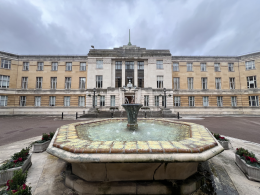
Millions of pounds of public money were approved in minutes at Wandsworth Council’s latest Cabinet meeting — with barely a question asked and no input from the public.
The meeting, held on Thursday evening, saw senior Labour councillors sign off on a string of major initiatives, ranging from housing technology trials to surveillance expansion, tree maintenance, and leisure outsourcing contracts. But despite the scale and implications of the decisions, scrutiny was largely absent — with Cabinet members asking each other soft, pre-arranged questions and offering only enthusiastic praise for their own proposals.
At no point were residents invited to speak or challenge what was being proposed. Several items passed without any questions or discussion at all. The session started out promisingly, with council leader Simon Hogg providing some details about the council’s Access for All program, but within minutes, it reverted to politburo politics.
Facial Check-Ins for Homeless Families
One of the most contentious proposals was a pilot scheme that would require families in temporary accommodation to take regular phone selfies inside their homes to prove they are still living there.
The Cabinet member in charge admitted that when he first heard the idea, “I paused — it sounded invasive.” But the trial was approved without challenge.
The council plans to spend over half a million pounds developing and deploying the system. Officers claim it will save money by catching a small number of fraud cases — but critics warn it raises serious ethical and data protection concerns, especially when applied to vulnerable families. It is also an untested and unproven system that hopes to achieve a complex goal with no prior testing, no previous experience and no input from outside bodies.
There was no mention of consultation with residents, housing charities or legal experts. No external evidence was provided to show whether such schemes have worked elsewhere.
CCTV Expansion Branded “Incredible” — With No Evidence
Another major decision rubber-stamped at the meeting was a significant expansion of Wandsworth’s CCTV network, including the formalisation of 24/7 monitoring, mobile surveillance vans, and an increase in deployable cameras across estates and streets.
The Cabinet member responsible said the system was “one of the very best in London” and claimed it had prevented several crimes, including assaults and suicide attempts. However, no independent evaluation or data was offered to back those claims — and the entire discussion was marked by hyperbole rather than hard evidence.
Not a single councillor raised questions about cost-effectiveness, oversight, or privacy safeguards. There was no indication that the public had been consulted about how or where CCTV is used, despite the cameras monitoring hundreds of thousands of people across the borough.
Leisure Contracts and Tree Tenders Read from a Laptop
The council also awarded a major new contract to run its leisure centres — including Putney Leisure Centre and Roehampton Sports and Fitness Centre — following a procurement process described as “comprehensive”. But the contract was introduced with a short speech read verbatim from a laptop, and no questions were raised about service standards, operator accountability, or delivery benchmarks.
Likewise, a multi-year contract to supply, plant and maintain trees across Wandsworth was approved in under two minutes. There were no questions about species selection, climate resilience, contract value or penalties for poor performance.
Budget Shifts and Funding Deals Passed Without a Word
Even large funding and budgetary changes were nodded through without scrutiny. One paper — a budget variation adjusting spending between two major council priorities — was approved with a 20-second summary and no discussion. Another paper, detailing how government funding would be used in Wandsworth, was passed despite the relevant Cabinet member being absent.
A Governance System Built to Avoid Challenge?
Putney.news has now watched and reviewed three Cabinet meetings. Each one has followed the same pattern: lengthy introductions from the Leader, followed by item after item agreed unanimously, with little interrogation or debate. Questions — when they are asked — are typically designed to tee up talking points rather than test the strength of the proposals.
This is not accidental. Unlike full council or scrutiny committees, Cabinet meetings are made up entirely of senior members of the ruling group. There is no representation from opposition councillors or independent voices. Public input is not permitted.
As a result, decisions involving tens of millions of pounds can be made by a single political party, in closed ranks, and without ever hearing from the people they affect.
That may make things run more smoothly — but it also risks a culture where assumptions go unchallenged, risks are overlooked, and serious issues are decided with the nod of a head.
The question is not whether councillors care. It’s whether they’re willing to be challenged. Right now, Wandsworth’s Cabinet system appears designed to avoid exactly that.