Wandsworth Council has been revealed as the UK’s top earner from parking-related income, bringing in more than £38.2 million from residential parking permits alone over the past five years – more than any other council in the country. When parking fines and other charges are included, the borough’s total annual parking revenue now exceeds £40 million, according to recently published data.
That figure puts Wandsworth ahead of even the wealthiest and most traffic-heavy boroughs, including Kensington & Chelsea (£31.5 million) and Brighton & Hove (£28.3 million). It also marks a steady rise in Wandsworth’s own permit income – up from £7.1 million in 2020 to £8.3 million in 2024 – alongside continued increases in penalty charge notices.
The council’s sharply focused enforcement regime is now drawing attention not only for its financial impact, but for what it suggests about Wandsworth’s wider approach to local government finances.
Long proud of having one of the lowest council tax rates in the country – currently £990 per year – Wandsworth has increasingly relied on alternative revenue sources, such as parking permits and fines, to balance its books. This has led to concerns about knock-on effects elsewhere, including on frontline services such as waste collection, public toilets, and parks maintenance, which have seen cuts or service reductions in recent years.
Borough-Wide Enforcement Nets Millions
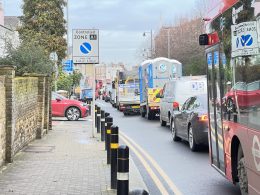
Wandsworth’s parking system stands out not because charges are unusually high – they are broadly in line with other London boroughs – but because enforcement is both more extensive and more frequent. The borough operates dozens of Controlled Parking Zones (CPZs) across five main areas: Putney, Battersea, Clapham Junction, Southfields, and Wandsworth Town. Almost the entire borough is covered by CPZs, ranging from one-hour restrictions designed to deter commuters, to all-day controls in commercial and high-demand areas.
Despite having over 61,000 on-street parking spaces, only 140 are free. The rest are regulated through a dense patchwork of sub-zones with varying time restrictions, requiring close attention from drivers and ensuring a steady stream of enforcement activity. Wandsworth uses both mobile patrols and camera-based ANPR technology to monitor compliance, issuing fines for serious contraventions at £140 to £160, and £90 to £110 for lesser ones. These rates follow London-wide norms set by Transport for London and London Councils, but Wandsworth distinguishes itself through the scale and consistency of its operations.

Comparing the Capital: Enforcement vs Equity
Compared to other London boroughs, Wandsworth issues more fines per capita than others with similar population sizes. It has fewer informal or unregulated streets – unlike boroughs such as Sutton or Kingston – and it offers little in the way of grace periods or leniency.
While other outer London boroughs sometimes take a lighter-touch approach to residential enforcement, Wandsworth’s parking rules are uniformly strict across both central and suburban streets. This model has helped the council sustain its council tax freeze, while generating increasing revenues from regulated parking – both through permits and penalties.
This financial model has raised concerns that Wandsworth is becoming structurally dependent on parking charges to prop up its budget. Critics point to visible signs of strain on other services, such as delayed waste collections and under-investment in local facilities, suggesting the low-tax boast comes at a broader public cost.
Freedom of Information requests submitted by Cinch, a car sales platform, showed that Wandsworth continued increasing its permit revenues even as other councils scaled back or froze theirs. By 2024, the borough’s income from residential permits had reached its highest ever level. Its aggressive strategy now places it alongside boroughs like Westminster and Lambeth – areas with far higher footfall and traffic volumes – despite Wandsworth having a more residential profile.
Conclusion: Success or Exploitation?
Supporters of Wandsworth’s approach argue that strict parking enforcement helps promote safety, manage congestion, and fairly allocate limited street space. Others, however, see the growing reliance on fines and fees as a form of stealth taxation – a system that disproportionately penalises residents while allowing the council to maintain its low-tax image.
What is clear is that no other local authority in the UK generates more income from parking than Wandsworth – and with enforcement intensifying, that position is unlikely to change any time soon.