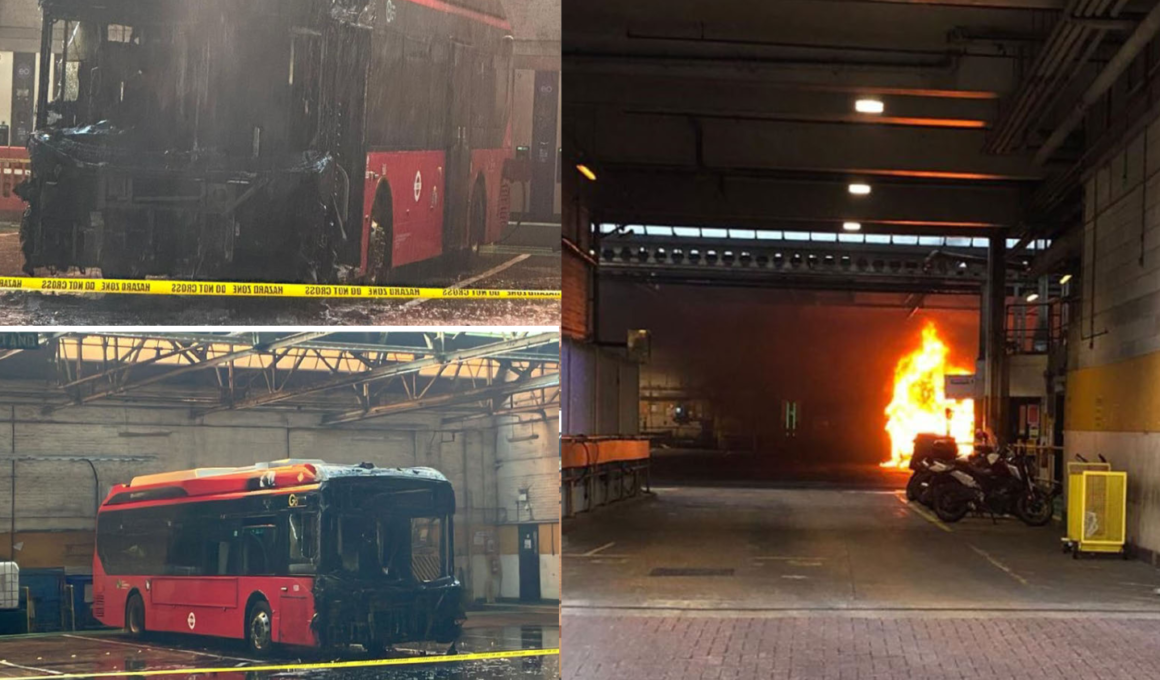
A major fire involving an electric bus at Putney Bus Garage triggered safety concerns across Transport for London’s (TfL) electric fleet, leading to the temporary withdrawal of dozens of vehicles and a full investigation into the fire’s cause.
The fire broke out in the early hours of January 22, engulfing a Caetano eCity Gold battery-electric bus serving Route 265. The vehicle was stationary and not in service at the time. According to official reports, the blaze originated in the rear battery compartment, where high-voltage lithium-ion cells are housed.
CCTV footage and eyewitness accounts revealed how quickly the fire escalated, with flames visibly spreading within moments. Emergency crews from the London Fire Brigade arrived at the depot shortly after 1:00am and were able to contain the blaze before it caused widespread damage. However, one bus was completely destroyed, and another nearby was damaged due to exposure to intense heat.
Thermal runaway
An internal investigation conducted by Caetano, in collaboration with BYD (the battery supplier), concluded that the fire was most likely the result of thermal runaway within the battery pack — a phenomenon where a battery cell failure causes rapid heat buildup, potentially triggering a chain reaction in adjacent cells. Though the precise cause of the failure has not been definitively confirmed, several possible contributing factors were identified.
One key area of interest in the investigation was the operation of the windscreen demister system, which was found to be running at the time of the incident. The demister, which draws power from the high-voltage battery, may have been contributing to sustained battery drain or thermal loading, even while the vehicle was parked. Investigators noted this as a possible exacerbating factor, though not necessarily the root cause. Importantly, the bus was not being charged when the fire started, and overcharging has been ruled out.
The Putney fire occurred just 11 days after a similar blaze destroyed another Caetano electric bus at Merton Bus Garage, prompting TfL to suspend all 57 buses of the same model across its network. These vehicles operate on several routes in south and southwest London, including Routes 200, 265, 413, and 485.
Following the incident, TfL coordinated with the manufacturers to perform full inspections and software diagnostics across the fleet. This included battery module voltage checks, thermal imaging scans, and a review of auxiliary electrical systems, such as the demister and onboard climate controls. Updated safety monitoring systems and revised operational protocols were introduced before the buses were gradually reintroduced to service.
Documents redacted
According to redacted documents released under a Freedom of Information (FOI) request, no single fault could be conclusively identified. However, the combination of a potential internal battery defect and auxiliary power draw may have contributed to the conditions that led to the thermal runaway event.
The fire has reignited discussions around the challenges of deploying electric vehicle technology in urban environments. Although TfL has emphasized that such events remain rare, unions and depot staff have voiced concerns about the need for greater oversight of electrical subsystems, especially those that remain active while buses are parked.
TfL maintains its commitment to a fully electric bus fleet as part of London’s strategy to cut emissions and improve air quality. Nevertheless, the fire at Putney Garage stands as a stark reminder of the importance of thorough risk assessments, real-time monitoring, and transparency when implementing new vehicle technologies.