

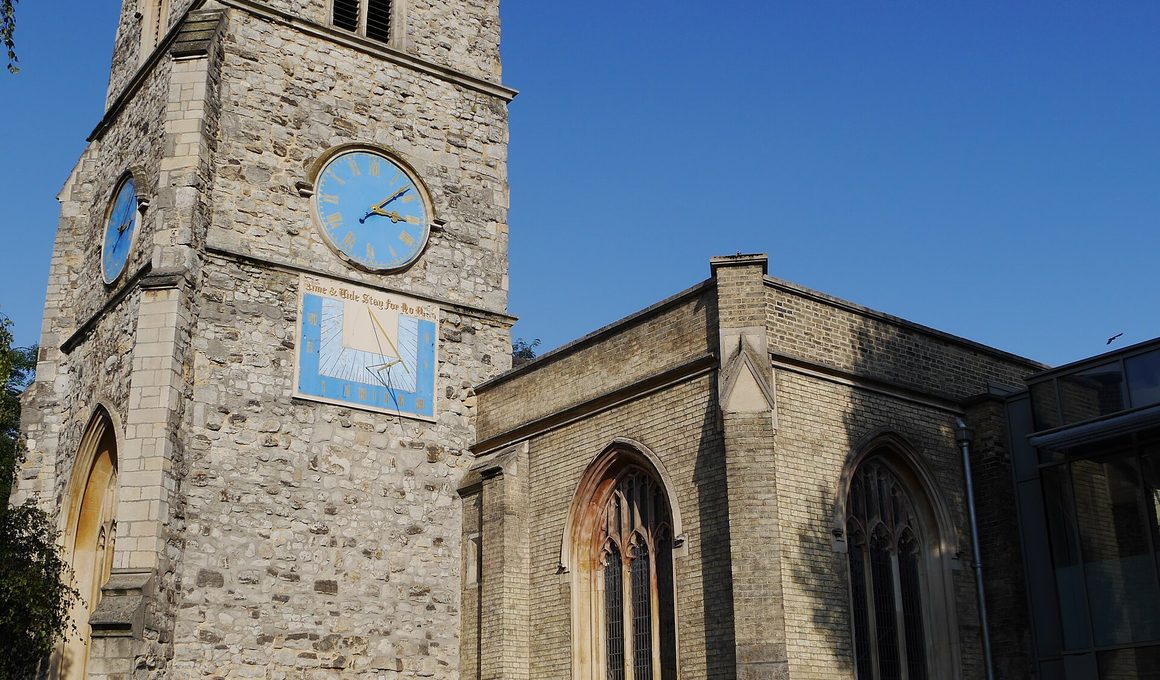
In his farewell letter in the parish magazine this summer, the Revd John Whittaker listed the things he was glad to have seen at St Mary’s Putney. Among them, wrote the departing team rector, the church’s governing council “has voted to offer services for couples celebrating same sex covenanted relationships”.
Since then, three same-sex couples come to the parish to ask for prayers once married. The parish says it is delighted to offer them.
What it can’t do is offer those married couples their own service. The prayers it agreed to support may only be said inside a service that was happening anyway. It’s not just Putney; no parish in the Church of England is allowed to offer more until the wider church agrees to do so.
Same-sex couples have been able to marry in England and Wales since 2014. The law that made it legal exempted the Church of England by name, and the Church has argued about it ever since. The last attempt to move it came in July. It failed.
What was decided, and when
We asked Revd Dr Daniel Trott, who currently oversees St Mary’s by Putney Bridge to outline where things stand at the moment.
He told us the parochial church council (PCC) met on 8 October 2025 and those present voted unanimously to back the clergy in offering what is termed Prayers of Love and Faith. Members had been told what the House of Bishops says about where the prayers can and cannot be used, Dr Trott said, before they voted.
The Prayers of Love and Faith are a set of prayers for same-sex couples that the House of Bishops approved in 2023. Clergy have been able to use them since December that year, if they choose to, inside a regular service. A Sunday communion. An evensong.
They cannot be used for a service arranged for the couple alone. The bishops’ current guidance, issued in December 2025, bars them from any service that would not be happening otherwise, and it names the case that matters most here: a service held after a civil ceremony.
Those services need the approval of the General Synod, and not by a simple majority: two-thirds of the bishops, two-thirds of the clergy and two-thirds of the laity, the ordinary church members, all saying yes. That has not happened and so while a couple in Putney can be prayed for, they cannot have a day of their own.
The choice belongs to the vicar rather than the council. Talking it over with the council is good practice and the bishops recommend it, but a council cannot make a minister use the prayers and cannot stop one either. What happened in October was the parish backing its clergy, and that is how the parish describes it.
Waiting on a new vicar
St Mary’s has no vicar at the moment. The Diocese of Southwark says that changes nothing: the decision still sits with whoever is ministering there, who is encouraged to talk to the council.
In 2003 the Parish of Putney was a founding member of Inclusive Church, a cross-denominational organisation working for greater inclusion in Christian churches. More than twenty years on, Dr Trott said, both St Mary’s and All Saints’ are as committed to inclusion as ever and want to put that into practice by being a welcoming place for LGBT+ people. St Margaret’s, Putney’s other main Anglican parish, is also a member of the same inclusion network.
The council met on 8 October 2025. About a week later the House of Bishops announced what it had decided at its own October meeting. Services of that kind could not go ahead without formal approval under church law, and the votes for that approval were not there. The Bishop of Manchester told his diocese in mid-October that it had been clear for six months that they never would be.
Four months after that, on 12 February 2026, the General Synod voted by 252 to 132, with 21 abstentions, to wind up Living in Love and Faith, the nine-year process that had produced the prayers, and to stop work on services of that kind. Two working groups were set up to keep talking.
The Archbishop of York, Stephen Cottrell, proposed the motion. He told Synod it was not where he wanted the Church to be, nor where he had hoped it would be three years earlier, and that he knew many members were angry and disappointed.
The bishops, and the rest of the Church
On 13 July 2026, at Synod in York, Professor Helen King put a motion of her own. It asked members to affirm that there are no fundamental objections to a committed, faithful, intimate same-sex relationship, and that such a relationship can sit entirely comfortably with Christian faith. Its supporters told Synod it was not an attempt to redefine marriage, and that LGBTQ+ clergy and lay people were feeling disregarded.
Opponents called it un-pastoral and ambiguous. One said it could not sit alongside the Church’s teaching on marriage, which clergy swear to uphold. Members then amended it, adding that there is a legitimate range of views held in good conscience across the Church, including views that reject what the motion said.
The amended motion had to pass in all three houses. According to Christian Today’s report of the debate, the clergy backed it by 93 votes to 79 and the laity by 101 to 83. The House of Bishops rejected it, 14 against to 11 in favour, with four abstentions.
The motion fell. Clergy and laity had voted for it. The bishops had not.
Mark Oakley is Dean of Southwark Cathedral, the cathedral of the diocese Putney’s churches belong to. After the bishops’ announcement he said he found it hard not to conclude that the Church of England is still homophobic and does not believe in the equality of love. David Monteith, Dean of Canterbury, wrote about being told that lives like his must stay marginal and hidden.
Together for the Church of England, the main liberal grouping, said the years since the 2023 prayers had brought delay rather than delivery.
Those who voted the other way say they were hurt too, by a process they felt had never really included them, and that the underlying question of doctrine was never settled. Synod elections are due this autumn and both sides are expected to fight them on it.
The Marriage (Same Sex Couples) Act 2013 got royal assent on 17 July that year, and the first weddings were held on 29 March 2014. Parliament exempted the Church of England in the same breath. The Act says a vicar’s duty to marry people, and a couple’s right to be married by him, does not extend to same-sex couples. It also shields the church law defining marriage as the union of one man with one woman. MPs and peers called the protections the quadruple lock.
Twelve years on, a man and a woman living in the parish have a legal right to be married at St Mary’s; a same-sex couple do not.
The poorest he
On 28 October 1647, the General Council of the New Model Army met in St Mary’s Church, Putney, to argue about who counts. The Levellers wanted every man to have a vote. The senior officers wanted it kept to men with property. Colonel Thomas Rainsborough told them that the poorest he in England has a life to live as the greatest he.
The line is carved into a wall of the church.
On 8 October 2025, in the same building, a small assembly voted on a version of the same question, and answered it as far as it was allowed to.
Correction, 4pm: We said in an earlier version that three couples had already had prayers at St Mary’s. In fact, those prayers have not yet happened but will shortly.



Thanks for reporting this survey. I do wonder exactly how WBC is contacting residents as I’ve certainly not been asked for my views on this most important local issue.