


Thamesfield’s ward panel met on Wednesday evening and kept all three of its policing priorities: street violence, theft from the person and shoplifting, and pedal cycle theft.
Graham Morrow argued that cycling offences should be on that list. He is a shopkeeper, former judge and told the room he has arrested a shoplifter himself; assaulted as the man broke free. He watches the traffic on Putney High Street for eight hours a day, and called what he sees an epidemic.
There is a problem with bikes going through the lights on red, and with the threatening and abusive behaviour that follows when riders are challenged. His own wife challenged a rider and was abused for it.
What he pressed hardest was not the traffic offence, however. It was the abuse given out to pedestrians who are lawfully crossing the road, and he made a legal point: behaviour likely to cause someone harassment or alarm is a public order offence in its own right, carrying up to six months in prison.
Others in the room agreed. One attendee described being sworn at after gesturing at a rider who had gone through a red light. Attendees also raised the weight of rental e-bikes, and what a collision at that weight and speed does to a person.
Ninety-seven per cent of readers who answered our poll last week said pavement and red-light cycling should be enforced, and it was cyclists and stolen car parts that have dominated local discussions ahead of Wednesday’s meeting.
So when the meeting’s chair asked whether anyone wanted the policiing priorities changed, Morrow said he would favour looking at the whole issue of e-bikes, bicycles and scooters riding on pavements and through red lights, and the danger that puts people in.
Police did not turn the request down. Acting sergeant Gary Berry told the meeting the issue could fit under one the ward’s current priorities “Theft – Pedal Cycle”.
Local policing priorities are increasingly important in a Met that is being asked to do more with less and leans increasingly on data to drive decisions. Berry set the ward’s crime figures out against them and asked the room how it wanted to proceed. Chair, Sylvie Chrzanowska, asked several times whether members were happy with the three as they stood.
Ward priorities are public. Thamesfield’s “Theft – Pedal Cycle” priority was agreed in May with a stated aim to reduce bicycle theft across the ward, particularly around Putney Embankment, through targeted patrols, prevention advice and partnerships.
The actions listed beneath it are patrols in hotspots to catch offenders targeting poorly secured bicycles, advice on D-locks and secure storage, promotion of the BikeRegister scheme, work with the council on cycle parking, and recording every bicycle theft with its location, time and method of theft. Cyclists appear once, as people to be given crime prevention advice.
That is the priority police said covers riding through a red light.
What the priority is doing
The bike theft work is substantial, and the meeting heard a good deal of it. The hotspot is the embankment and the coffee shops around it, where riders finish a ride and leave the bike, with a spike around the Clubhouse, run by Raptor Bikes. Some of the high-end bicycles are worth up to £10,000, officers noted.
The Met runs high-visibility patrols along the embankment on Fridays and Saturdays. The Clubhouse has been provided locks to customers but they are easily removed and the police advised heavy-duty ones that take a minute or two to get through to give enough time to challenge thieves, the meeting heard.
New CCTV tracks people approaching the cafe but cannot cope with the crowd on a Friday or Saturday, so has been advised to put a member of staff outside at peak times. Three bike-tagging events have been held and around 50 bikes tagged, with more planned and more locations and volunteers wanted.
Facial recognition can work from a clear image even if a face is partially obscured, officers said, which is why reporting quickly and with photographs matters. Police asked for pedal cycle theft to be kept as a priority because of the ongoing work is, and holding the priority helps them keep resources on it. As a result, on the promise that it will be expanded to include cycling offences, the room agreed to keep the current priorities as they are.
When cyclists are the problem not the victim
When it comes to the issue of cyclists running red lights and being abusive, however, the situation is different. Asked about existing cameras being used to identify riders, officers said camera enforcement is Transport for London’s job rather than the police’s, and that TfL will not act without hotspot data that residents have not generated.
Putney is not the only part of London dealing with this. Just this week in Camden, two Kentish Town wards changed one of their priorities to “Enforcing cycling offences”. It covers cycling on pavements, failing to stop at red lights, and riding in a careless or antisocial manner, and officers enforce it with warnings, fixed penalty notices, or by reporting riders.
They have already started: a two-hour operation at a junction on Kentish Town Road in June issued 23 fixed penalty notices, for offences including pavement cycling and failing to stop at a red light.
The priority list does move. In February, the Thamesfield panel dropped street violence as a priority and added theft, after a jump in vehicle crime. By May street violence was back and pedal cycle theft had been added.
The figures put to the meeting covered April to June, set against January to March. Shoplifting, the ward’s largest single category of crime, fell sharply, while Sergeant Berry said he had expected the opposite, because the team has been pushing shops to report more offences, so a drop runs against the direction of his own effort. Violence fell too, while bicycle theft barely moved, and theft from the person rose.
Most categories were moving the right way. The two exceptions officers named were drugs and offensive weapons, and they gave the reason before anyone asked: both are driven by officer-initiated stops, so the figures track how much the team is out looking rather than how much is happening.
Officers also gave their fullest account yet of the thefts of sensors from parked cars, the run of thefts that saw seven cars stripped in one night last month.
The part sits behind the badge on some VW, Mercedes and BMW models, and officers told the meeting a stolen sensor sells for around £1,500. One officer’s own estimate was that somebody working a good night could clear over £10,000. Police described the vulnerability as a design fault on the manufacturers’ side, and said it is being raised with them.
They do not believe the people doing it are local. The working theory is that they travel i from other parts of London on e-bikes quick enough to make the distance worth it and to lose any car that gives chase. Two arrests have come out of proactive patrols, including for drug offences, and officers are weighing a look-backward approach, tracing the platforms the parts are sold on rather than waiting for the next car.
One resident told the meeting a new VW has been hit on Mascotte Road just days earlier. The job is thought to have taken about ten minutes. If there was any consolation, officers said, it was that other parts of the borough have been hit worse. The Met is aware of the issue and is actively working on it, they noted.
What you can do
For a crime in progress, a bike being taken, a car being opened, a fight, officers said the number is 999.
For anything that is not an emergency, they advised using the Met’s online reporting rather than 101, because evidence and photographs can be uploaded with the report.
On cycling, officers said hotspots should be reported to Transport for London, on the basis that the weight of public reports counts for more than an escalation from the police.
The ward team can be reached at Thamesfield@contact.metengage.co.uk.
The next Thamesfield ward panel is listed for Tuesday 1 December at St Mary’s Church on Putney High Street. Before that, the team is running a crime prevention stall at the same church on Saturday 12 September, from 2pm.
Roehampton
Reports of a child being kidnapped in Roehampton last week are less serious than they first appeared.
The child’s mother was within sight of the child throughout, though the episode was traumatic for her. Local officers were there within minutes, and more arrived shortly afterwards. The person in question was later held under the Mental Health Act.



There is clearly a legitimate case for enforcing dangerous cycling, pavement riding and red-light jumping. But taken together, the four recent articles seem less like a balanced examination of road safety than an increasingly elaborate case against cyclists, built around selective statistics, anecdotes and a decidedly self-selecting readership. The much-repeated 71% figure is real, but it is a comparison of 137 versus 234 pedestrians killed or seriously injured by cyclists in 2016 and 2025 — not evidence of a 71% increase in the risk posed by cycling, nor evidence that cyclists have suddenly become the principal road-safety problem. The subsequent conflation of bicycles, e-bikes, illegal e-bikes and e-scooters only makes the argument less robust.
What is striking is the almost complete absence of equivalent scrutiny of motorists. Anyone walking around London will routinely see cars and vans crossing stop lines, blocking crossings, turning across pedestrians and proceeding through lights that have just changed. Red-light running by drivers is not a hypothetical problem: the Met recorded 71,249 driver red-light offences in 2025. Yet only 245 of London’s 6,455 traffic-light junctions — less than 4% — have red-light camera enforcement. If red-light running is sufficiently dangerous to form the centrepiece of a campaign against cyclists, why is the same scrutiny not applied to motorists?
The polling doesn’t really rescue the argument either. Saying that 97% of respondents support enforcement sounds impressive, but this was a voluntary online poll attached to an article explicitly about “dangerous cyclists”, not a representative survey of Putney residents. Likewise, four cyclists writing in to say that e-bikes are the real problem are four anecdotes, not evidence. Indeed, that article rather undermines the first: if the real concern is illegal, high-powered e-bikes and their behaviour, why repeatedly frame the issue as a general “cyclist problem”?
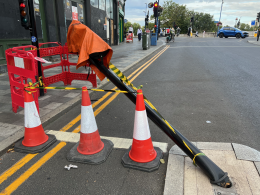
By all means enforce dangerous behaviour — but do it consistently. Protect pedestrians, prosecute abusive behaviour, tackle illegal e-bikes and enforce red lights. But apply the same standard to cars, vans and motorcycles. Otherwise this starts to look less like road-safety journalism and more like a familiar culture-war narrative in which the most irritating behaviour by one group is elevated into a social crisis, while equivalent behaviour by motorists is simply treated as part of everyday London traffic. The recent description of a traffic light being demolished by a “stray vehicle” is a case in point.
The comparison doesn’t hold, and the source you’re citing shows why. Cars are 69% of vehicles involved in collisions and pedal cycles 9%, so a raw count between them mostly measures how much of each is on the road. DfT publishes the exposure-adjusted version in the same release: per billion vehicle miles, pedal cycles are involved in 1,306 fatal or serious collisions against 114 for cars.
You’ve also set 245 pedestrians killed by cars against 234 killed or seriously injured by cyclists: a fatality count against a KSI count, which aren’t comparable quantities.
On enforcement, officers at Wednesday’s meeting made the point from the other end: a driver can be identified after the event and a cyclist can’t, because there’s no registration mark. A camera can capture a number plate which months later can be used to precisely identify someone; bicycle offences require immediate on-the-ground response. Plus there are the structural issues around the law, metrics, and so on. More on all of this on Sunday.
Kieren