

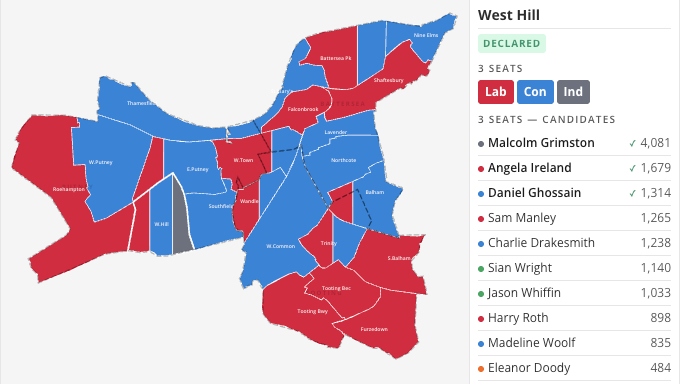
The Conservatives came within one seat of winning back Wandsworth Council last night. Labour came within two seats of holding it. In the end, neither got what they needed – and the result is a hung council decided by a single independent councillor who has been winning elections in West Hill since 1994.
The arithmetic tells one story. The vote shares tell a more important one.
| Party | 2022 | 2026 | Change |
|---|---|---|---|
| Conservative | 40.6% | 31.2% | -9.4pp |
| Labour | 42.5% | 33.6% | -8.9pp |
| Green | 8.9% | 17.3% | +8.4pp |
| Lib Dem | 6.0% | 9.1% | +3.1pp |
| Reform UK | 0% | 7.3% | +7.3pp |
The Conservative vote share fell nearly ten percentage points. Labour’s fell nearly nine. Both main parties lost ground – heavily – to a set of insurgent movements that between them took more than a third of the vote and won not a single seat.
The squeeze from the left
The Green Party’s vote share nearly doubled across the borough, rising from 8.9% to 17.3%. In Tooting Broadway – their main target seat – the surge was extraordinary.
| Ward | 2022 | 2026 | Change |
|---|---|---|---|
| Tooting Broadway | 5.8% | 35.0% | +29.2pp |
| Falconbrook | 0% | 23.1% | +23.1pp |
| Tooting Bec | 9.4% | 29.6% | +20.2pp |
| Nine Elms | 4.4% | 20.9% | +16.5pp |
| South Balham | 6.5% | 17.4% | +10.9pp |
| Lavender | 7.0% | 16.6% | +9.6pp |
| Trinity | 4.8% | 14.4% | +9.6pp |
Green Party vote share by ward
The correlation between Green gains and Labour losses is striking. Wherever the Greens surged hardest, Labour collapsed hardest. The two moved in near-lockstep. The correlation between Green gains and Conservative losses, by contrast, is barely detectable.
Approximately 81% of the Green surge came from former Labour voters. For every vote the Greens took from the Conservatives, they took 4.4 from Labour.
The Greens didn’t split the left — they gutted it.
The 51-vote moment
In Tooting Broadway, the starkest example: Green candidates polled 5,373 votes combined. Labour’s third-placed winner, Rex Osborn, held on with 1,956 votes. The first Green candidate, Michael Bankole, finished with 1,905. The gap between Labour holding and the Greens breaking through: 51 votes.
That margin never closed. Three Green candidates, no seats. And Labour held the ward — but only just, and at a cost that rippled through the borough’s arithmetic.
to see results
The squeeze from the right
While the Greens were pulling Labour’s progressive vote, Reform was doing something equally damaging from the other direction – and in a pattern that runs counter to the national story about Reform.
Nationally, Reform UK is understood primarily as a Conservative problem: disaffected Tory voters drawn to a more populist offer. In Wandsworth, the picture is reversed. Reform’s strongest performances came in Labour’s most working-class heartlands.
In Roehampton – the most deprived ward in Wandsworth, with the highest concentration of households in relative poverty and the highest unemployment rate in the borough – Reform polled 15%. In Shaftesbury & Queenstown, the second most deprived ward, 11.3%. In Falconbrook, a working-class Battersea ward where Labour took 71% of the vote in 2022, Reform took 10.2%.
Now look at the Conservative heartlands. In Northcote – one of the least deprived wards in Wandsworth, with unemployment at 3%, the lowest in the borough – Reform polled 4.4%. In Balham, 4.3%.
| Ward type | Example wards | Avg Reform vote |
|---|---|---|
| Most deprived | Roehampton, Shaftesbury & Q, Falconbrook | 8.2% |
| Mixed | Nine Elms, St Mary’s | 8.9% |
| Most affluent | Northcote, Balham, Southfields | 5.5% |
The Wandsworth Reform voter is not the disaffected Home Counties Conservative. They are the disaffected working-class Labour voter in Roehampton and Battersea: people for whom neither the Greens’ environmentalism nor Labour’s metropolitan offer is landing. In Wandsworth’s most deprived communities, Reform is the protest vote. In the affluent professional wards, the Conservative brand held.
Where Labour actually lost it
The wards where Labour’s vote collapsed most dramatically: Battersea Park, down 14.6 percentage points. Tooting Bec, down 18.2. Furzedown, down 18.9. Tooting Broadway, down 25.5. Falconbrook – historically Labour at 71% and home to council leader Simon Hogg – down 26.5 points.
In each case the Green vote surged. In each case Reform also made inroads. In each case, Conservative candidates needed only to stay roughly where they were.
Five wards changed hands:
| Ward | Seats | 2022 | 2026 | Change |
|---|---|---|---|---|
| St Mary’s | 3 | CON×1, LAB×2 | CON×3 | CON gain 2 |
| West Putney | 3 | CON×1, LAB×2 | CON×3 | CON gain 2 |
| Battersea Park | 3 | LAB×3 | CON×1, LAB×2 | CON gain 1 |
| Trinity | 2 | LAB×2 | CON×1, LAB×1 | CON gain 1 |
| Wandle | 2 | LAB×2 | CON×1, LAB×1 | CON gain 1 |
Labour didn’t lose to Conservative candidates who worked harder or offered something better. Labour lost to its own fracturing vote, and the Conservatives happened to be standing where the pieces fell.
The Conservative paradox
This is an unusual kind of near-victory. The Conservatives’ vote fell in almost every ward: down 9.1 points in Thamesfield, 9.3 in Shaftesbury & Queenstown, 10.5 in Falconbrook, 11.5 in Roehampton. They went up in precisely one ward: Nine Elms, by 1.2 points.
In their own strongholds the picture was little better: down 9.1 in Thamesfield, down 5.6 in Wandsworth Common. A party whose vote is falling across the board does not normally gain six seats. In Wandsworth last night, it did – because Labour’s vote collapsed faster, and the seats fell to whoever was left standing.
The third-party picture
No Green, Liberal Democrat or Reform candidate won a seat anywhere in Wandsworth. The scale of the disproportionality is striking.
| Party | Vote share | Seats won | Seats if proportional |
|---|---|---|---|
| Labour | 33.6% | 28 | ~19 |
| Conservative | 31.2% | 29 | ~18 |
| Green | 17.3% | 0 | ~10 |
| Lib Dem | 9.1% | 0 | ~5 |
| Reform UK | 7.3% | 0 | ~4 |
Based on 58 total seats, final results
Under a proportional system, the Conservatives – with fewer votes than Labour – would have fewer seats than Labour. Instead they have more. Three parties with a combined 34% of the vote have no representation at all. First-past-the-post absorbed more than a third of Wandsworth’s votes and returned nothing.
The Putney picture
In Putney, the Conservative surge was pronounced. West Putney was the ward that decided the council’s arithmetic: the Conservatives won all three seats, having held only one in 2022. Labour’s vote fell 17.4 points. Nick Austin, returning as a Conservative candidate after a period of suspension from the party, topped the poll.
East Putney held its 2022 shape – CON 2-1- with Ravi Govindia returning by just 20 votes. Thamesfield held for the Conservatives despite the Liberal Democrats surging to 29.9%, their strongest showing in the ward for decades and 16 points above 2022. Not enough.
Roehampton held for Labour, all three seats. And West Hill returned Malcolm Grimston with 4,081 votes – more than double his nearest rival – and with it, the balance of power in Wandsworth’s most extraordinary election in half a century.
The man who decides
Grimston has sat on Wandsworth Council since 1994. He is a nuclear energy academic at Imperial College who left the Conservatives over library closures in 2014 and has run as an independent ever since, winning every election since with commanding personal votes. He has given no indication of which party, if either, he would support.
With CON on 29 and LAB on 28, either party needs Grimston — or needs the other party to fracture — to command a majority. He has positioned himself carefully for 30 years as a man who cannot be counted on by anyone. Wandsworth Council is now, for the first time, a place where that matters enormously.
The Liberal Democrat story
The Liberal Democrats ran a focused target seat campaign and came close in two wards without breaking through in either.
In Southfields, the party surged from 7.7% to 27.6% — a 20-point increase. The second Conservative candidate held on by 328 votes. In Thamesfield, their most ambitious target, they reached 29.9%, up 16 points from 2022. The Conservatives held all three seats. Just.
In Northcote, the third target, the Lib Dems improved from 6.6% to 13.5% but were never competitive. In Nine Elms, where they had polled 26.3% in 2022, their vote collapsed to 8% as those voters migrated to the Greens and Reform.
Across all 22 wards, the average Lib Dem share rose by just over three points. They concentrated their resources, came close in two wards, and won nothing.
What it means
Wandsworth has a hung council. Labour lost ground not primarily to the Conservatives but to two insurgent movements pulling in opposite directions — Greens taking its progressive middle-class vote, Reform taking its working-class vote. The Conservatives gained six seats without increasing their own vote anywhere that mattered.
The political landscape beneath the headline result has shifted considerably. A party that took 17% of the vote won no seats. A party that won 29 seats did so on 31% of the vote — less than Labour’s 33.6%. The council will now be shaped by conversations with one independent councillor in West Hill who has spent 30 years refusing to be anyone’s ally.
That is what first-past-the-post does to a fragmented electorate. And that is what Wandsworth got last night.



Just listened to the king maker Malcolm Grimston on Rverside Radio. He says council needs more open debate and honesty about finances. The numbers mean the position of casting vote of Mayority comes into play. Jeremy Ambache to play crucial role.
And this again proves the futility of the first past the post system !!!
i repeat – all councillors ought to be independent.
Referring to the national political situation is not pertinent to local issues. Local
knowledge with inspiring solutions is what is truly required.
Yes everyone would have to work a little harder but surely that’s part of the right to vote.
Surely the case for PR is now unanswerable. Labour nationally has decided this isn’t a priority, but as your story suggests they could have hung on in Wandsworth if it wasn’t for FPTP and could have entered a progressive arrangement with the Greens and/or LibDems.