

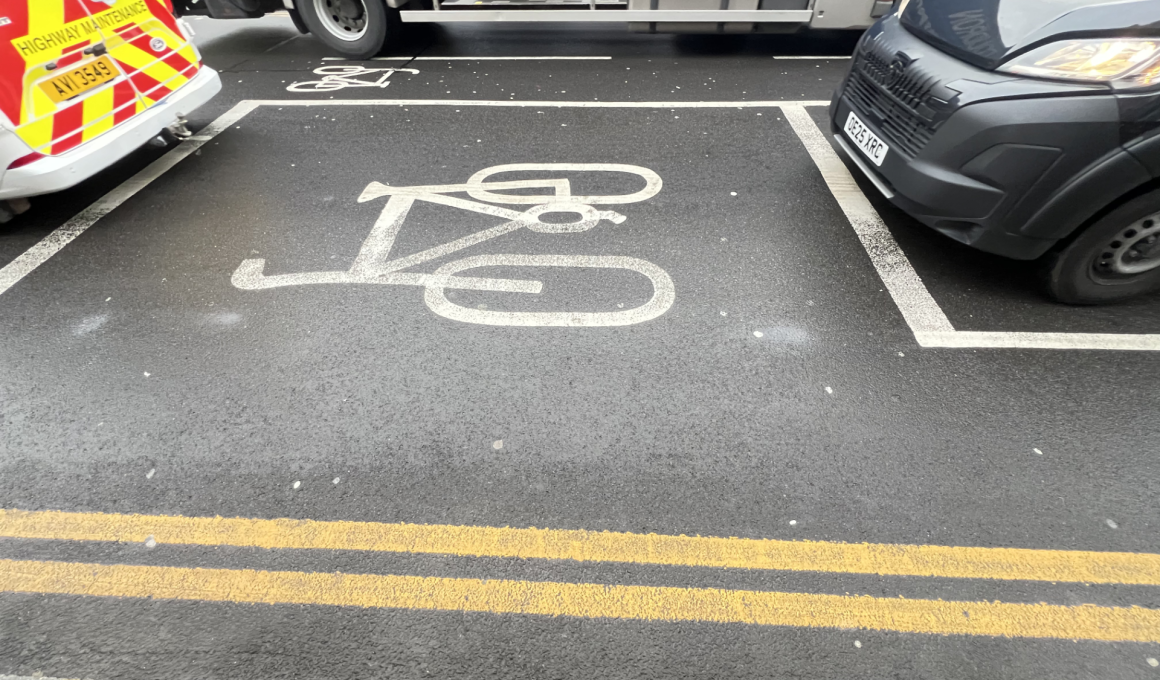
On Disraeli Road, four separate pieces of cycling infrastructure collide and leave everyone worse off.
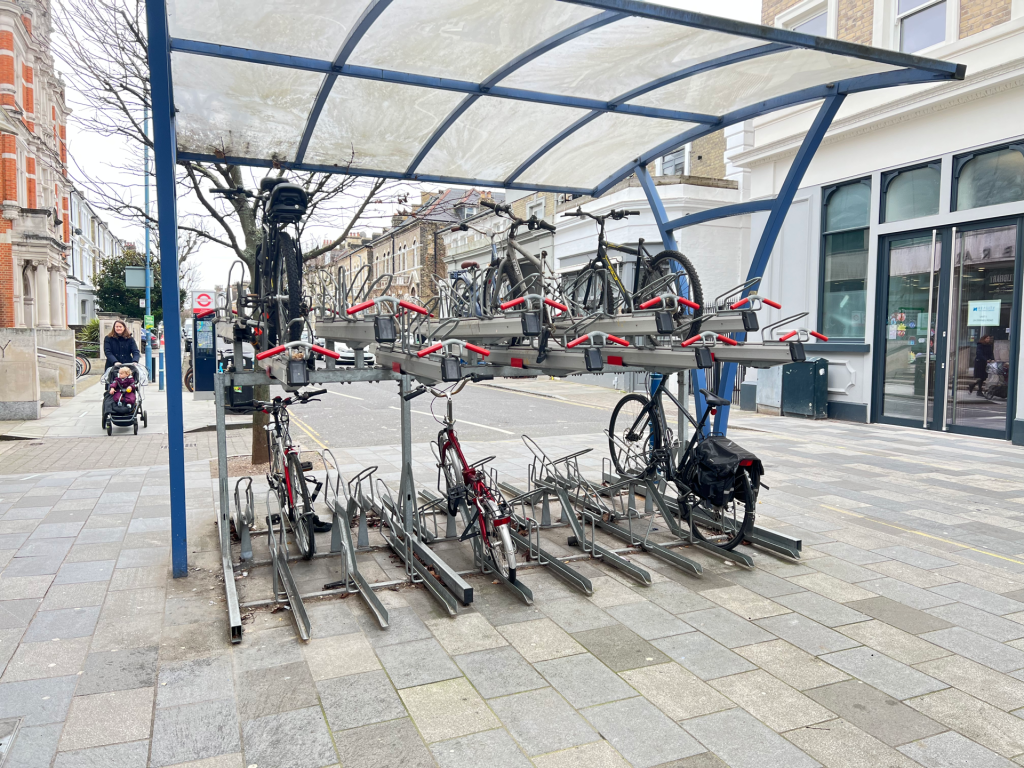
Next to the High Street sit two large covered council bike racks that could hold 64 bicycles but rarely hold more than 10, rusting bikes filling almost as many spaces as serviceable ones. Next to them, TfL’s Santander hire bikes has 28 docks and runs at around 25% occupancy. Both represent an over-provision while taking up extremely valuable space – and not in a useful way.
The council racks take up an entire lane, forcing cars to queue single file while trying to reach Putney High Street, sometimes stretching 200 metres back to Oxford Road. They also get in the way of cyclists trying to cross Putney in a contraflow system who enter Disraeli and are immediately given a choice of squeezing between cars or pedestrians to get any further. The Santander bikes take up five parking spaces right in front of the library, limiting its accessibility and forcing residents to find spots on neighbouring streets.
Go another 200 metres down the road and you have the opposite problem. Underneath the Tube bridge sits the designated e-bike bay, which frequently overflows with Lime and Forest bikes and get in the way of pedestrians. Beside it is a privately-run, council-owned bike hangar that is full and has a waiting list even at £72 a month, but which locals say blocks sightlines for all road users.
And yet, despite all this infrastructure, cyclists still struggle to find somewhere to lock a bike near Putney High Street or Putney station, and many still avoid the High Street out of safety concerns.
This is what happens when local authorities are told to solve an issue, given too much leeway, and no one coordinates.
Six separate cycling systems operate across Putney, run by six separate bodies with no obligation to talk to each other. The result is a borough that has built too much in the wrong places and too little where demand exists, overshooting its own target for bike storage by 49%, four years ahead of schedule, with no revised goal published and no public account of whether any of it is working.
Nobody coordinates between these six systems. TfL, Richmond, and Wandsworth each make decisions within their own remit. No body is responsible for the whole — and the whole is not working.
The boundary at Putney High Street
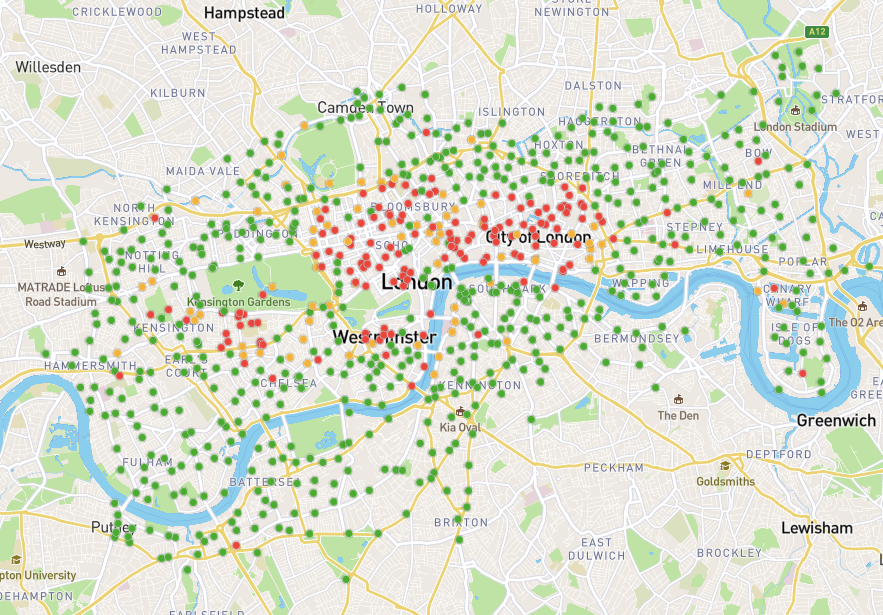
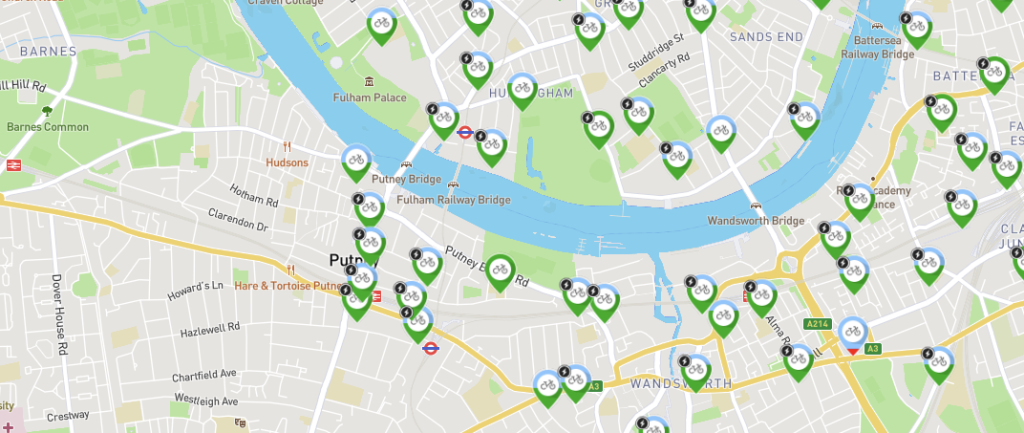
The Santander network’s seven Putney stations, with around 183 docks in total, are all clustered east of the High Street.
Hotham Road, Clarendon Drive, and the residential streets of west Putney where hire-bike demand is highest have no coverage at all. This is a TfL decision, not the council’s. The east side of Putney High Street seems like an arbitrary boundary line, and it is. TfL, as far as we are aware, have never felt the need to explain it.
From this summer the picture gets considerably worse. Richmond Council has awarded its dockless bike contract exclusively to Forest, banning Lime. The decision was influenced by a concession payment of around £3 million from Forest despite Lime scoring higher on quality.
National Cycle Route 4, which runs the full length of the south bank towpath, becomes inaccessible on a Lime bike after roughly ten minutes, when the Richmond border cuts across at Beverley Brook. When Hounslow took the same approach and banned Lime in favour of Forest and Voi, e-bike use in the borough dropped by half.
Wandsworth has said nothing publicly about what happens to its residents when they reach the dead-end, and the council has also installed 170-plus dedicated Lime parking bays across the area since June 2024, bays that will still be there when Lime can no longer operate past the border.
Where the demand actually is
Then there is the program to provide locked hangars on the street for people’s own bikes.
The hangar programme’s problem is not uniform oversupply: it is that provision bears little relationship to where demand exists. Ruvigny Gardens has 44 people on the waiting list. Felsham Road has 34. Putney Hill junction has 34. The commercial bike storage cages on Bessborough Road, placed through demand-led commercial logic rather than the council’s siting process, had five of their six spaces taken on the same date. Yet Pentlow Street, where a Phase 4 hangar was installed in April against the unanimous opposition of everyone on the street, has a waiting list of zero.
We reported how Pentlow Street residents discovered the hangar during installation rather than before it, and that the council’s own ward councillors were not consulted. Cllr Ethan Brooks said: “This wasn’t our decision as local councillors… we weren’t consulted.” Simon Scott-Taylor, a 30-year resident of the street, was more direct: “Not one household on the street supported the proposal.” The same pattern repeated across five streets in Thamesfield the following week.
Wandsworth decided where it wanted the hangars to go, create a process to make it hard as possible for residents to object, and then ignored them anyway, often putting eight-foot metal boxes in the middle of two parking spaces on roads that have too few of them, despite expensive parking pemits.
The junction
Putney Bridge carries 6,602 cyclists on an average day (15% of all road users), so there was a genuine case for improving cycle provision at the junction.
The council installed a number of dedicated cycling lanes, several of which are rarely or never used. It gave one lane 12 seconds of signal time. When the result was gridlock across Putney, the council admitted (deep in committee papers) that fewer than 10 cyclists per day used it, against 37,245 motor vehicles receiving 21 seconds, and 2,813 daily bus services whose journey times have worsened as the bridge’s traffic has backed up. The lane is now being removed and the timing unwound.
Three Labour members of the Transport Overview and Scrutiny Committee, the body that scrutinises these decisions, had declared membership of the London Cycling Campaign, which lobbied the junction consultation.
No rules were broken, and the declarations are properly recorded in the register of interests. But the overlap between the lobby group and the scrutiny body is a matter of record. As is the daily result of a terrible redesign that serves nobody: cyclists report fearing the junction because of the erratic behaviour of motorists deeply frustrated after spending up to an hour in traffic.
The strategy nobody questioned
The bikehangar programme crosses two administrations and three cabinet papers, with a consistency that suggests nobody looked too hard at the evidence at any point.
The Conservative administration approved the original strategy in 2019 with a target of 1,390 spaces by 2030 and a commitment to “no ongoing costs.” Labour accelerated the programme after winning the council in 2022 and drove the subsequent phases.
A 2023 paper repeated “no ongoing costs” and reported that “all hangars” were fully occupied with waiting lists. A 2024 paper then introduced the Access for All scheme, under which the council reimburses CycleHoop 50% of subscription fees for eligible residents, while the same paper still described the programme as having “no ongoing costs.” The occupancy claim had shifted quietly from “all” to “nearly all.”
No contract for the CycleHoop programme appears on Contracts Finder or Find a Tender. Westminster published a four-year maintenance contract worth £200,000. Waltham Forest published a £100,000 contract that includes hangar relocation as a standard costed line item, so residents and councillors can see what removing an unwanted hangar costs before asking for it. Wandsworth has published nothing equivalent.
The English Devolution Bill, currently in Parliament, would give TfL regulatory authority over dockless e-bikes, potentially enabling minimum service standards and cross-boundary access requirements. Even if it passes, uniform regulation is probably several years away. Until then, whether a Putney resident can cycle the towpath to Richmond depends on how much money a competitor paid to exclude their preferred bike.
What you can do
To join a bike hangar waiting list or check availability, search by postcode at cyclehoop.com/uk/wandsworth/. Abandoned bikes in rack spaces can be reported via wandsworth.gov.uk; the council approved a 14-day removal policy in 2023, though enforcement at the Disraeli racks suggests it is not being applied.
Thamesfield, West Putney, and East Putney ward councillors are reachable via wandsworth.gov.uk if you want to raise the Santander coverage gap with the council. If you currently use Lime bikes on the towpath, downloading the Forest app before this summer is worth doing.
Mick Stone of the Putney Action Group asked out loud the question nobody in a position of authority has yet answered: “I want to know the rationale for these things and where they’re being put… who’s responsible for such a stupid decision and failure to communicate?” He was asking about a specific set of hangars. The question fits the whole picture.
TfL decides where Santander docks go. Richmond decided which e-bike company can operate on its side of the towpath. Wandsworth officers decide where the hangars go, without publishing the contract that governs it, and without telling ward councillors. The junction was approved under one administration and dismantled under another. The strategy overshot its own target by 49% and nobody published a revised one.
Six systems. No coordinator. One borough left to live with the gaps between them.
Putney.news has previously covered the bikehangar programme in November 2025, the Disraeli Road racks in January 2026, safety concerns the same month, and the wider policy picture in late January.


I don’t really understand the part about the PHS cycle lane. It can’t be the southbound one, judging by the signal timings which don’t apply, and for the excellent northbound cycling ‘gate’ the quoted timings are simply wrong. So maybe its the PBR left turn for cyclists, which has been removed anyway?
The northbound one should not be removed as it allows northbound cycles to get ahead of the vehicles, so avoiding clashes with left-turning vehicles, although too many cyclists ignore the red light: a separate issue.
I should have added that its good to see a piece that looks at cycling in Putney overall, and there are many good points, on the mess in Disraeli Road in particular.
A legacy from the out going Mayor …. Some junctions, in reality are death traps.