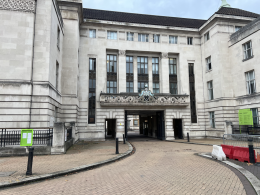
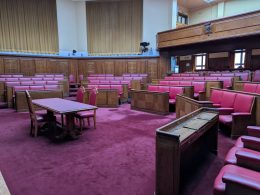
Wandsworth Council is refusing to release fire safety records for a building where 150 people were evacuated and 60 residents lost their homes.
A review of the fire ordered by the council – and given a limited remit – concluded that the fire spread so quickly because of an attic space the council had never inspected. The fire also came a year after the housing regulator warned Wandsworth Council about serious fire safety failings across its housing stock.
Putney.news requested fire safety inspection reports and records of overdue work for that block; records that would show whether anyone knew about the danger before the fire. The council has refused to provide them.
On a Wednesday evening last September, as residents of Fox House in Battersea were home for the night, fire ripped through an attic space that the building’s own safety inspection had never checked, half the length of a football pitch, destroying the top floor and roof. The same inspection had told residents to “stay put” in the event of a fire. Residents who saw flames reflected in the windows of the block opposite ignored that advice and got themselves out. One described watching a window above their flat blow out and crash to the ground below. Mercifully, no one was killed.
Barry Quirk, who was drafted by the government to lead Kensington and Chelsea council after 72 people died at Grenfell Tower in 2017, reviewed the council’s response to the Fox House fire. He wrote that “the cause of the fire was not clear” but “the cause of the spread of the fire was obvious.”
He recommended the council check the attic spaces in similar buildings. The council committed to doing so “without delay.” Whether those checks have happened, and what they found, has not been disclosed.
Quirk’s review looked at the council’s response to the fire, not at what happened before it. Cllr Kate Stock raised this at the housing committee where Quirk presented his findings, noting that residents seeing an independent report into the Fox House fire would expect it to cover why the fire started and why it spread. It did not. The question of what the council knew before the fire sits in the records it now refuses to release.
A failure the council documented itself
The council’s own documents tell the story of how it got here.
After 72 people died at Grenfell Tower, the government published its Social Housing White Paper in November 2020, promising that “never again would the voices of residents go unheard.” Most social landlords responded by investing in safety teams and updating their systems. Wandsworth did nothing for four years.
When the council finally reviewed what had gone wrong, its own papers described “decades of stagnation,” a department with “entrenched ways of working” that was “out of touch” with what the law required. The Housing Department has since been abolished and rebuilt under a new name, with an independent board brought in to watch over the fixes. Despite all of that, 326 fire safety actions remained outstanding as of January 2026.
That followed a year of documented failures. In February 2025, the housing regulator gave Wandsworth its second-worst rating for 1,800 overdue fire safety actions, all more than a year old. By November, an internal audit found 16 of 25 housing blocks tested had overdue safety work. A 64% failure rate.
While carrying those failures unfixed in its own buildings, some three years overdue, the council was also taking private landlords to court for identical problems: broken fire doors, faulty alarms.
How the council’s leaders responded
The Cabinet Member for Housing, Cllr Aydin Dikerdem, has consistently played down the fire safety record that Fox House now sits at the centre of.
When the regulator’s rating was published in February 2025, identifying nearly 1,800 overdue fire safety actions, he told councillors it was “not what we hoped for” but “all fixable.” At committee, he described the overdue work as things like “no smoking signs in the communal corridor.” The actual list included broken fire doors and faulty smoke detectors.
When residents criticised the council’s response to the Burke Close gas explosion weeks later, he dismissed their concerns as “misinformation.” When Putney.news revealed the council was taking private landlords to court for fire safety failures it carried unfixed in its own blocks, he dismissed the council’s own failures as “a scary headline.”
The same defensive instinct was on display in May 2025, when the Housing Ombudsman found “severe maladministration” in the council’s handling of a four-year roof leak and ordered a wide-ranging overhaul of how Wandsworth manages repairs and complaints.
At a council oversight meeting, Dikerdem pointed to a tenant satisfaction score of 22% as evidence of progress. A satisfaction score of 22% means, of course, that 78% of tenants – more than three in four – were not satisfied. The score had risen from 16%.
At a scrutiny committee the following month, with 18 of 23 Housing Ombudsman rulings against the council upheld, Dikerdem described the Ombudsman’s approach as “more aggressive” and suggested complaints were being driven by law firms rather than by conditions in the homes.
In January 2026, when the council’s own papers admitted it had ignored the Grenfell reforms and described “decades of stagnation,” Cllr Dikerdem blamed the previous Conservative administration. Labour has controlled the council since May 2022. No one has been held accountable.
At the same housing committee where Quirk presented his findings and Cllr Stock asked about prevention, Cllr Dikerdem described the fire as “the biggest and the scariest incident” of his time as a councillor. His focus was on how quickly displaced residents had been found new homes, which he called “the strongest policy outcome.” He praised officers, praised the administration, and promised to be “as transparent as possible.” He did not mention the uninspected attic space, the “stay put” advice, the C3 rating, or the programme of attic inspections Quirk had just recommended.
The man who reviewed the fire had flagged a serious safety gap. The man responsible for housing did not mention it.
The FOI and the challenge
We asked for the fire safety records for Fox House on 18 January 2026 under the Freedom of Information Act. The council had 20 working days to respond. No reply came.
Two months later, and more than a month past the legal deadline, we filed a formal complaint about the delay. The council sent a holding letter the following day. The answer arrived on 9 April: a refusal. The council committed to implementing Quirk’s safety recommendations “without delay.” It took nearly three months to respond to a request about whether it had done so.
The council says releasing the records could harm the London Fire Brigade’s investigation into the cause of the fire. As of February 2026, the LFB had told Inside Housing it had not been able to get into the building. The council is relying on an investigation that cannot get through the front door.
Quirk himself told the housing committee that examining the attic space problem “can be done without knowing the diagnosis of the fire.” The council is using that same unfinished investigation as its reason for withholding the records.
We have challenged the refusal. These are safety records that existed before the fire, not evidence from the investigation. The council’s own failure record is reason enough for the public to see them.
What happens next
The council has 20 working days to respond to the challenge. If it rejects it or fails to reply, we will take the matter to the Information Commissioner.
Fox House, Maysoule Road, was a five-storey council block with 37 flats. Around 150 people were evacuated on the night of the fire. Approximately 60 lost their homes for good. The last was rehoused on 15 January 2026, 16 weeks after fleeing. The building remains unsafe.
Those residents, and the residents of similar blocks whose attic spaces may not yet have been checked, have a direct interest in what the records show. Residents who feel the council has failed them can complain to the Housing Ombudsman.
Wandsworth’s housing scrutiny committee is open to the public. So are the ballot boxes on 7 May.