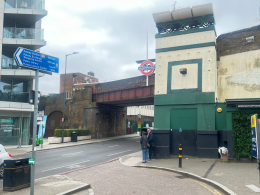
East Putney is officially the worst Tube station in London for signal failures, according to figures released by TfL.
Data obtained under freedom of information and analysed by Putney.news shows East Putney recorded 147 hours of signal failure disruption in 2024, more than double the next worst station on the entire Underground network. The three worst stations in London were all on the District Line’s Wimbledon and Richmond branches, all maintained by Network Rail, and all running on signalling equipment that is decades out of date.
TfL does not publish these figures. In fact, it does not measure branch-level performance at all. Its official reliability metric counts trains at a single station, Embankment, on the central section, blind to the branches where Putney and Wimbledon passengers travel. When we asked the organisation for Wimbledon branch reliability data, TfL said it could not provide it. “We do not record information on when a ‘good service’ is running,” a senior case officer told us earlier this week.
What TfL does hold is raw disruption data logged on station screens every time something goes wrong. Those messages name the specific station and section affected. TfL pointed us to a dataset of roughly 96,000 of these records, covering January 2020 to February 2025. TfL’s own notes warn of overlapping entries and double-counting, so we merged the overlapping intervals to produce reliable figures across all ten lines and 155 stations.
The results are stark. East Putney (147 hours), Richmond (71 hours), Kew Gardens (56 hours): the three worst signal failure stations in London, all on Network Rail track. The next worst on the entire network, Moor Park on the Metropolitan line, recorded 35 hours. Eight of the top 20 worst stations were on the District Line. Network Rail sections accounted for 71% of all District Line signal disruption hours. The problem sits overwhelmingly on the ageing infrastructure that serves Putney, Wimbledon and Richmond.
Source: TfL service status disruption data, FOI-3588-2425. De-duplicated hours (overlapping intervals merged). Data covers January–December 2024.
The data records disruption against the station where the fault is located, not every station affected by it. East Putney absorbs the hours because that is where the failing signals sit. Every station further down the branch, Southfields, Wimbledon Park, Wimbledon, experienced the same disruption.
The scale of 2024 was unprecedented. East Putney’s signal failure hours in previous years were 13 in 2020, zero in 2021, four in 2022, and three in 2023. Then 147. Almost all of it came in a single month.
Nine days in September
On 22 September 2024, a signal failure began at East Putney. It did not end for nine days. Across those nine days, the data records 124 hours of continuous disruption spread over 12 merged periods, starting at dawn and running to midnight, day after day.
The signal, identified by a former District Line driver on rail forums as W361 (a Network Rail asset located after the East Putney tunnel), defeated repeated repair attempts. “Despite multiple periods of track access and repairs undertaken both overnight and during the day, the issue persists,” one forum user wrote at the time. Network Rail eventually replaced almost all the signalling infrastructure at the location before discovering a damaged cable.
Putney MP Fleur Anderson wrote to TfL and Network Rail the day after the failure ended. The London Assembly later pressed TfL on the issue. TfL confirmed to the Assembly that the Wimbledon branch had experienced “a two-week period of delays due to signalling performance on that section of the line.”
The cyber attack overlap
That same September, TfL was dealing with something else entirely. On 1 September 2024, TfL detected suspicious activity on its network. On 12 September, it publicly disclosed a cyber attack, later attributed to the Scattered Spider group, that would cost the organisation over £30 million.
TfL’s performance data collection went dark from 12 September to 18 October. The guidance notes accompanying TfL’s published performance data state plainly: “Due to a cyber incident in September 2024, there is a data hole between 12 September 6pm and 18 October 8am.” Period 7 of 2024-25 is entirely missing from the official figures.
The ESUB disruption recording system, which feeds the FOI dataset we analysed, is a separate system. It continued recording throughout September. But TfL’s official performance metrics have a hole that covers the worst month of District Line failure in at least five years.
Was fault detection delayed because TfL’s monitoring systems were offline? Was coordination between TfL and Network Rail hampered while internal systems were down? The data cannot tell us. But with 124 hours of signal failure at a single station in a single month, the questions deserve answers.
The 13-month gap
The disruption data released under freedom of information stops in February 2025. Everything that has happened since, the summer 2025 meltdown that forced the Mayor to apologise, the interventions from both local MPs, the London Assembly questions, falls in a gap. TfL holds the data for this period. When asked, TfL told Putney.news that it “intends to publish more recent service status data in the summer.”
That means at least 16 months will have passed between the last data point (February 2025) and publication (summer 2026, at the earliest). The period covers everything readers most want to know about: whether the Wimbledon branch is getting better or worse, and whether the political pressure is making any difference.
We have filed a follow-up request asking TfL to release the data from March 2025 to the present. TfL has 20 working days to respond.
What you can do
Both local MPs are pressing on District Line reliability. Fleur Anderson (Putney, Roehampton and Southfields) can be contacted at fleur.anderson.mp@parliament.uk. Paul Kohler (Wimbledon) can be contacted at paul.kohler.mp@parliament.uk. TfL complaints can be made at tfl.gov.uk/help-and-contact.
The District Line currently ranks 17th of 20 Underground lines for reliability, delivering good service just 67.9% of the time over the past year. Everyone now agrees the Wimbledon branch is worse than that average. The data that would show exactly how much worse, and whether anything is getting better, exists. The question is when TfL will let the public see it.
This is the third in a series of Putney.news investigations into the District Line. Data analysis was conducted on TfL service status disruption records obtained via FOI-3588-2425, covering all ten London Underground lines. Overlapping time intervals were merged following TfL’s own warning about double-counting. All figures are de-duplicated unless otherwise stated. Signal failure rankings cover 155 stations across the network. Six years of waiting on the District Line. This is why your commute is hell.