

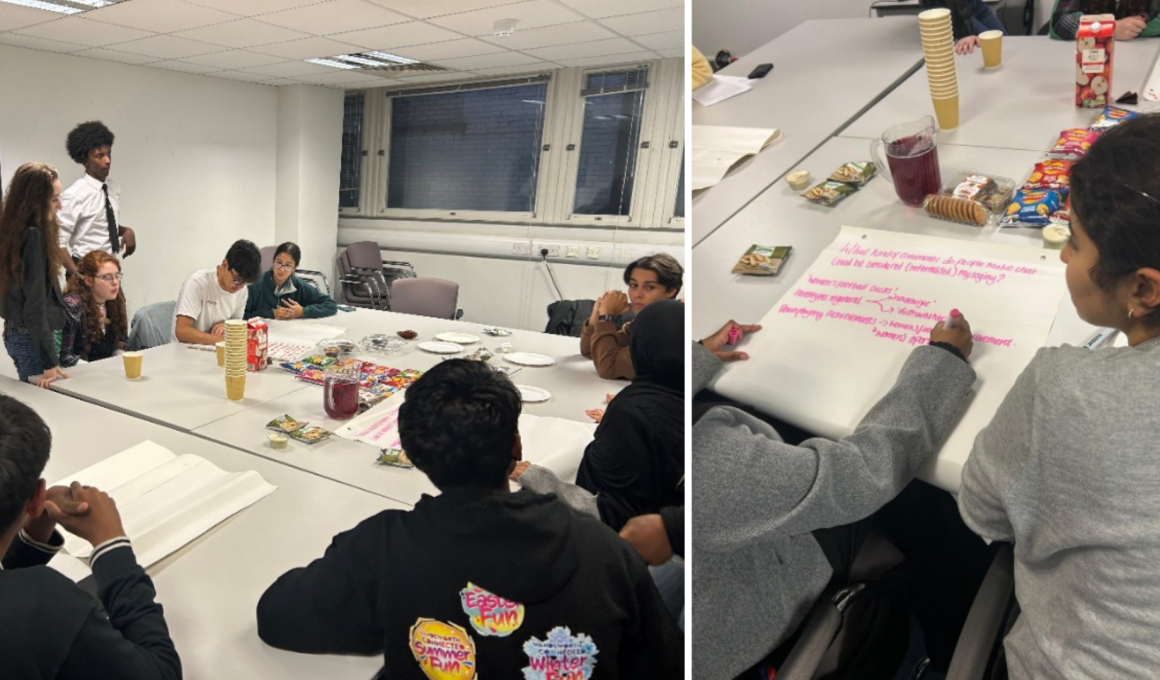
Violence against women and girls does not begin with a punch. It begins in classrooms where misogyny goes unchallenged, in youth groups where girls learn to stay quiet, in the gap between what boys absorb online and what anyone bothers to talk to them about. Wandsworth Council spent four months and consulted 355 people to understand this. On Monday, Cabinet will decide whether to do anything about it.
The process was, by any measure, serious. A cross-party Task and Finish Group, set up in August 2025, visited schools, sat with parent champions, talked to women in refuge accommodation, and brought in the youth council. The question, as chair Councillor Lizzy Dobres framed it, was not how to respond to violence against women and girls but how to prevent it happening in the first place. Prevention, not crisis response. That shift matters.
The young people who came to speak to the committee earlier this month had thought about this harder than most adults. Youth councillor Kwasi described a school environment where misogyny travels through social media in ways that boys often do not even recognise as such. “Loads of young boys specifically don’t realise they’re going down specific misogynistic pipelines,” said Elizabeth, another youth councillor. “It’s making the conversations less of a taboo and less of a feared topic.”
Kwasi pushed back on a councillor’s suggestion to simply ban phones in schools. Young people, he said, needed to learn to challenge what they see online, not be shielded from it. “If we are just cutting off social media, young people lose their access to being curious, being inquisitive and challenging such ideologies.” A youth councillor politely correcting an elected member on evidence and strategy. The irony was not lost on the room.
Why prevention is hard
Mysha Sumer, chair of the VAWG Community Forum and a survivor of domestic abuse, set out precisely what is at stake. “Choosing to focus on prevention isn’t necessarily the easiest option,” she told the committee. “It requires long-term thinking, sustained investment and political courage, but it is the most impactful choice you can make.” She described her own journey from victim to forum chair, a journey that went through a youth space in Tooting. “Every time prevention is delayed, another woman learns to tolerate harm and another girl learns to stay quiet whilst another boy grows up without being taught accountability.”
Georgina Crowley, area manager for Hestia’s refuge accommodation, grounded the discussion in what frontline workers see. Pockets of good practice exist, she said, but they are not joined up. Housing is where survivors often first disclose. “We need all professional responses to be appropriate. This can make a direct impact to someone’s safety and their openness to receive further support.”
Then came the questions that the report could not answer.
Co-opted member Nabila Haroon asked directly: what are “the specific accountable actions, dedicated resources including budget, and measurable outcomes that will move them from proposal to implemented reality?” Dobres was honest. A Task and Finish Group cannot commit resources. What it can do is give Cabinet the best evidence and hope they act on it. The action plan would come after, she said, “given budget and resources available.”
Councillor Will Sweet went further. He had read the report carefully. “I’m struggling to see what is going to be done that’s actually different from what’s already going on,” he said. “Some of the language in the report makes clear that this is about consolidating existing activities rather than doing things differently.” He noted that Appendix 2 measures the themes against eight principles of effective prevention, and concludes that these activities “already apply.” He asked how the council moves from this report “to a really firm list of actions that is different from what’s been done before.”
Dobres did not dispute it. The report is an overview, she said. The specifics come later.
No concrete action
Even the recommendations, when you read them, are written in the language of possibility rather than commitment. Recommendation one says the council should “consider commissioning specialist services.” Recommendation three says it should “explore commissioning ‘by and for’ organisations.” Consider. Explore. Co-opted member Irene Wolstenholme pointed out that the first recommendation is illustrated with the suggestion of making a video. “A video takes what, a month or two to make? A childhood takes ten, fifteen years.”
Cabinet member for Health and Community Safety Graham Henderson was in the room. Cabinet member for Children Judy Gasser was also present. Gasser, towards the end of the meeting, spoke up. “I hear how very important this is to everybody in this room,” she said. She invited the Task and Finish Group to come to Cabinet and tell members exactly what they had heard. “And let’s try and get a real big commitment from the cabinet,” she said, “and if we can find any money, let’s spend some money on this.”
If we can find any money.
The Cabinet paper, published ahead of Monday’s meeting, asks members to “note” the report and approve the three recommendations for further development. It contains no budget commitment. No timeline. No action plan. The action plan, if it comes, will come after Cabinet decides whether to act, and will be shaped by whatever money is available.
The upshot
Three recommendations go to Cabinet on Monday. The consultation they are based on is genuine. The voices that fed into it are powerful. Mysha Sumer, who has been through what this strategy is trying to prevent, put it plainly. Survivors, she said, “don’t just want services that respond well after harm but we want a future where few women and girls ever need those services in the first place.”
That future requires what she called long-term thinking, sustained investment and political courage. Cabinet meets at 7pm on Monday 23 February at the Town Hall. You can watch live at the Wandsworth webcasting portal.



“Every time prevention is delayed, another woman learns to tolerate harm”. The most powerful thing I have ever heard which proves this statement beyond any doubt is a question asked of my niece, who works with female prisoners. These women have often come through the care system, are addicted to drugs, have worked in the sex industry, and are in an abusive relationship. The question was devastating in its simplicity and was “Well what do you do when your husband hits you? ” This was the norm for them. They had been so deprived of love throughout their lives that they did not even question it. START TEACHING GIRLS THEY ARE NOT DEFINED BY A RELATIONSHIP WITH A MAN.