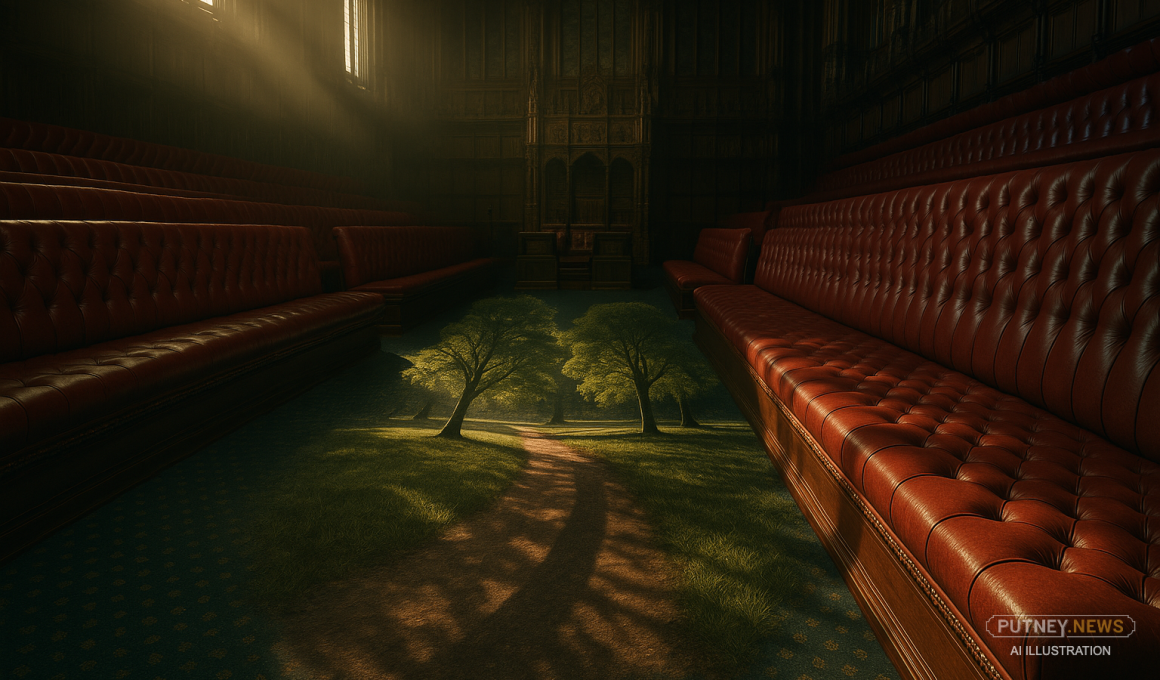
A small line on Monday’s House of Lords order paper could have enormous consequences for public land. Buried among the week’s business is an amendment to the Local Government Act 1972 that would undo a Supreme Court ruling and sweep away long-standing legal duties protecting parks, greens and recreation grounds.
Supporters call it a “clarification.” In reality it would rewrite the law retrospectively, erasing the obligation on councils to hold public land in trust for local people. It would make past transfers that were ruled unlawful suddenly lawful. And it would hand private developers, and the powerful institutions behind them, the comfort of knowing the courts can no longer stand in their way.
At first glance, this might seem like an arcane technical fix. But the timing and sponsorship tell another story. The first name on the amendment is Lord O’Donnell — once the country’s most senior civil servant, now a board member of the All England Lawn Tennis Club. His club’s controversial plan to expand into protected parkland at Wimbledon has been stalled by the very kind of legal restriction this amendment would remove.
He is joined by two eminent KCs: Lord Grabiner, once condemned by MPs for lending “a veneer of establishment credibility” to Philip Green’s BHS empire, and Lord Banner, a newly-minted Conservative peer whose nomination came from Rishi Sunak’s government earlier this year. Banner is best known to most of the public for being escorted off a British Airways flight after an argument about his children’s nanny’s seat in business class – but within legal circles he is regarded as exceptionally able and well-connected.
The amendment that won’t go away
In September, ministers considered and rejected a near-identical proposal, warning it posed “significant constitutional and practical concerns.” Yet six weeks later, it re-appeared – same words, different names, no public consultation. If the government itself did not support the change, who exactly is this for?
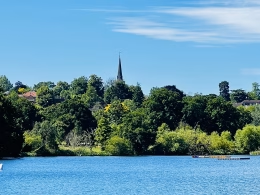
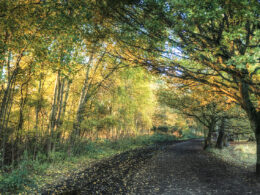
The Open Spaces Society, the oldest conservation charity in the country, has warned that “we could lose many open spaces with recreation rights, with no consultation and no recourse.” That risk is not hypothetical. The land in question is real, visible, loved: the green fields between Wimbledon Park Road and Church Road where thousands walk, play and breathe every week. Once protections go, they do not return.
The House of Lords is supposed to scrutinise power, not exercise it unchecked. Its moral authority depends on restraint — on the idea that expertise is used to defend the public interest, not to serve private causes. When peers with direct or historic links to the beneficiaries of a law use their privileged position to advance it, that line blurs dangerously.
This is not an attack on individuals. It is a warning about culture: a quiet assumption that those born to or appointed into authority know best, and may safely adjust the law when it proves inconvenient. That mindset is precisely what has corroded trust in institutions from Parliament to the police. It is why so many people now believe, with weary accuracy, that the rules are different for the powerful.
Public land is not a technicality; it is a promise. A promise that certain places belong to everyone – not just today’s freeholders or tomorrow’s investors. If Parliament allows the privileged to erase that promise by amendment, it won’t just be Wimbledon’s green that’s lost. It will be something much harder to recover: faith that the guardians of our democracy still remember whom they serve.