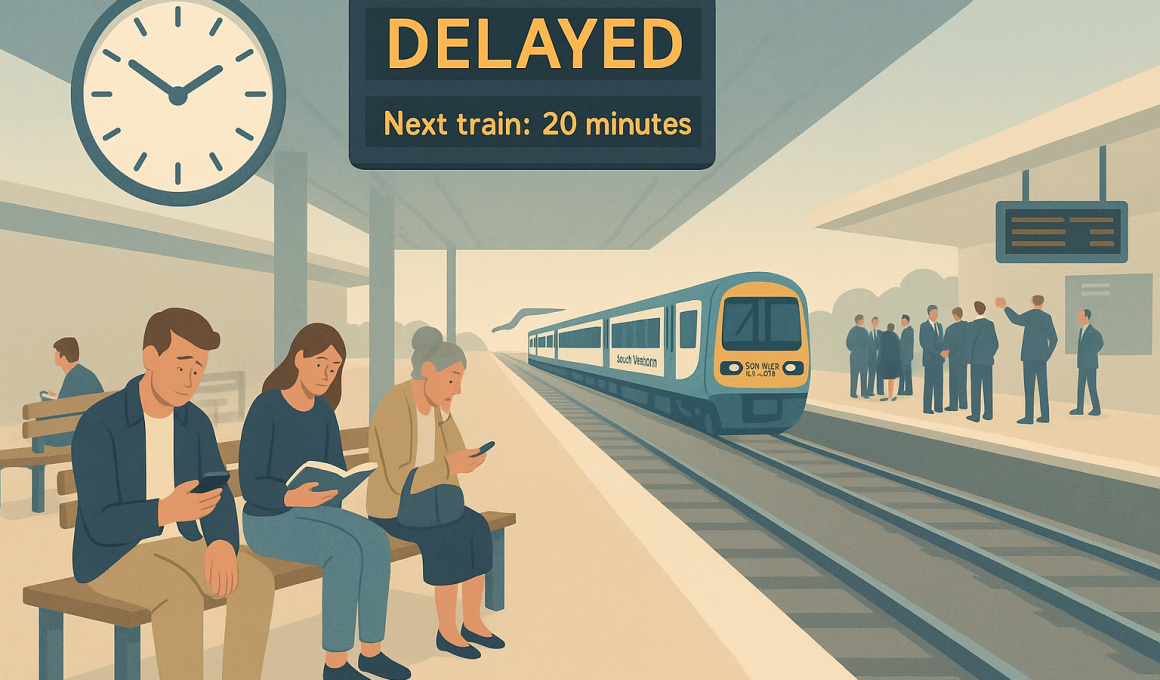
South Western Railway’s performance has dramatically deteriorated since nationalisation in May, with July 2025 recording the worst punctuality and cancellation rates since the chaos of October-December 2024, according to official statistics.
New data reveals that only 83% of trains arrived within three minutes of their scheduled time at Putney station in July, while cancellations soared to 5.6% – matching the worst levels seen during widespread tube strikes and Christmas engineering works.
The stark decline has triggered an unprecedented response from eleven Liberal Democrat MPs collectively covering 60-70% of the railway’s passenger catchment area, who have signed a hard-hitting letter demanding urgent government action.
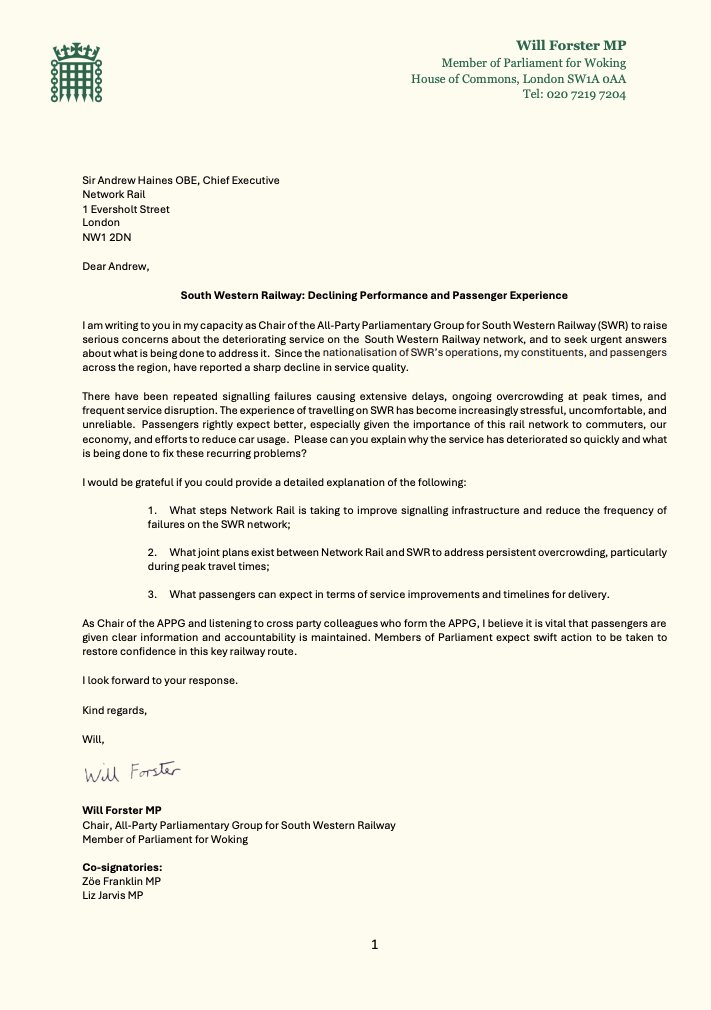
Will Forster MP, Chair of the All-Party Parliamentary Group for South Western Railway, has written to Network Rail Chief Executive Sir Andrew Haines expressing “serious concerns about the deteriorating service” since SWR’s nationalisation on 25 May 2025.
The letter is co-signed by ten other MPs representing SWR’s core commuter routes from Southwest London through Surrey to Hampshire and Dorset – including Guildford, Woking, Twickenham, Wimbledon, and Eastleigh.
Forster highlighted how passengers have reported “a sharp decline in service quality,” citing “repeated signalling failures causing extensive delays, ongoing overcrowding at peak times, and frequent service disruption.” He demanded specific answers on improving signalling infrastructure, addressing overcrowding, and delivery timelines for service improvements.
Performance data tells stark story
The official statistics paint a troubling picture of declining performance across key metrics. Looking solely at Putney station (other parts of the SWR network have significantly worse figures):
Punctuality (Trains arriving within 3 minutes):
- July 2025: 83.0% (worst since December 2024’s 80.0%)
- June 2025: 87.1%
- May 2025: 88.4%
- April 2025: 87.7%
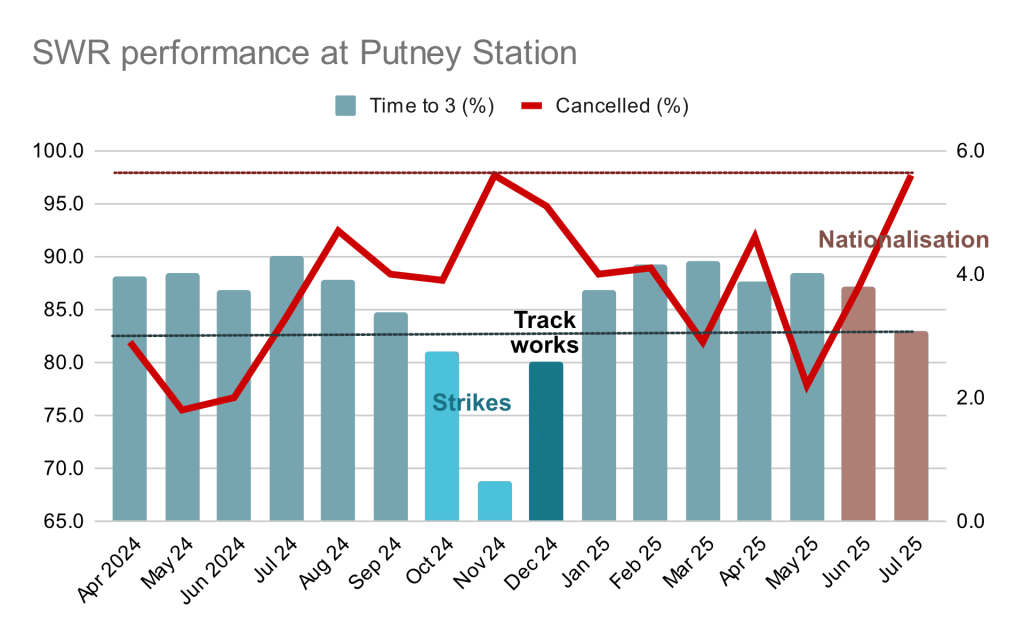
Cancellations (%): Percentage of trains that were scheduled but did not call at the station
Statistics: Government Office of Rail and Road (ORR)
Cancellation Rates:
- July 2025: 5.6% (joint highest on record with November 2024)
- June 2025: 3.8%
- May 2025: 2.2%
- April 2025: 4.6%
The July figures represent the worst combined performance since October-December 2024, when the network was severely disrupted by widespread London Underground strikes that forced commuters onto alternative transport, combined with major engineering works during the Christmas period.
Political divide emerges over rail nationalisation
The deteriorating performance has exposed a stark political divide over the success of nationalisation, with the comprehensive Liberal Democrat response contrasting sharply with Labour MPs’ public messaging.
Most notably absent from the critical letter is Putney MP Fleur Anderson. Instead of joining the parliamentary pressure, Anderson told the Evening Standard that “more trains are coming” to tackle overcrowding, crediting public ownership for progress.
However, Anderson’s claims appear disconnected from operational reality – most of the new Arterio trains won’t serve Putney, none will serve Wandsworth Town, and SWR has actually reduced off-peak services this summer.
Fears of return to “bad old days”
The sharp performance decline has raised concerns that nationalisation may be failing to deliver the promised improvements, potentially signalling a return to the reliability problems that plagued British Rail before privatisation in the 1990s.
South Western Railway became the first operator to be nationalised under Labour’s programme on 25 May 2025, with the government claiming the move would “improve reliability” and reduce “unacceptable delays, cancellations, and waste.”
Transport Secretary Heidi Alexander had promised that public ownership would create “a reliable rail network that puts customers first” and deliver “improved rail performance and reliability.”
However, the latest performance data suggests passengers are experiencing the opposite, with both punctuality and reliability declining significantly in the network’s first two months under public control.
The deteriorating performance validates concerns raised by industry experts when nationalisation was announced. Andy Bagnall, chief executive of Rail Partners, had warned that “simply changing who runs the trains won’t deliver more reliable and affordable services for passengers.”
He argued that “the key to both improving performance and holding down fares is restoring the railway to financial sustainability” rather than changing ownership structures.
Wider Context of Rail Struggles
The performance decline comes as SWR continues to face operational challenges including the delayed rollout of new Class 701 Arterio trains, originally due in service by 2019 but held up by technical faults, safety concerns, and driver training bottlenecks.
The railway has also been implementing service cuts, with the summer timetable reducing off-peak suburban services, while major engineering works around Barnes Bridge at the end of August will further disrupt services with bus replacements.
In his letter to Network Rail, Will Forster emphasised the need for transparency and accountability in addressing the performance crisis.
“As Chair of the APPG and listening to cross party colleagues who form the APPG, I believe it is vital that passengers are given clear information and accountability is maintained,” he wrote. “Members of Parliament expect swift action to be taken to restore confidence in this key railway route.”
The letter is co-signed by MPs Zöe Franklin (Guildford), Liz Jarvis (Eastleigh), Munira Wilson (Twickenham), Paul Kohler (Wimbledon), Edward Morello (West Dorset), Chris Coghlan (Dorking and Horley), Al Pinkerton (Surrey Heath), Luke Taylor (Sutton and Cheam), Helen Maguire (Epsom and Ewell), and Alex Brewer (North East Hampshire).
Collectively that represents virtually all major SWR routes: Southwest London commuter services (Twickenham, Wimbledon, Sutton and Cheam), Surrey’s railway heartland (Woking, Guildford, Dorking and Horley, Surrey Heath, Epsom and Ewell), Hampshire connections (Eastleigh, North East Hampshire), and the West of England main line (West Dorset).
One of the problems with nationalising the rail network is that it immediately pulls the issue into the political arena. Regardless, the letter representing hundreds of thousands of SWR passengers and raises serious questions about whether public ownership can deliver promised reliability improvements.
With c2c and Greater Anglia scheduled to follow SWR into public ownership later in 2025, the early performance of the nationalised South Western Railway will be closely watched as a bellwether for the success of the government’s broader rail renationalisation programme.
For passengers currently enduring deteriorating services, the immediate concern remains whether the promises of improvement will materialise, or if they are witnessing the early signs of a return to the operational problems that historically plagued Britain’s state-run railways.