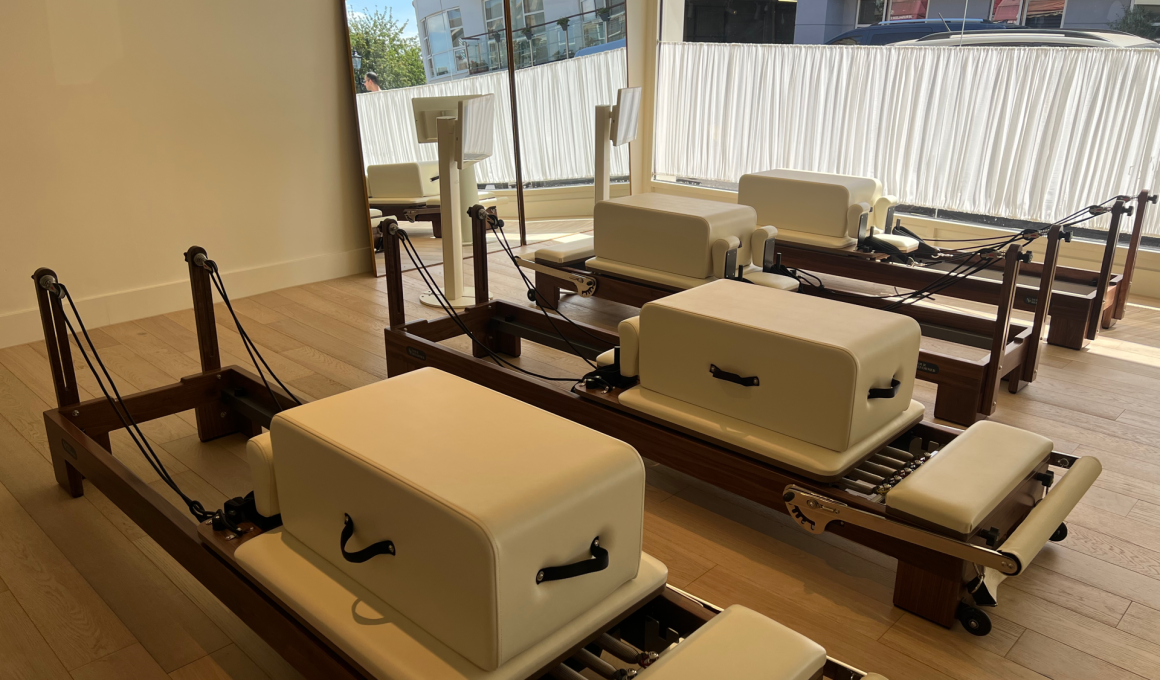
About halfway through the class, lying on the machine relaxed and listening to music piped into the speakers, one leg suddenly started shaking from the strain. Which was odd, because up until now it had felt like gentle exercise in a spa.
“Any injuries… any pain? Good. And first time, right?”
Right. Pilates is something heard I had heard about for years but never done, and with Reformer studios opening up all around Putney – many in shops that had stood empty – when Sculpt House on Lacy Road offered us a place in a beginners’ class, it seemed like as good a moment as any to find out what actually goes on inside.
There was one man in the class. He’s writing this review.
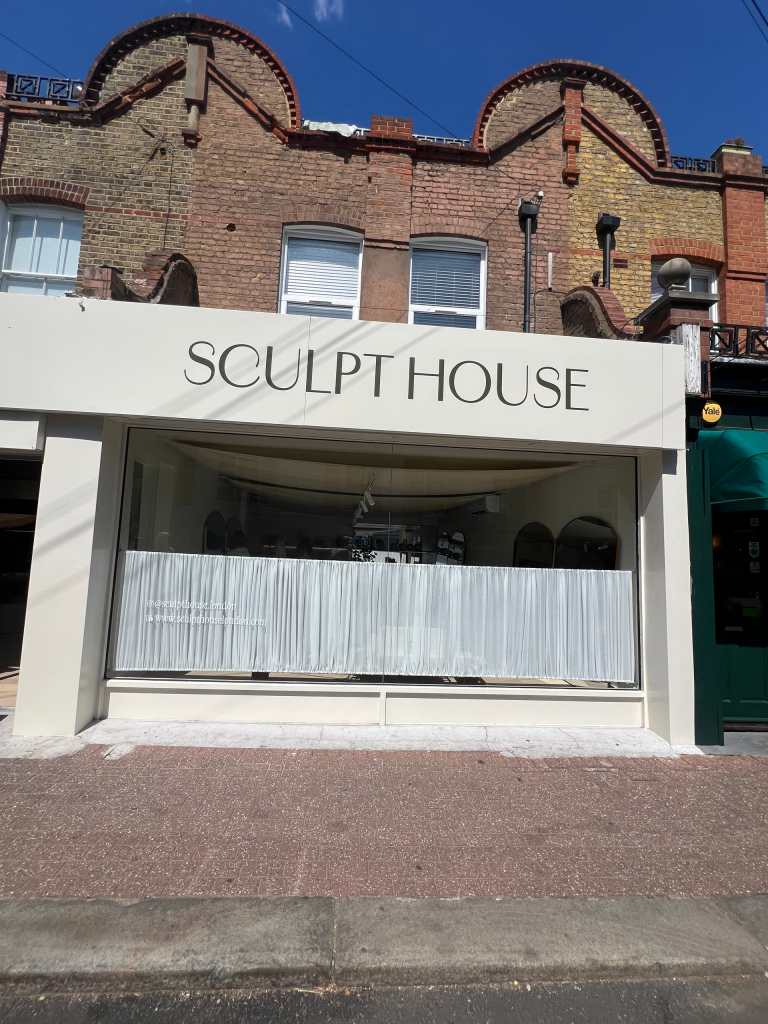
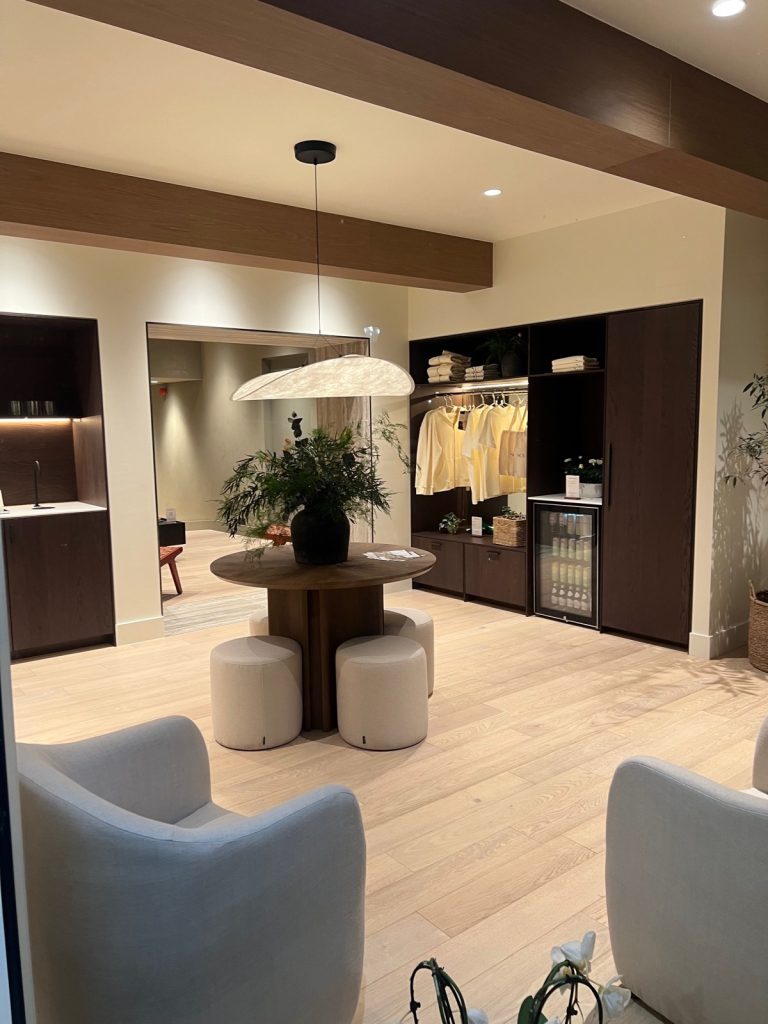
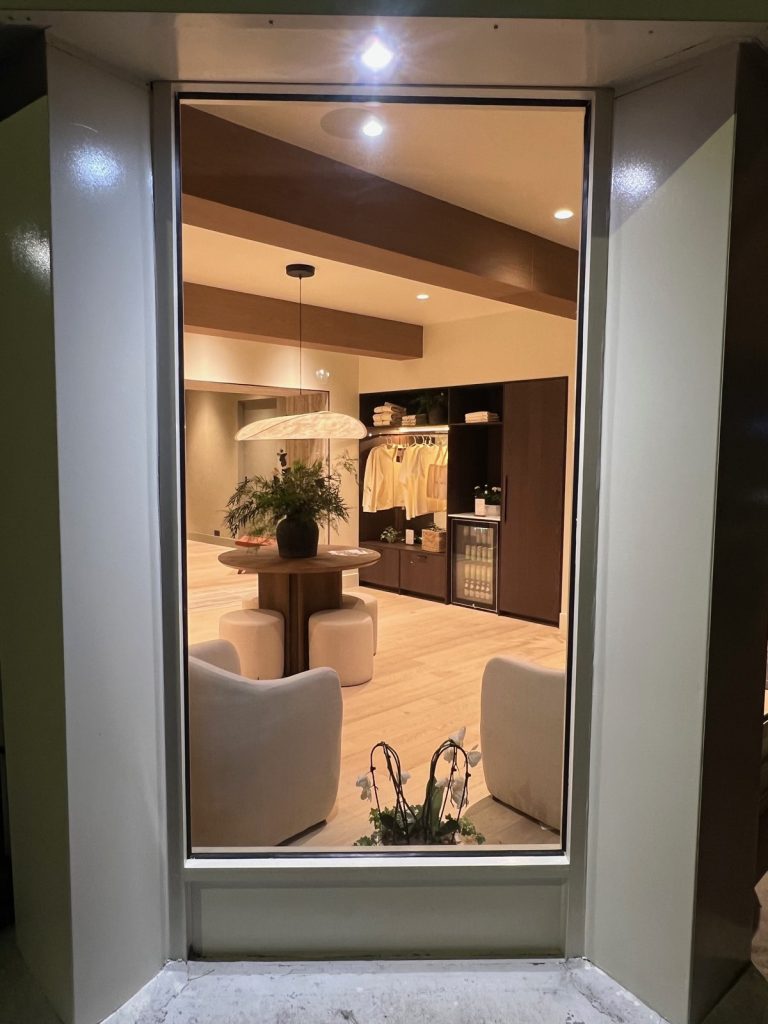
Sculpt House feels less like a gym than an upmarket clothes shop. At the front are Pilates clothes and drinks for sale, seats and lockers. Off to the side and in a different room rest six reformers, leather carriages in wooden frames, with drapes hanging from the ceiling. Once the class begins, the door is locked. The instructor, Marti Kapron, starts with a tour of the machine.
“So you’ve got the springs. This is the yellow, then the blue and the red.”
A reformer is a padded carriage that slides along rails, held back by springs, yellow the lightest and red the heaviest. There is a bar for the feet and straps with loops for hands and feet. These machines were once prohibitively expensive, specialist equipment; factories in China now make them for a fraction of the price of the big Western brands, which may help explain why they are suddenly everywhere. These machines are not the cheap ones.
Sculpt House opened in August in what was Kashmir restaurant, a unit that had stood empty for more than a year. Another reformer studio has opened at 214 Putney Bridge Road, and a sticker in the old EE shop on Putney High Street says the American chain Club Pilates is “Opening this fall”. They join Studio Pilates on Upper Richmond Road and the reformer room at the Fitness Exchange gym in Putney Exchange. Another has just opened in Southfields on Erpingham Road. The classes are not cheap: £34 each here.
“Two reds and a blue.”
The springs go on, and springs are where Pilates began, or so its inventor said. Joseph Pilates, a German boxer and circus performer, was living in Blackpool when the First World War broke out, and spent much of it interned at Knockaloe, a camp on the Isle of Man that at its height held 23,000 men.
There, by his own account, he began working out a system of exercise he called Contrology. In his 1945 book, Return to Life Through Contrology, he described it as “complete coordination of body, mind, and spirit”: a way to develop the whole body evenly, correct poor posture and restore vitality, built on correct breathing and a flexible spine.
Later in life he spoke of working in one of the camp’s hospitals and using the springs from its beds to build early versions of this machine. In 1926, with the war over, he sailed for New York, where he and his partner, Clara, ran a studio for more than 40 years.
His contacts in the dance world brought dancers through the door, among them the choreographer Martha Graham. After his death in 1967, his students opened studios of their own and modernised the machines. It is now practised by millions and has become a multi-billion dollar industry. It has been the most booked workout in the world for three years running, with reformer classes the favourite. One of his last surviving students, John Howard Steel, thinks he knows why: most of us now spend our days sitting in offices and confined spaces, and Pilates had worked out how to use a body with no room to move.
“Close your eyes and take deep breaths into your nose.”
Eyes closed, the mind wanders. Nobody is competing. There is none of the sweat and noise of a gym. It’s an oddly peaceful workout.
“If you would rather not be touched, you can give me a little wave.”
A couple of times Marti corrects a position with a small twist, and each time you can feel the muscle she was after.
“Both heels lift, all the way up, like wearing high heels.”
For a man, it can feel a little like walking into somebody else’s space. Everyone else knows the language. A “Pilates V” turns out to mean heels together, toes apart; the trick is to watch the others and follow. Much of the work is on the hips and the core. Some of the women said they had been trying to persuade their husbands to come along. One had agreed, then backed out at the last minute.
Some of it is gentle enough that you wonder about asking for a heavier spring. Not for long.
“Feeling the glute activating, lift and lower.”
In Pilates, it seems, glutes are not worked so much as activated. Lying on one side, a strap around the upper thigh, you lift the leg, circle it and pulse it, again and again, and the meaning soon becomes clear. This is where the leg starts to shake.
“Don’t worry, you will feel it tomorrow even more.”
The prediction is half right. After a bath, the next morning was fine. The ache came the day after, the kind that follows a long day of DIY, in muscles you forget you have.
“I know. Stay with me.”
That is the plank, hands on the platform, knees hovering, the carriage sliding out and back beneath you. It does to the stomach what the leg work did to the thigh.
“If it’s hurting, it’s working.”
The sun is out, the room is warm, and Marti apologises that there is no shade to offer.
“No more hard work to do.”
The stretches. Lying back, soles of the feet together in a butterfly stretch, it is easy to see the appeal: low-impact, meditative exercise that reaches muscles you do not normally use, for anyone, men included. There is little cardio, it is not cheap, and it would be more enjoyable with someone you know but the overall sensation is that you’ve done your body some good.
“You all did amazing today… especially first timers.”
Then the door is unlocked, and it is back out onto Lacy Road, refreshed and tired at the same time. It was oddly satisfying to experience a gentler form of exercise. The benefits are said to accrue; this reviewer is still thinking about booking a second session. A niggle in my left hip that flares up occasionally, especially when sat all day in front of the computer, has gone. It would be nice to banish it forever.
Try it
- Where
- Sculpt House, 18 to 20 Lacy Road, SW15 1NL.
- Which class
- Foundation Reformer, for people new to the machines. Classes last 50 minutes, with six people at most.
- Cost
- £34 a class.
- Good to know
- Arrive 10 to 15 minutes early, as nobody is let in once a class has started. Ages 16 and over.
Putney.news was a guest of Sculpt House and did not pay for the class.