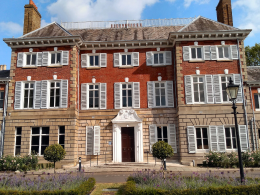
Two schoolgirls from Emanuel School in Battersea have turned the heat from rotting food waste into electricity, winning third place nationally for their homemade prototype.
Daniela and Amélie, both 15, built a working device that generates enough current to power a lightbulb, using only the heat given off by decomposing food. Their project, Rot-to-Watts, placed third in the Institute of Physics’s Eurekas competition. Entries came from schools across the UK and Ireland.
‘We just thought about how much food we waste on a daily basis and tried to find ways to utilise it, instead of just letting it rot,’ said Daniela. ‘That’s when we came up with the idea to use physics and different electrical components to solve our problem. I really enjoyed the practical aspects too, and I’ve learnt so much about compost and sustainable food waste through our research!’
The device works by placing thermoelectric generators directly into hot compost, which reached temperatures of 49 to 71 degrees Celsius during testing. The generators convert the difference between the compost’s heat and the surrounding air straight into voltage, with no battery or mains power involved.

Eureka!
Turning compost heat into electricity isn’t a new discovery. Researchers built a similar system in 2018, published in the journal Applied Thermal Engineering, generating more than 11 volts from a compost pile using the same principle. What impressed the judges wasn’t new physics but how well the pair applied it. The Eurekas is judged on relevance to the competition’s question, originality and creativity, technical quality, and whether the entry reflects the spirit of the campaign. A working device that actually generates power sets Rot-to-Watts apart from many past winners, who have tended to explain physics through art, video or writing rather than build something that works.
‘We’re so excited to have won third place! I can’t believe it, especially since so many people took part,’ said Amélie. ‘We both also really care about the environment and it’s brilliant to show how energy for our lights and charging can be done sustainably, especially as this will matter so much more in the future!’
Daniel Martin, the school’s physics teacher, said the pair had ‘shown an impressive level of dedication in researching and building their energy-conversion prototype,’ adding: ‘They really do give you a lot of hope for the physicists of tomorrow.’
Sarah Bakewell, Head of Diversity and Inclusion at the Institute of Physics, called it ‘a sensational Eureka moment,’ adding: ‘Amélie and Daniela showed that they clearly understood the physics behind this innovative idea, and that physics solves real world problems.’
Past winners give a sense of how varied the competition can be. In 2022, four Year 8 pupils at Avanti Fields School in Leicester won with a cake baked in the shape of a cochlear implant, explaining the physics behind the hearing device. Runners-up that year included a video on solar power and a piece of art exploring the physics behind a pair of glasses. In 2024, David from Chellaston Academy in Derby won for The Mystery of the Atom, and last year’s winner, Amelia from Adamstown Community College, took the prize for a project called Through Another’s Eyes.
Daniela and Amélie say the idea could extend beyond the classroom, from emergency lighting to charging devices or powering weather monitors, though the prototype remains a demonstration rather than a ready-made product.