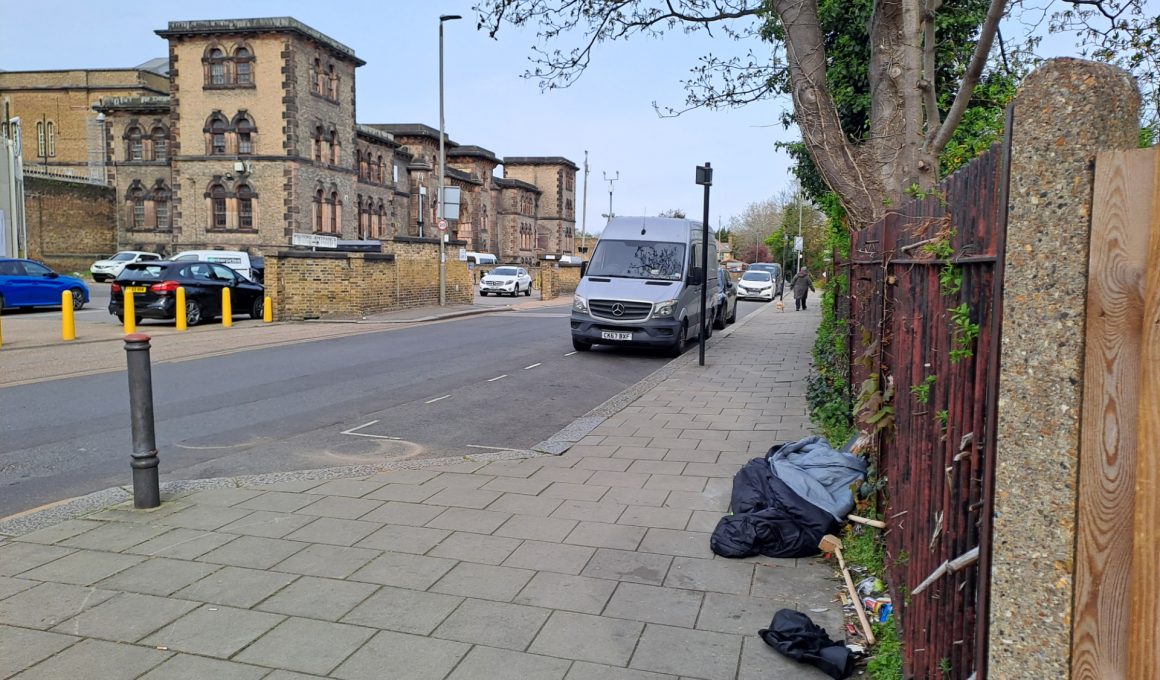
Rob Alford has been sleeping on the pavement outside HMP Wandsworth for about four weeks. The sleeping bag he is using was donated to the prison by a charity that supplies them knowing men will be released with nowhere to stay.
Mr Alford was released on bail. Bail carries no probation officer, no statutory supervision, no allocated accommodation. He came out with nothing.
A different man, released from the same prison a year earlier, died 13 days after he walked out. The Prisons and Probation Ombudsman published its report into Alexander Boy’s death last week. The findings are unusual for the series of HMP Wandsworth reports we have covered: this time, the prison did almost nothing wrong.
Mr Boy was 30. He was released on 31 March 2025 after serving three months for assaulting an emergency worker. He had been diagnosed with schizophrenia and was prescribed an antipsychotic. He had a history of alcohol use linked to his offending. Before release he was placed in temporary accommodation, referred to drug and alcohol services, and assigned a probation officer.
There was one error. The contractor who fits electronic monitoring tags fitted Mr Boy with a GPS tag rather than the alcohol monitoring tag his licence required, apparently mixing him up with another prisoner. Mr Boy noticed the mistake himself. His probation officer corrected it the same day. The tag fitting service is outsourced; the contractor is not a prison employee.
No mistakes this time, just tragedy
What followed was, by every measure the Ombudsman applied, what is supposed to happen. On 2 April Mr Boy reported to his probation officer that he had registered with a GP, was taking his medication, and that his mental health was “really well”. On 8 April he took a drug test. He told his officer that alcohol, not drugs, was his issue, and that he was sober. He spoke about the effect of sobriety on his life and his relationships. The next day he had a job interview lined up, with another later that week.
The drug test came back negative. By the time the result arrived, Mr Boy was dead. Police found him at his temporary accommodation on 14 April, after neighbours raised the alarm. He had died the previous day. Drugs were in the property. The post-mortem recorded acute cardiac failure caused by cocaine toxicity. An inquest concluded on 10 December 2025 that this was a drug-related death.
The Prisons and Probation Ombudsman, Adrian Usher, said in his report that he was “satisfied that probation staff engaged appropriately with Mr Boy and did all they could to support his substance use issues”. The report makes no recommendations to anyone. It contains a single note to the Governor of HMP Wandsworth, asking him to “ensure” appropriate quality assurance is in place for tag fitting. That is the only finding for the prison to act on.
The 14-day window
Days after release from HMP Wandsworth
Sources: Prisons and Probation Ombudsman report into the death of Alexander Boy, published 30 April 2026; account of Rob Alford’s situation via Mark Lawry, Wandsworth Prison Improvement Campaign, who has spoken with Mr Alford.
Fortnight factors
The Ombudsman investigates post-release deaths because the first fortnight after a man leaves prison is the most dangerous. The current policy was introduced in September 2021, after a one-year pilot established the scale of the problem. The PPO has since reported that homelessness on release is a significant factor in these deaths: nearly a third of the people who died within two weeks of release were homeless when they came out.
That is why Alexander Boy’s death triggered an investigation. Day 13 fell inside the window. The Ombudsman read his prison file, his probation file, and his medical records, and concluded that nobody had failed him. He had a flat. He had support. He had a future he had begun to talk about. Then he used cocaine and his heart stopped.
Rob Alford is on day 35. He is past the window. There is no mechanism to investigate what happens to him.
The man on the pavement
The account of Mr Alford’s situation comes from Mark Lawry, who chairs the Wandsworth Prison Improvement Campaign (WPIC) and has spoken with Mr Alford. We have not yet been able to reach Mr Alford directly. He has consented, through Mr Lawry, to being named.
According to Mr Lawry, Mr Alford was sleeping rough outside the prison for several days after his release on bail. He was then assaulted seriously and admitted to St George’s Hospital, where he was treated for major trauma over about two days. On the evening of Sunday 27 April, Mr Lawry says, Mr Alford was discharged, transported by hospital vehicle, and left at the gate of HMP Wandsworth. He had no painkillers. He was given a discharge pack and told to return to hospital the next day.
“He had not even been given any painkillers, despite being in very significant pain,” Mr Lawry wrote, in an email forwarded to Putney.news. “He was left with a pack from St George’s dealing with major trauma which I have seen. It included a leaflet headed words to the effect of, ‘What to do when you get home after major trauma.’ The fact that he didn’t have a home, let alone anyone to look after him, didn’t seem to matter.”
Mr Lawry says he gave Mr Alford money for the bus back to hospital the following day. Mr Alford did not make it. He was, in Mr Lawry’s account, in too much pain to travel.
The sleeping bag is from the Wandsworth Prison Welfare Trust, the charity run by Liz Bridge, which supplies them to the prison for men who walk out with nowhere to go. “The prison requests a supply of sleeping bags,” Mr Lawry says, “in the full knowledge that many men will be released with nowhere to stay.”
This last point is Mr Lawry’s characterisation. What is not in dispute is the sleeping bag, the pavement, and the brick wall behind him.
The distance between them
The Ombudsman’s report into Alexander Boy is the first in the recent series of Wandsworth investigations to find that the prison did its job. It is also the most quietly devastating. Mr Boy had everything the system can give a man on release: a flat, a probation officer, a referral to drug services, a job interview. The system gave it to him. He died anyway.
Mr Alford has none of that. He was not on licence; he was on bail. The 14-day window has closed around him without anyone opening a file. The distance between Alexander Boy and the man on the pavement outside the prison is not a difference of policy or institutional intent. It is 14 days, and the presence or absence of a probation officer.
If you are affected by anything in this article, Samaritans are available 24 hours a day, 365 days a year. Call free on 116 123, email jo@samaritans.org, or visit samaritans.org. Mind, the mental health charity, runs an information line on 0300 123 3393 (Monday to Friday, 9am to 6pm).
If you or someone you know has been released from prison and needs housing help, Shelter offers free advice on 0808 800 4444. St Mungo’s works specifically with people leaving prison and rough sleeping in London (mungos.org).