

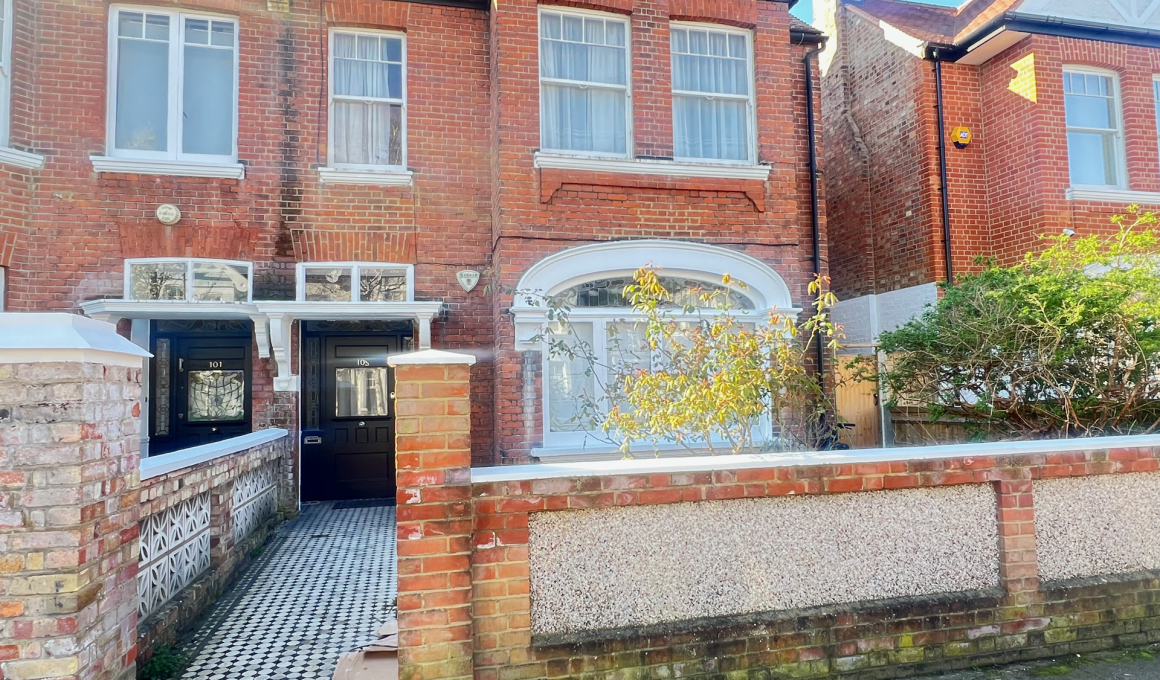
Wandsworth Council wants to convert a first-floor flat it owns in a Putney conservation area street into a five-bedroom home for nine people. The living space proposed (kitchen, dining room and sitting room combined) is 23.3 square metres. The legal minimum is 37 square metres. The current application attracted 61 objections before its consultation closed yesterday.
It is not the council’s first attempt. It applied for an almost identical conversion in July 2025, attracted 74 objections from 47 addresses – virtually the entire street – and withdrew the application before a decision was made. No explanation was given.
The revised application (2026/0626) was registered in February. There is a single person in support.
What changed between the two applications? The rear windows are now wood rather than plastic (it’s a conservation area), the ridge was raised 20cm, and the dormer was set back 50cm from the eaves. What did not change: the five-bedroom, one-bathroom layout on the first floor; the cramped loft living space; the absence of any outdoor amenity; and the decision not to commit in writing to single-family use.

What nine people would actually live in
Clarendon Drive is a Victorian terrace, and that matters structurally. A neighbour who has lived on the street since 1997 told the planning portal that similar loft conversions on this stretch of the street have historically cost in excess of £100,000 because of the characteristically low roof pitch. Independent analysis submitted by the planning consultancy HGH, instructed by the ground-floor leaseholder, found that only 46% of the proposed space would meet the 2.5-metre minimum ceiling height. The required proportion is 75%.
The Putney Society, which objected to both applications, noted that for dwellings of five or more bedspaces, two living rooms are required and outdoor space is mandatory for family homes with three or more bedrooms. The scheme provides neither. Fire safety submissions described a single staircase and a single front door as the only escape route for all occupants.

The HMO question
The layout objectors have consistently described the design as “upside-down” with all bedrooms on the first floor and communal space above in the loft – and this forms the core of the legal challenge.
JMW Solicitors, acting for the ground-floor leaseholder, served a formal Letter Before Action on Wandsworth Council on 25 September 2025. The letter cited three potential breaches of the lease: use of the property other than as a “private dwelling house” under Clause 1 of the Third Schedule; breach of the covenant of quiet enjoyment under Clause 4(a); and structural alterations carried out without written consent under Clause 3(c).
The council has not formally responded to that letter in nearly six months.
The council’s Heritage, Design and Access Statement for the revised application states: “There will be no change of use, and the property will not be used as a House in Multiple Occupation (HMO), addressing concerns raised in a previous planning application.” But while the statement appears in a planning document, it is not a legal commitment.
No planning condition requiring single-family use was offered, and when objectors asked the council to provide a legally binding undertaking that 103B would not be used as a House in Multiple Occupation – i.e. not as flats – the council declined.
The council’s Public Transport Accessibility Level for the site is rated 3 on TfL’s scale. Wandsworth’s Local Plan policy LP29 requires a PTAL of 4 or above for HMO use.
The policy consistency question
There is another inconsistency too: an application by the ground-floor leaseholder to extend their space was refused by the council, citing three planning policies: LP1, LP3 and LP5 of the Wandsworth Local Plan 2023, as well as Section 72(1) of the Planning (Listed Buildings and Conservation Areas) Act 1990.
The refusal notice stated that the proposed extension would be “an unduly dominant addition that would fail to maintain subservience to the host property” and would cause harm to the character and appearance of the Landford Road Conservation Area.
Those same policies now govern the council’s own application for the floor above – and the street points out it fails under them too.
No officer’s report or decision notice for either of the council’s applications has yet been published; neither application reached determination. The Putney Society’s submissions noted that recent planning decisions have established a benchmark dormer setback of approximately 400mm from the eaves, and that this standard should apply equally to the council’s own schemes. The revised application improved the setback to 500mm. The space standards remain unmet.
Both applications were filed under the Regulation 3 procedure, which applies when a council submits a planning application for its own development. Under this procedure, the council is simultaneously the applicant, the freeholder of 103 Clarendon Drive and the planning authority determining the application.
Who is objecting and why
The objections came from virtually every address in the street, from a professional planning consultancy, from JMW Solicitors submitting 116 paragraphs, from an ARB-registered heritage architect who hand-delivered her letter after the planning portal kept rejecting it, from a structural engineer detailing fire safety failures, and from the Putney Society. One objector submitted a single full stop.
One intended purchaser of the ground-floor flat withdrew from the sale after due diligence flagged the application. The previous tenant of 103B, who had lived there for over 30 years, moved to a care home in August 2024. The flat has been vacant since.
Wandsworth’s own Housing Needs Assessment, published in December 2024, identifies that approximately 70% of affordable housing need in the borough is for two and three-bedroom properties. The council’s scheme at 103B would create a five-bedroom unit.
Cllr John Locker, the Thamesfield ward councillor, is referenced in the planning record as being in communication with objectors about whether the application might be referred to the Planning Applications Committee for a public decision rather than being determined by a delegated officer. No committee date had been set as of the time of writing.

What the council was asked
Putney.news has written to the council’s press office and planning department with five questions:
- Why has the formal Letter Before Action served on the council in September 2025 not received a formal response?
- Why did the council decline to provide a legally binding undertaking that 103B would not be used as an HMO?
- How does the council address the policy consistency point: LP1 and LP5 were used to refuse the ground-floor leaseholder’s extension, and the same policies now apply to the council’s own scheme above?
- Does the council consider the proposed dwelling meets the National Described Space Standards, and will the application be referred to the Planning Applications Committee?
- Given that the council’s own Housing Needs Assessment identifies 70% of affordable need as for two and three-bedroom properties, what is the policy justification for a five-bedroom conversion at this location?
This story will be updated if a response is received.

What happens next
Progress on the application can be tracked on the Wandsworth Planning Explorer at planning.wandsworth.gov.uk. No date for a decision has been set.
Residents can contact the planning department with any further representations. The planning reference is 2026/0626; the department can be reached on 020 8871 8319.
The Thamesfield ward councillors who represent this area are Cllr Ethan Brooks (cllr.e.brooks@wandsworth.gov.uk), Cllr James Jeffreys (cllr.j.jeffreys@wandsworth.gov.uk) and Cllr John Locker (cllr.j.locker@wandsworth.gov.uk). Fleur Anderson is the local MP; residents can contact her office via fleuranderson.co.uk.


