

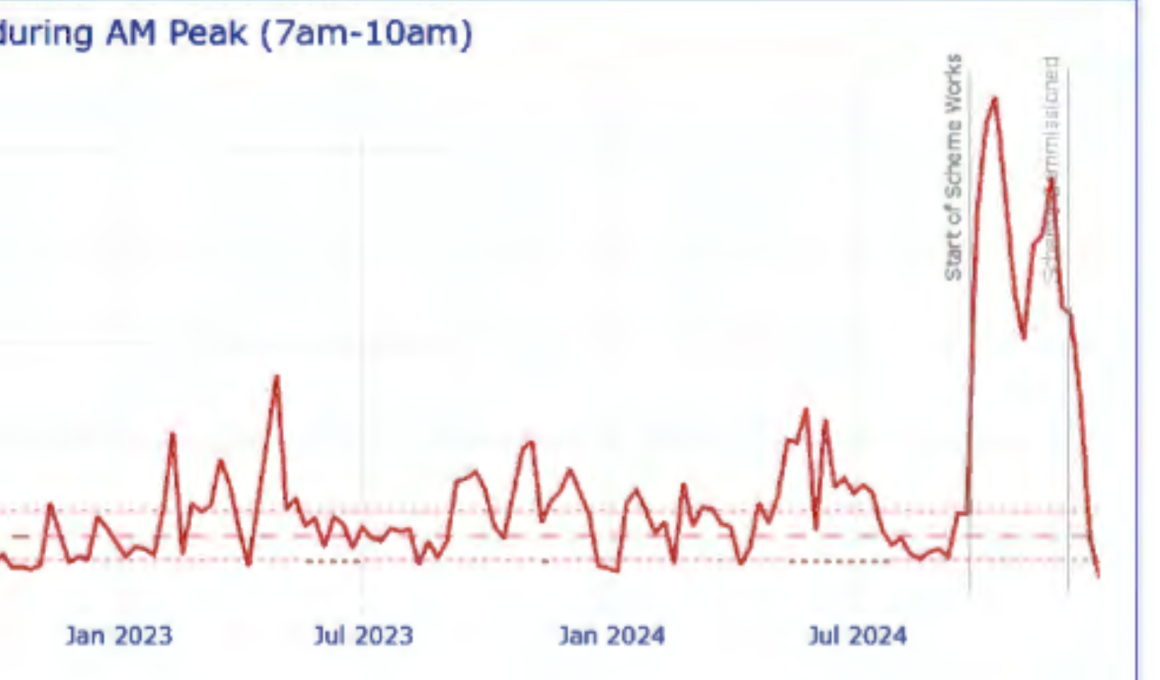
Data obtained by Putney.news reveals what Wandsworth Council’s committee papers won’t tell residents: five years of stable journey times were destroyed when the council redesigned Putney Bridge junction in late 2024, and journey times are now at least double what they were before the redesign, despite £1m spent on the junction.
Transport for London (TfL) charts covering January 2019 to December 2024 show bus journeys on Lower Richmond Road averaged around 5 minutes throughout that period, fluctuating within a stable baseline range except during pandemic lockdowns. Then the junction changes happened. Journey times spiked dramatically, often going over 25 minutes: five times the norm.
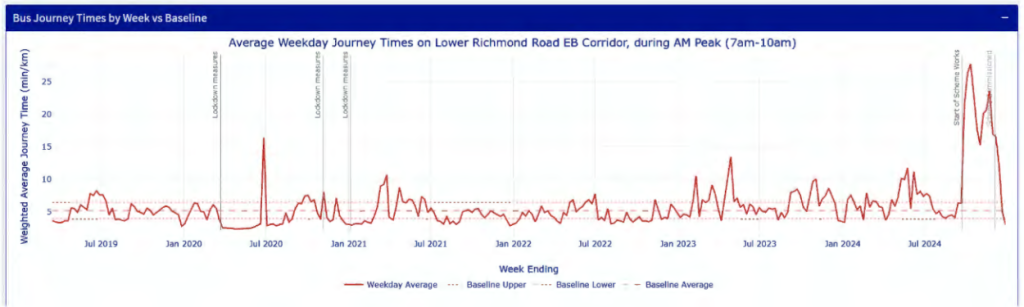
The council’s own paper to Wednesday’s Transport Committee admits buried in Appendix 3: “The AM peak journey times remain above the 23/24 baseline.” But the committee paper compares only June 2025 with November 2025, both after the disaster, claiming “improvement” without revealing they’re measuring between two snapshots of failure.
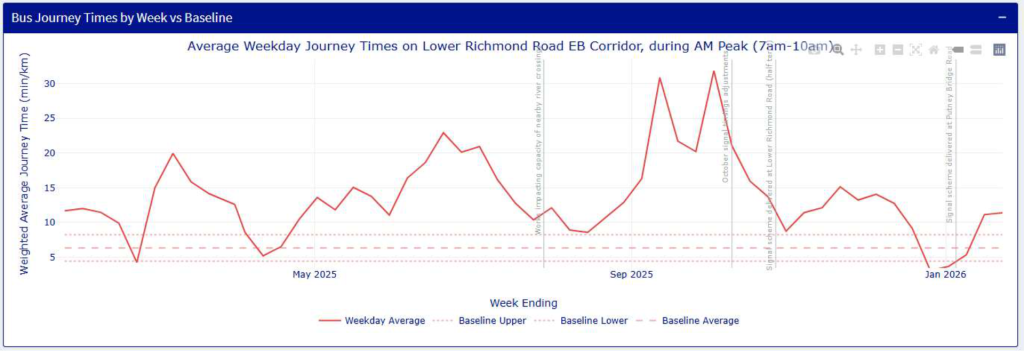
The charts include three horizontal lines that are timing baselines that buses have largely stayed within for the previous five years.
The new charts show that the only time previous norms have been reached since the new junction was introduced have been during school holidays and at Christmas – when buses times are at their lowest.
More importantly, changes to traffic light timing – which the council’s assistant head of engineering has admitted is the most we can expect to get out of the junction point on Lower Richmond Road – may have improved the situation but average journey time is still more than double what it was before the junction was redesigned.
That context is entirely missing from the Transport Committee papers this week.
The charts show bus times and the example we have highlighted is from Lower Richmond Road, although other charts show the same pattern. We don’t have the car traffic data because Wandsworth Council has refused to provide it, claiming it would release the information at the end of January – 10 days ago. It has not done so.
We received the bus data through a Freedom of Information request sent to TfL: the charts were within a presentation sent to Putney MP Fleur Anderson in October 2025; part of an 82-page document that was itself one of 30 documents sent in response to our request.
The five-year evidence the council won’t show you
The TfL data shows the same pattern on every corridor approaching Putney Bridge: baseline stability from 2019 to 2024, followed by catastrophic increases when the junction was redesigned.
Putney High Street northbound in the morning peak: ~10 minutes baseline for five years. Late 2024: spiked dramatically as scheme construction began.
Lower Richmond Road eastbound in the morning peak: ~5 minutes baseline for five years. Late 2024: spiked to over 25 minutes, a 400% increase.
Putney Bridge Road westbound in the morning peak: ~6 minutes baseline, volatile but mostly within range. Late 2024: spiked to over 25 minutes.
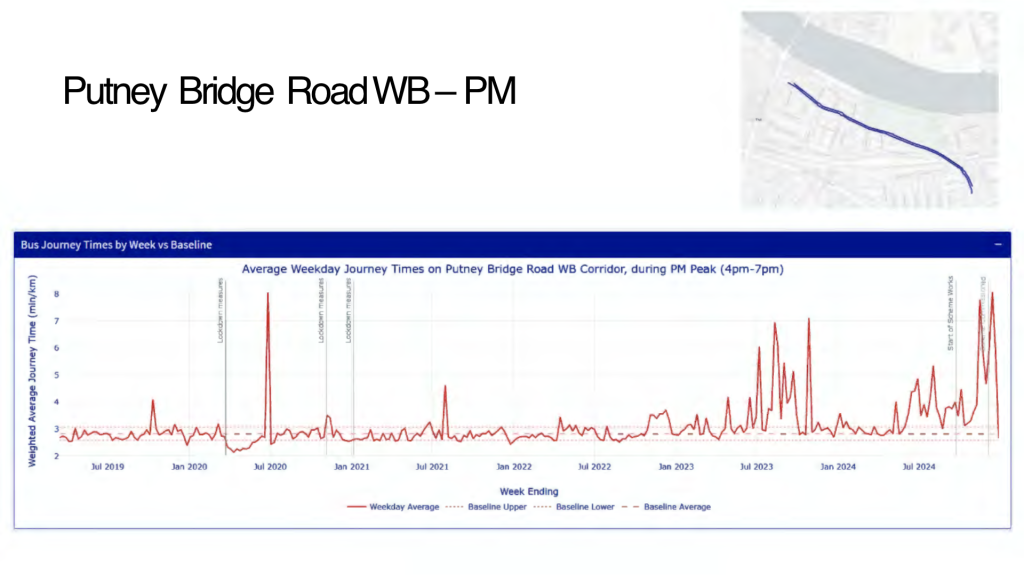
The charts end at week ending 27 December 2024, just as the junction redesign completed. Yet in February 2026, the council’s own Appendix 3 admits: journey times on these corridors remain above the 2019/20 baseline. Fifteen months of “fixes”, costing over £1 million, have not restored what existed before.
TfL’s summary of its own data, prepared for the Bus Taskforce, is explicit:
“Increased journey times seen during the works phase of the Putney High Street scheme from 23/09/24 to 5/12/24. Largest increases seen northbound on Putney High Street, southbound on Putney Bridge in the PM, Lower Richmond Road eastbound in the AM and Putney Bridge Road westbound in the AM.”
The transport authority admits the scheme caused the problem. Yet neither TfL nor the council have presented this five-year baseline to residents or councillors.
The modelling that doomed Putney
The junction redesign was based on traffic data collected at two terrible moments.
Initial surveys were conducted in October 2019, six months after Hammersmith Bridge closed in April 2019, capturing displaced traffic patterns rather than normal conditions.
When TfL demanded revalidation due to prolonged design processes, new data was collected in July 2021, just as “Freedom Day” lifted work-from-home guidance but before any return to normal working patterns. The July 2021 snapshot captured a phantom traffic pattern that never stabilized.
Yet this data, collected under pandemic conditions when nobody knew what “normal” would become, was used to model a junction that wouldn’t open until December 2024. Adding to the miscalculation, the modelling assumed Hammersmith Bridge would reopen by 2026. It hasn’t.
Council analysis now shows Putney traffic volumes crossing Putney Bridge in 2024 were actually lower than in 2018, before Hammersmith Bridge closed. Some 37,313 vehicles crossed daily in 2024 compared to 42,498 in 2018, a reduction of over 5,000 vehicles per day.
The junction was designed for traffic conditions that no longer existed, and then it failed even under lighter-than-expected demand.
What the committee paper hides
The council’s Appendix 2, prepared by consultants AECOM, compares journey times between June 2025 and November 2025. The presentation shows “improvement”, coloured charts with arrows pointing downward.
But June 2025 and November 2025 are both after the junction broke. Measuring improvement between two states of failure tells you nothing about whether the problem is actually solved.
The council had access to TfL’s five-year baseline data. TfL produced charts comparing 2024 journey times to the 2019/20 baseline for its Bus Taskforce. The data was sitting there. The council chose not to use it.
Instead, residents and councillors receive a comparison designed to show progress without revealing the scheme’s fundamental failure: it destroyed years of stable journey times and hasn’t restored them.
The signal timing trap
Even the emergency fixes reveal why this can’t be solved through minor adjustments.
Putney Bridge Road’s green time was increased from 16 seconds to 25 seconds per cycle, a 56% increase that sounds dramatic. Yet it produced only a 3% improvement in journey times during the morning peak, from 422 seconds to 410 seconds.
The reason is geometric. A 104-second traffic light cycle allocates 25 seconds to Putney Bridge Road traffic and 43 seconds to Putney High Street northbound at the same junction. Putney Bridge Road gets the green light for less than a quarter of the time.
During the other 79 seconds, queues build. When the light finally turns green, 25 seconds isn’t enough to clear them. The queue grows across cycles, creating the 6-minute-50-second wait that drivers now experience.
Putney High Street northbound, the route the council and TfL prioritized, gets 43 seconds per cycle. Yet its journey times also remain above the pre-scheme baseline.
The fundamental problem isn’t signal timing tweaks. It’s that the junction design removed capacity without adding sufficient new capacity elsewhere to compensate.



This is a disgrace and this morning (10th Feb) was the worst I’ve seen in 30 years as a resident. Not helped by the fact that recycling collection now seems to happen from 7.30am in my area, so roads (like Fawe Park Road) are also now completely congested. I used to think that the traffic in Bamgalore was bad….Putney, hold my beer! Something needs to be done, but I am not holding out any hope.