

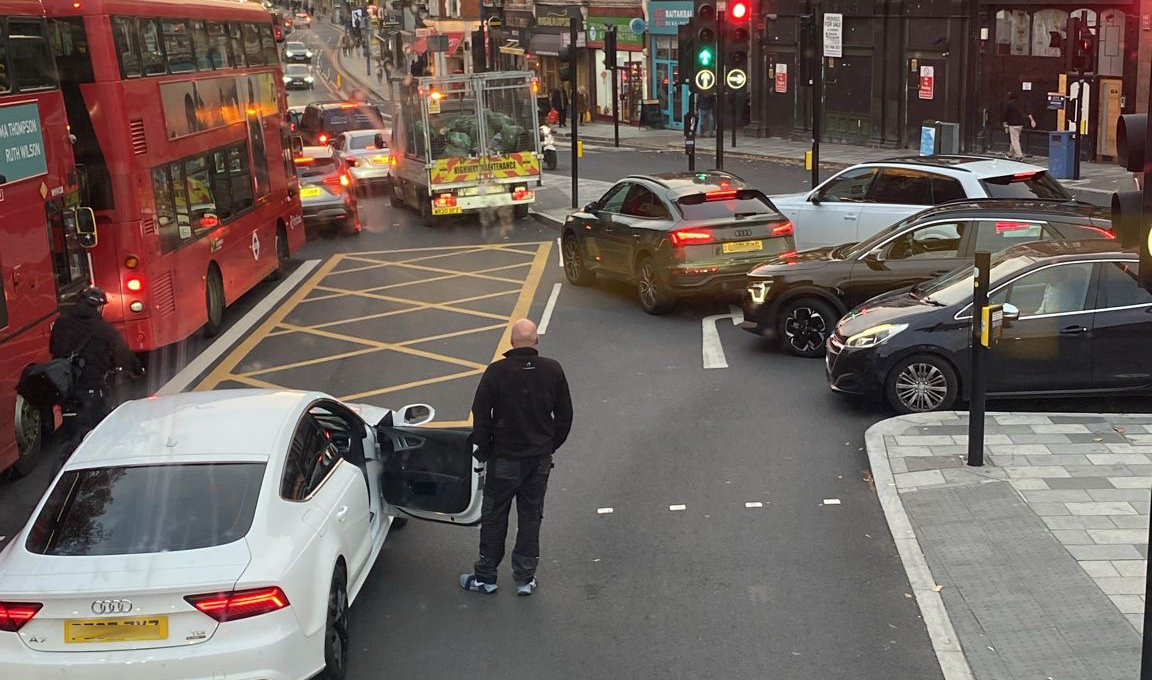
Wandsworth Council will tell its transport committee on Wednesday that Putney Bridge junction is improving. It has produced charts showing journey times fell between June and November last year. But when you extract the actual numbers from those charts – something the council has not done for councillors – the picture is more complicated than the presentation suggests.
The update on Putney Bridge junction, which the committee specifically requested after November’s bruising meeting where over 1,700 residents reported worse journeys, has not been presented as a standalone report. Instead, it is buried inside a 14-page paper on the council’s Walking and Cycling Strategy, covering everything from bikehangars to Tooting Market paving. The junction – the single most contentious transport issue in Wandsworth – gets three pages.
The council has also not published the traffic monitoring data it promised residents. Its dedicated junction webpage states: “We will publish the information here once the initial data has been analysed in full.” When Putney.news submitted a Freedom of Information request for the traffic data, the council withheld it, saying it would be published by the end of January. It was not. Instead, the data has appeared only in committee charts that require manual extraction to read – which is what we have done.
Putney.news has extracted and verified every data point from the council’s charts, which use confusing formatting that makes comparison difficult. Here is what the numbers actually show.
Important context: These journey times measure traffic between specific points approaching and leaving the junction itself. They do not capture the full impact on residents. When the junction backs up, queues extend far beyond these measurement points – meaning drivers from Barnes, Wandsworth, or deeper into Putney’s residential streets can face delays of up to an hour to cross the bridge, even though the junction measurement shows just a few minutes. The congestion ripples outward, creating gridlock across SW15.
The morning: getting to work
In the AM peak (7am-10am), the critical routes are the ones residents use to get onto Putney Bridge and reach the rest of London. Two routes dominate the picture:
Putney Bridge Road -> Putney Bridge: 410 seconds in November. That’s 6 minutes and 50 seconds. It improved by just 12 seconds – 3 per cent – from June. Residents turning right onto the bridge from Putney Bridge Road are still waiting nearly seven minutes.
Lower Richmond Road -> Putney Bridge: 270 seconds – 4 minutes 30 seconds. This improved by 125 seconds, a 32 per cent reduction. A real improvement. But 4 minutes 30 seconds to turn left onto a bridge is still a long wait.
By contrast, coming off the bridge is quick. The three routes from Putney Bridge into PBR, Putney High Street and Lower Richmond Road average just 98 seconds in November. Getting onto the bridge in the morning takes 3.5 times longer than getting off it.
| Route | June (s) | Nov (s) | Change | % |
|---|---|---|---|---|
| PB → PBR | 129 | 91 | -38 | -29% |
| PB → PHS | 137 | 105 | -32 | -23% |
| PB → LRR | 128 | 97 | -31 | -24% |
| PBR → PB | 422 | 410 | -12 | -3% |
| PBR → LRR | 439 | 376 | -63 | -14% |
| PHS → PB | 116 | 128 | +12 | +10% |
| PHS → LRR | 160 | 123 | -37 | -23% |
| LRR → PB | 395 | 270 | -125 | -32% |
| LRR → PBR | 206 | 175 | -31 | -15% |
| LRR → PHS | 200 | 157 | -43 | -22% |
Key: PB = Putney Bridge | PBR = Putney Bridge Road | PHS = Putney High Street | LRR = Lower Richmond Road
The evening: getting home
The PM peak (4pm-7pm) is the mirror image. Now the congestion hits people coming off the bridge, trying to get into residential streets.
Every “off bridge” route takes over three minutes, with Putney Bridge to Putney High Street at 252 seconds – over four minutes despite a 30 per cent improvement.
Three PM routes got worse or stayed flat: Putney Bridge Road to Putney Bridge worsened by 6 per cent, Putney High Street to Lower Richmond Road worsened by 21 per cent, and Putney High Street to Putney Bridge was unchanged.
| Route | June (s) | Nov (s) | Change | % |
|---|---|---|---|---|
| PB → PBR | 337 | 193 | -144 | -43% |
| PB → PHS | 360 | 252 | -108 | -30% |
| PB → LRR | 280 | 175 | -105 | -38% |
| PBR → PB | 298 | 316 | +18 | +6% |
| PBR → LRR | 296 | 281 | -15 | -5% |
| PHS → PB | 120 | 120 | 0 | 0% |
| PHS → LRR | 104 | 126 | +22 | +21% |
| LRR → PB | 194 | 142 | -52 | -27% |
| LRR → PBR | 379 | 272 | -107 | -28% |
| LRR → PHS | 493 | 301 | -192 | -39% |
Key: PB = Putney Bridge | PBR = Putney Bridge Road | PHS = Putney High Street | LRR = Lower Richmond Road
What the council isn’t comparing
The general traffic data compares June 2025 with November 2025. Both dates are after the junction was redesigned in December 2024. The data shows things got somewhat better between two post-scheme snapshots. It does not show whether things are better or worse than before the scheme was installed.
But buried in Appendix 3, the council’s own bus data does include a pre-scheme baseline – average journey times from 2023/24, before the redesign. And those bus charts tell a stark story.
On Lower Richmond Road in the AM peak, bus journey times were running at two to four times the pre-scheme baseline for most of 2025. After the October signal timing changes, they came down – but the council’s own text admits: “The AM peak journey times remain above the 23/24 baseline.”
On Putney Bridge Road, the pattern is similar. On Putney High Street northbound – the route the council and TfL prioritise – buses are also still running above pre-scheme levels.
In other words: the December 2024 junction redesign made every bus corridor through Putney worse, and after fourteen separate interventions over the past year, none has fully returned to where it was before.
The effort is not in question – the design is
The council has not been idle. Its own webpage listing improvement works catalogues fourteen changes since December 2024: lane markings, signal timing adjustments, bus lane suspensions, bus stop relocations, double yellow lines, enforcement action, and more. Officers have conducted two walkabouts with residents, written to affected households twice, and the council itself acknowledged the changes “resulted in unexpected congestion.” The effort and the expenditure – running into hundreds of thousands of pounds – are real.
But that is precisely the concern. If fourteen interventions over fourteen months, two rounds of signal timing changes, and ongoing physical roadworks have still not returned morning journey times to where they were before the redesign, the question residents are asking is no longer whether the council is trying hard enough. It is whether the junction design itself is the problem – and whether any amount of incremental fixes can make a fundamentally flawed layout work.
The signal timing mechanism
The council also published signal timing data showing how green time was redistributed at the junction between September 2025 and January 2026.
Putney Bridge Road’s green time went from 16 seconds to 25 seconds per cycle – a 56 per cent increase that sounds dramatic. But 25 seconds out of a 104-second cycle means PBR traffic gets the green light for less than a quarter of the time. Putney High Street northbound gets 43 seconds at the same junction. This explains why a 56 per cent increase in green time produced only a 3 per cent improvement in journey times – 25 seconds simply isn’t enough to clear the queue that builds up during the other 79 seconds.
Lower Richmond Road’s left turn gained 32 per cent more green time and journey times fell by 32 per cent – a near-perfect correlation that confirms signal timing is the binding constraint. Every second counts.
What happens next
The council has completed several Putney High Street changes aimed at improving traffic flow – the bus lane suspension outside the Odeon, double yellow lines, removal of the cyclists’ left turn from PBR, and the TK Maxx kerb realignment that started last week. Further changes are due in February and March, including lane reassignment outside Putney Station and bus stop changes.
The logic is sound: if High Street flow improves, more signal time can be released to the side roads. The data suggests even small additional green time for PBR and LRR could produce significant journey time reductions. But several changes are delayed, require TfL approval, or involve utility company coordination. And the journey time data in this paper only runs to November – the January signal timing changes and the current High Street works are not yet reflected in the numbers.
The transport committee meets on Wednesday at Wandsworth Town Hall to consider this update. It is an information item – no decision is required. Whether councillors treat it as a rubber-stamping exercise or use it to ask the questions the paper doesn’t answer will tell residents a great deal about how seriously the committee takes its scrutiny role.
The full committee papers are available on the council website.
This is the first in a series of stories this week on the Putney Bridge junction update ahead of Wednesday’s committee meeting. Tomorrow: the questions the council paper doesn’t answer.
All journey time data was independently extracted and verified by Putney.news from AECOM’s Appendix 2 charts.

And another consequence which I discovered when I needed to get to Charing Cross Hospital (served by the 22 bus) was that it simply stopped running across Putney Bridge, instead commencing its journey further along the route. There was no indication whatsoever that it was pointless waiting on Putney Bridge for a 22 bus as they simply were not crossing the bridge. I waited 20 minutes before asking the driver of another bus whether the 22 was running. He was helpful and suggested I take his bus a couple of stops along the route, and then pick up the 22 bus from there. Another lady who had been waiting 45 minutes had that defeated look of people who know that they are being treated with disrespect but have no power to do anything about it, because they are made to feel as if they count for nothing. When I finally managed to get on a 22 bus a little way along the route, I asked the bus driver of that bus why no one was bothering to even try and let people standing on Putney Bridge know what was happening. He was rude and defensive and said it was nothing to do with him. I have to say here that he was not representative of the many bus drivers I come across, but he did rather prove the point I made above, that bus passengers are disregarded by TFL. He was, I suggest, simply reflecting the attitudes higher up the food chain.