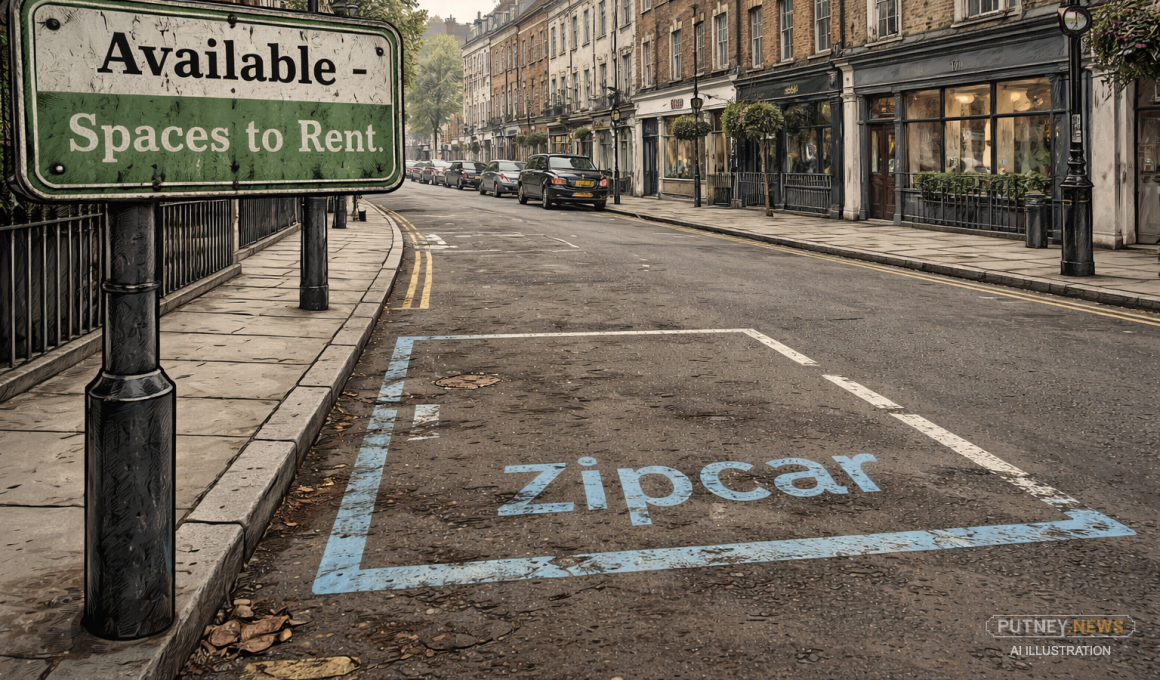
Wandsworth Council has admitted it is “unlikely” to find a replacement for Zipcar after the company withdrew from the UK market, leaving 122 of 133 car club bays across the borough vacant and multiple housing developments relying on car clubs without viable transport alternatives.
The council is waiving all fees for new operators until April 2027 in the hope of attracting a replacement for the company but it has already drawn up plans to convert the vacant bays to e-bike stations, bike hangars, and electric vehicle charging points.
The admission undermines planning justifications for several developments, including the controversial Lennox Estate tower where 81 homes were proposed with zero parking on the basis that car clubs would be available.
Paper 26-34 [pdf], which will be presented to Tuesday’s Transport Committee, outlines the council’s position and says the £214,000 annual revenue loss (£201,000 from Zipcar, £13,000 from Enterprise fee waivers) “can be met from existing approved revenue budgets” but does not explain which budgets will absorb the cost.
What happens to developments banking on car clubs
The Lennox Estate application is the most visible casualty. The council proposed 81 homes with zero parking spaces, justified partly by car club availability. The planning application states the transport strategy depends on Enterprise remaining in the market.
The reality however is that Zipcar ‘s exit has already undercut the idea that a shared car can replace parking: while there were 41 Zipcars in permanent bays in Putney and more Flex cars, Enterprise has a single vehicle for sharing. The same pattern is true across Wandsworth.
Twenty-four development sites across Wandsworth have planning obligations requiring car club provision. If Enterprise also withdraws (as Zipcar and at least two other major providers have done over the past 15 years) the entire car-free development model is effectively dead.
Residents in new developments would face parking restrictions with no car club alternative. Existing residents on estates like Lennox would see parking regulation schemes enforced to prevent “overspill” from developments that no longer have the transport justification that made parking restrictions necessary.
All 287 public comments on the Lennox Estate application opposed the scheme, with parking cited as the second most common concern after loss of green space. The council’s answer was car clubs.
| Ward | No. of car club bays (nearly all Zipcar) | No. occupied (Enterprise) | No. vacant (following Zipcar’s withdrawal) |
|---|---|---|---|
| East Putney | 9 | 1 | 8 |
| Roehampton | 1 | 0 | 1 |
| Southfields | 7 | 0 | 7 |
| Thamesfield | 15 | 0 | 15 |
| West Hill | 4 | 0 | 4 |
| West Putney | 5 | 0 | 5 |
| Grand Total | 41 | 1 | 40 |
What the numbers show
Zipcar operated two services: 122 back-to-base bays where cars returned to the same spot, and Flex vehicles that could be picked up and dropped off anywhere within zones. All are gone. The 11 remaining Enterprise bays are scattered across the borough.
The council estimates 7,000 to 8,000 residents used car clubs actively each quarter. Zipcar member accounts will be deactivated later this month, eliminating 175,000 trips that residents made annually using the service.
A survey by CoMoUK, the shared transport charity, found up to 80% of displaced members might buy cars instead. The council paper notes this is “not a scientific sample” but acknowledges the risk that losing car clubs could trigger increased car ownership and parking pressure.
While the council has removed all fees until April 2027 to attract new operators, its paper reveals the actual expectation: vacant bays will be repurposed according to a priority order.
E-bike stations come first, then bike hangars, then electric vehicle charging points, then residential parking. The decision will be made bay-by-bay, ward-by-ward, with no borough-wide strategy apparent in the paper.
Car clubs are Action 17 of the Climate Action Plan 2025, which commits the council to “promoting and enabling car clubs.” The 92% collapse in provision (from 133 bays to 11) now creates a significant gap between policy commitment and service reality.
The council paper notes car clubs were introduced in 2007 and have operated continuously until now. Zipcar’s withdrawal follows similar exits by other providers over the past 15 years. The UK car sharing market has proved unstable, with operators struggling against rising costs and policy changes like London’s congestion charge extension to electric vehicles.
What happens next
The key test comes in April 2027 when fee waivers end. If no operators have taken up the 122 vacant bays during that 14-month window, the council will need to decide whether to extend incentives or accept that car clubs may not return.
For the 24 development sites with car club obligations, the question is whether developers can fulfil requirements when no providers are operating. The council paper states developers “will be expected to” provide car clubs but does not explain enforcement mechanisms if Enterprise withdraws or no alternative operators emerge.
That means we could well end up in the ludicrous situation where the only parking made available on new development is for cars that don’t exist; similar to the care-home bike shed with 18 bicycle spaces for 8 elderly residents.
The council built a planning policy on the assumption of stable car club provision. Zipcar’s withdrawal has tested that assumption. The council’s own paper now admits replacement is unlikely. Multiple housing developments justified on that assumption now face a transport model that may not exist.