Application 2025/4170 proposes 81 homes in two buildings up to 14 storeys on the Lennox Estate. After reviewing 1,000+ pages of planning documents, we’ve identified 10 policy violations and statutory failures that warrant refusal.
1. The tower breaks clear height policy
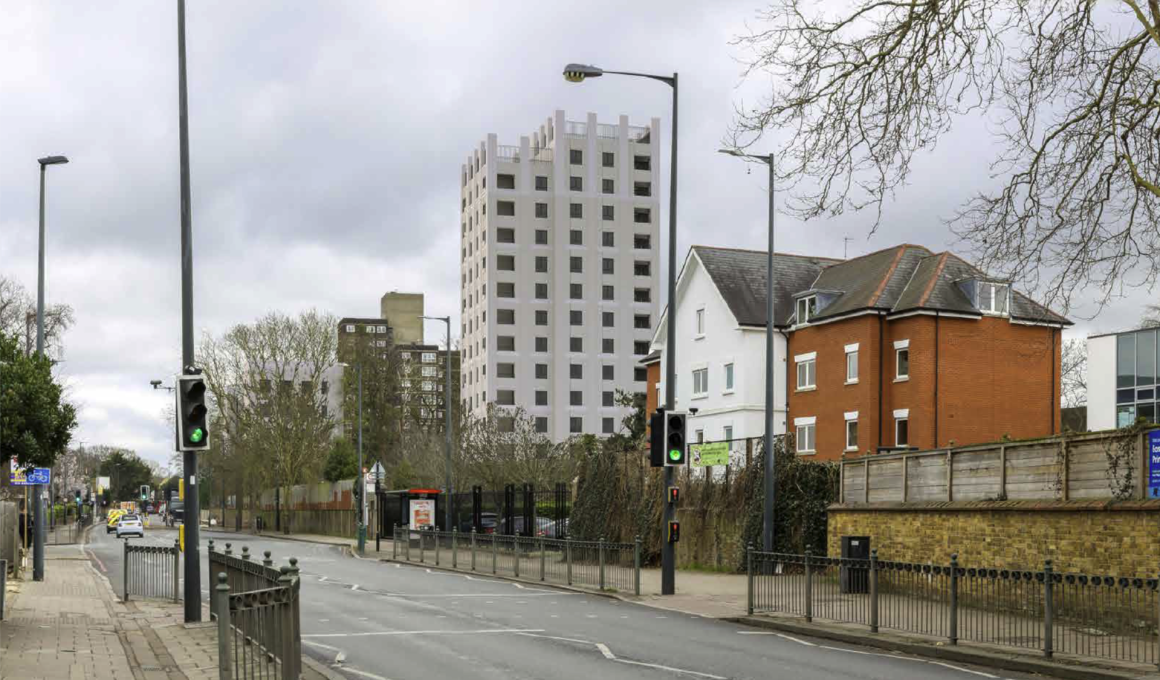
Wandsworth’s Local Plan permits buildings up to 6 storeys (12 metres) on this site. The proposal is for a 14-storey tower.
The site isn’t in a designated tall building zone. The council’s own Design Review Panel reviewed this scheme three times and remained “sceptical and tentative” about the tower, calling it “the last resort” and noting it would have “adverse effect on heritage assets.”
2. Protected open space gets built on
The development site is designated Protected Open Space in Wandsworth’s Local Plan, specifically to prevent building on it. Residents successfully defended this land from development six times between 1989 and 1994.
The Biodiversity Net Gain assessment reveals 54% of accessible grassland will be lost, in an area already “deficient in Local, Small and Pocket Parks” according to the Health Impact Assessment.
The council promises 131 new trees and green roofs. A green roof on top of a 14-storey building does not replace grassland where children can play.

3. Emergency access depends on construction success
Emergency vehicles will access via a new internal road created by closing part of Arabella Drive, a public highway. The route depends on successful construction of the new road layout, a single turning head between two buildings, and a one-way system working as designed. There is no alternative route.
On 27 March 2025, a major fire at Burke Close (800m away) required 6 fire engines and displaced 21 households. The Fire Safety Strategy for this application is dated 11 April 2025, just 15 days later, and makes no mention of the incident or lessons learned.
The site also has MEDIUM RISK unexploded ordnance present. If a bomb is found during construction and work stops, emergency access arrangements would be compromised.
4. The transport strategy relies on a single car club provider
This “car-free” development (zero parking for 81 homes) is justified by car club availability. Zipcar recently withdrew from Wandsworth. Enterprise is now the sole provider. The entire transport strategy depends on Enterprise remaining in the market.
The Transport Assessment admits one of five traffic monitoring locations “failed” because vehicles kept parking on the equipment. If monitoring equipment couldn’t function due to parking pressure, the assessment’s conclusions about parking demand are questionable.
5. Hundreds of existing residents lose parking freedom
Currently, Lennox Estate roads are outside controlled parking zones. To enforce “car-free” status for 81 new homes, the entire estate will get parking controls. Hundreds of existing residents will need permits to park on their own estate, before construction even starts.
Existing residents bear the restrictions and endure years of construction disruption before any housing benefit arrives. That benefit goes to new residents, not those who suffered through it.
6. Statutory biodiversity requirement not met
The Environment Act 2021 mandates 10% Biodiversity Net Gain. This has been law since February 2024.
The application admits: “0% change in watercourse units”, failing the mandatory 10% requirement. The deficit will be remedied through “local enhancements to Beverley Brook or via purchasing off-site biodiversity units.”
The application is statutorily incomplete.
7. Protected species surveys are inadequate
Any new development, especially at this scale, needs to consider whether protected species, at risk of survival, are present in the area.
European stag beetles are thought to be present on site but a survey to discover to what extent was dismissed because areas were “overgrown and difficult to access.”
Bat surveys are required before building demolition: one survey was conducted for a building on the Green where guidelines – for good reason – require 2-3.
Beverley Brook runs alongside the estate and contains a huge range of wildlife, including protected newts. A watercourse survey for the development concluded that 80% of the area (4 of 5 modules) had impeded access, so no assessment was carried out. Instead the report relied on “assumptions” and “what limited observations could be made.”
We don’t know if protected species are present in significant numbers at the site because the surveyors haven’t tried to find out.
8. Existing affordable housing residents lose daylight
39 neighbouring windows fail daylight standards. All 39 are at The Willoughbys, the existing affordable housing block next door.
Seven bedrooms will receive less than half the required daylight (VSC ratio 0.38 or below).
The council would darken its own tenants’ homes to build homes for new tenants, in a ward with a 5.5-year life expectancy gap compared to affluent areas.
9. Health assessment was done backwards
A Health Impact Assessment should inform design decisions. This one was conducted after the design was finalised, so it can describe impacts but could not prevent them.
Construction impacts (air quality, noise, vibration) were “scoped out” based on a Code of Construction Practice that does not yet exist and has not been submitted.
The existing MUGA (basketball/football court) will be demolished for 2+ years as a construction laydown area, with no secured alternative provision during the gap.
10. Council judges its own application
Wandsworth Council is simultaneously the applicant, the landowner, the highway authority (which must approve closing Arabella Drive), the beneficiary (receiving £87,000 carbon offset payment from itself), and the decision-maker.
The council’s own heritage advisors have already recommended refusal, citing policy breaches.
What you can do
The deadline to object was yesterday 19 January 2026 but the council will continue to received comments.
Planning reference: 2025/4170
Object here: Search planning applications and enter reference 2025/4170
You can reference these violations in your objection or simply state your concerns. Planning committees must consider all material objections.
The Design Review Panel was right to be sceptical. This application breaks height policy, fails statutory biodiversity requirements, compromises emergency access, darkens existing affordable housing residents’ homes, and depends on construction success and provider stability.
This application should be refused.