


“Dear Sir/Madam, With increasing frequency, seemingly every two days now, whilst out dog walking on Putney Common I have found human excrement and associated paper littering the Common.”
So begins a letter to Wandsworth Council’s Public Health department that manages to be both deeply earnest and scatologically hilarious.
The Putney resident, who asked not to be named for fear of unwanted deliveries from what he dubbed the “Phantom Pooper of Putney Common,” went on to describe finding evidence near the bus driver’s toilet behind the Spencer Arms and along paths near the Barnes four-way traffic lights.
The frequency, he noted, suggests “not a case of someone being in desperation, but having made a habit of it.”
But here’s where the complaint gets interesting. The resident has a theory about the culprits.
“Although I have no proof, I suspect that this is being done during the hours of darkness and by moped delivery drivers from companies like Deliveroo,” he wrote, pointing to the positioning of faeces “routinely within 10m of roads” and the pattern of night-time defecation.
Before dismissing this as speculation, it’s worth noting the theory has more merit than might initially appear.
A national crisis for delivery workers
Delivery drivers across the UK face a well-documented crisis accessing toilet facilities. A 2022 Unite the Union survey found only 22 per cent of truckers were always given access to customer toilets, despite this being a legal requirement since 2017 under Workplace Health, Safety and Welfare Regulations.
The Trades Union Congress reported that “hundreds of workers report urinating and excreting in bags, bottles, buckets and bushes for lack of access to a toilet.” For delivery drivers working late-night shifts, the problem intensifies when public toilets close and businesses refuse access.
Progressive International documented Amazon delivery workers resorting to public defecation due to brutal delivery quotas that leave no time for breaks, combined with widespread denial of toilet access at delivery locations.
The pattern our correspondent observed on Putney Common matches these documented behaviours: locations near roads where drivers park, night-time defecation when other options have closed, and the same routes used repeatedly.
Wandsworth’s toilet provision problem
This isn’t the first time human excrement on Wandsworth commons has prompted complaints. In 2020, Friends of Tooting Common wrote to the council about an “increasingly serious problem of human excrement being found on the Common, particularly in wooded areas.”
They requested portable toilets, noting Wandsworth Council had provided them on Wandsworth Common and Battersea Park but not Tooting Common. The request appears to have been ignored.
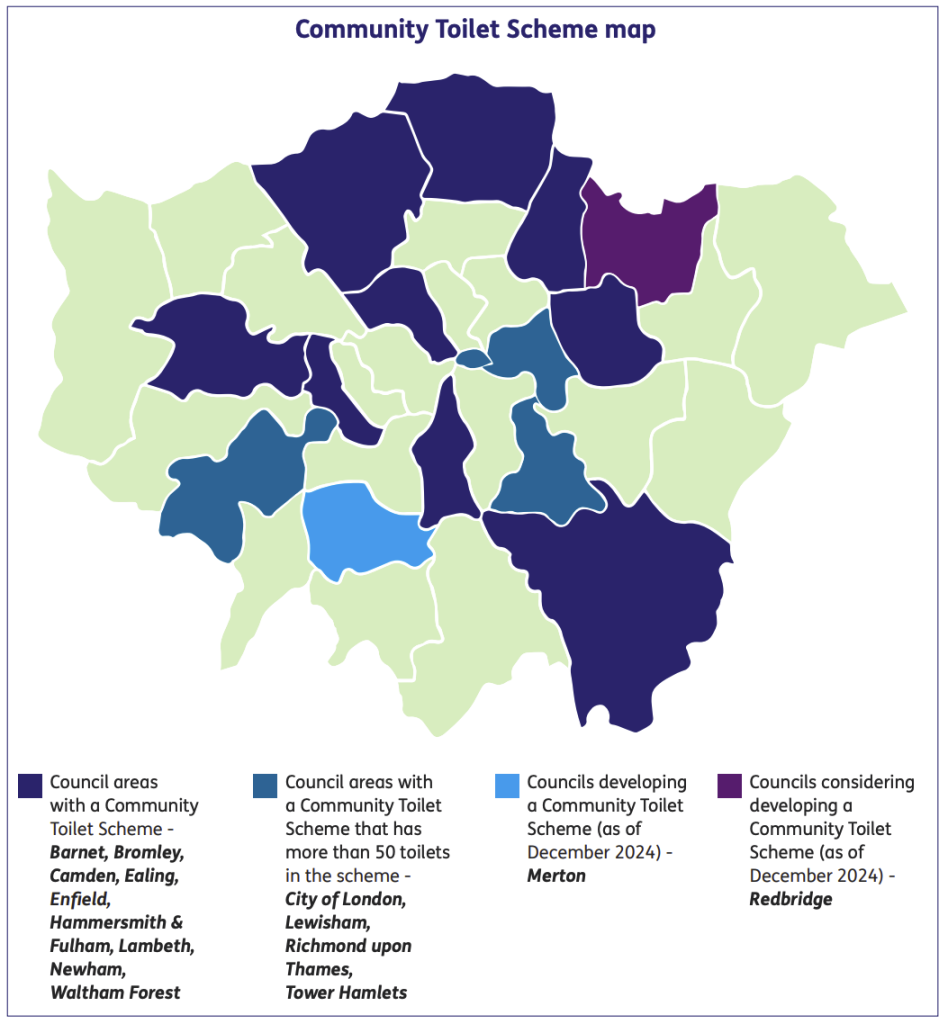
Wandsworth Council currently maintains nine public toilets across the borough, supplemented by a Community Toilet Scheme where participating businesses allow public use of their facilities. However, the council stopped paying businesses to participate in the scheme in 2013, and it’s unclear how many locations remain active.
Part of London’s wider crisis
The problem extends far beyond Wandsworth. Age UK London’s January 2025 report found that across London, three times as many public toilets have closed as opened since 2013, with 97 facilities permanently shut and only 32 new ones opened.
Their 2022 survey revealed 81 per cent of older Londoners rated public toilet provision in their borough as bad, with nine in 10 considering toilet availability before leaving home. The closure of public toilets since 2010 has been particularly acute, with a 22 per cent reduction nationally.
“Public toilets are essential for a civilised and welcoming city,” said John McGeachy, Age UK London’s Campaign Manager. The charity coordinates the London Loo Alliance, a coalition of 15 organisations demanding better provision.
For delivery workers, parents with young children, people with medical conditions, and older residents, the lack of facilities creates what campaigners call the “loo leash” where people avoid leaving home due to toilet access concerns.
What residents can do
For Putney Common specifically, the area is managed by Wimbledon and Putney Commons Conservators, a registered charity that maintains both commons. Residents who encounter anti-social behaviour, including human waste, can contact the Ranger’s Office at Manor Cottage, Windmill Road, Wimbledon, SW19 5NR, by phone on 020 8788 7655, or by email at rangersoffice@wpcc.org.uk.
The Putney correspondent’s letter concluded with a pragmatic suggestion for delivery companies: educational campaigns helping drivers understand that public defecation isn’t acceptable, and that “if they really, really are so desperate that they must do this then they could at least show the consideration of bagging it up and binning it like dog walkers do.”
It’s an absurd situation to have reached. But until councils, businesses and employers address the fundamental shortage of accessible toilets, our correspondent and other Putney residents may continue encountering the “Phantom Pooper of Putney Common.”





There is a Park Ranger for commons, attention should be bought to him and services.
I live near Putney Common and I have increasingly noticed this. There are bags and bottles of urine and worse, as well as empty food cartons, cans and bags thrown on the roads especially around Erpingham. Lower Common South and at the ends of other roads (Wymond, Fanthorpe, Abbotstone etc.). Disgraceful.
A much more positive approach to providing public toilets in SE London see this article:
https://www.dezeen.com/2026/01/04/woolwich-market-pavilion-studio-weave-toilets/?utm_medium=email&utm_campaign=Dezeen%20Debate%20944&utm_content=Dezeen%20Debate%20944+CID_fafefc6783b5439461d968e1ec555057&utm_source=Dezeen%20Mail&utm_term=Studio%20Weaves%20Woolwich%20Market%20Pavilion%20provides%20public%20toilets%20in%20southeast%20London