

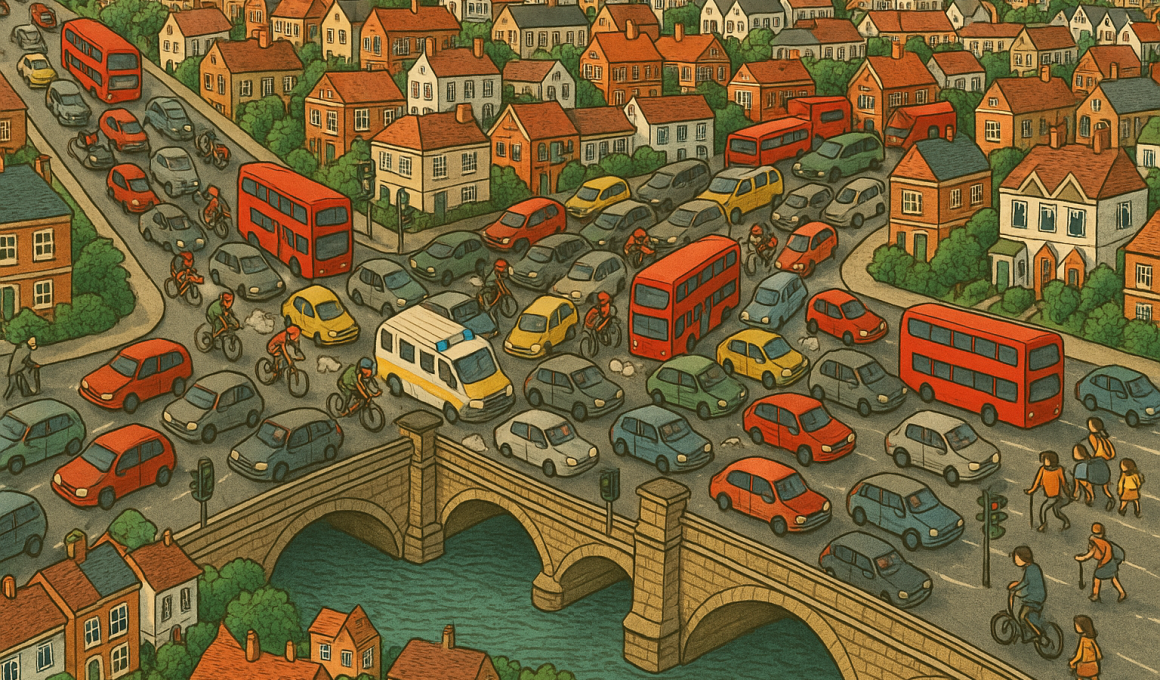
A major junction redesign intended to help cyclists has backfired so badly that even cyclists are calling for it to be reversed, a huge community survey has revealed.
The survey that recorded the views of 1,371 Putney residents reveals that 86% gave the strongest negative response possible to the redesign of the crucial intersection of Putney Bridge Road, Lower Richmond Road and Putney High Street, including the very cyclists the scheme was designed to help.
The survey, conducted by the Putney Action Group over the summer, has forced local officials into a rare face-to-face accountability meeting next week.
The findings expose not just the failure of the junction redesign, but a fundamental breakdown in trust between residents and authorities, with responses highlighting a significant “loss of trust in authorities” as a result.
Policy failure
Perhaps most damning for the council is that the scheme has failed even its intended beneficiaries. While the junction redesign was specifically created to make cycling easier and both cyclists and pedestrians safer, the survey reveals that both are unhappy with the new layout.
“Only a few cyclists said they were happy with the new layout,” according to survey organisers, despite cycling representing 36% of transport usage among respondents, roughly 500 people.
The failure extends beyond cyclist dissatisfaction. Parents report they “don’t let their children cycle in Putney” due to safety concerns, with reported incidents of children being knocked over by other cyclists as mounting congestion leads to erratic behaviour from all road users.
“Cars are acting erratically, which makes cyclists worry. Some cyclists are mounting pavements which in turn is worrying pedestrians,” explained one of the survey organisers during an interview with Putney.news.

Geographic displacement reveals spread
The survey has revealed a fundamental shift in Putney’s traffic problems that goes far beyond the original High Street congestion. Putney Bridge Road has overtaken Putney High Street as the most complained-about road, with Lower Richmond Road coming second.
This is a stark shift as Putney High Street has always received the most attention and gathered the most complaints. The redesign appears to have displaced rather than solved traffic problems, with “rush hour conditions all day” now affecting residential roads that were previously quiet. Traditional High Street traffic has been “joined by rat-running through every side street and up the hill, pushing congestion into areas” that never experienced such problems before.
As one resident put it in the survey: “It feels like Putney has been turned into a car park. The side streets are jammed, the air is filthy, and no one asked us before making changes that affect our daily lives.”
Human cost of policy failure
Beyond the statistics, the survey reveals the profound human impact of the traffic crisis on residents’ daily lives. Healthcare access has been severely compromised, with one resident reporting:
“I missed a hospital appointment because the bus never got through on time.”
Another described the exhausting reality of seeking medical treatment: “I have to allow over an hour just to get across Putney Bridge for medical treatment. It’s exhausting and stressful.”
The elderly are particularly vulnerable, with families reporting safety fears as public transport becomes unreliable.
“My elderly mother no longer feels safe because buses terminate early when stuck in traffic, leaving her to walk home alone,” one respondent explained.
Children’s education is also suffering, with the gridlock making school runs increasingly difficult. “Parents cannot get their children to school on time because of the queues on Putney Bridge Road and Lower Richmond Road,” according to another survey response.
Perhaps most telling is how residents have become prisoners in their own neighbourhoods:
“Putney Bridge Road is now completely gridlocked… We can’t even leave our own road, because it has become a rat run for people trying to gain a few places in the traffic jam.”
Community uprising born from democratic failure
The Putney Action Group emerged from frustration with what residents see as a pattern of being systematically ignored by authorities. The catalyst was last year’s petition calling for a review of the junction changes, which organisers say was “ignored by the council.”
Mick, a 69-year-old retired police official who has lived in Putney since 1975 and initiated the group, explained: “The petition came up, that was ignored by the council, and that really kicked me into gear. The people have been ignored for far too long.”
The group’s formation represents an unprecedented level of community organising in recent Putney history. Starting from conversations on local WhatsApp groups, three residents – Mick, Fran, and Keri – coordinated the survey that ultimately captured 1,300+ views.
“I didn’t really want to be involved in this because it’s a lot of work, and I’m retired,” Mick admitted. “But a lot of people kept asking me to do it, and I said, ‘Well, if there’s a couple of others that want to help with the work, I’ll do it.'”
Trust breakdown and official disconnect
The survey reveals a community that feels fundamentally disconnected from its representatives. Survey organisers describe officials as “out of touch” and point to a pattern of inadequate consultation processes.
“Every meeting that has happened, people have been cut short, they haven’t allowed enough time for questions,” explained Fran.
The disconnect extends to basic awareness of local conditions. At one meeting, councillors admitted they couldn’t believe the amount of congestion in Putney High Street. “They had to park three streets away themselves,” notes Mick.
The traffic problems are linked to wider concerns about Putney’s decline. The survey revealed significant worries about “the High Street’s decline – empty shops, reduced footfall, and an unattractive environment.”
Mick warned of a predictable pattern: “When you see the decay of an area, you start to see these people flocking in, because it’s an easy, soft touch. So you get antisocial behaviour, you get young gangs on bikes and stuff like that, robbery, street drinkers sitting outside businesses.”
The concerns extend to suspected money laundering operations among High Street businesses, squatting in empty premises, and a visible absence of police presence. “Everything we told them at that meeting – burglary, crime, drug dealing, and squatters… has come to pass,” Mick said.
Health and safety impact
Air quality has also emerged as a major concern, particularly affecting schools along congested routes. Survey responses highlighted “links made to asthma and other respiratory issues” among residents.
The breakdown in road safety affects all users. Emergency services face delays, cycling has become more dangerous despite being the intended beneficiary of the changes, and pedestrian safety has deteriorated as cyclists mount pavements to avoid erratic traffic.
Notably, the Putney Action Group has chosen not to publish the full survey results, citing “political sensitivities,” suggesting more controversial findings that the group is withholding until it talks to officials.
The survey has succeeded in forcing what residents see as overdue accountability. On 17 September, the group will meet with MP Fleur Anderson and the Council cabinet member in charge of transport, Councillor Jenny Yates, to present their findings and demand action.
Even arranging that meeting was fraught. “We felt like they were trying to control the narrative; that it could end up as little more than a photo opportunity,” explained Fran. The meeting will now take place locally, with just the three survey organisers representing the community.
The group’s primary demand will be straightforward: “People want the road layout reversed. Traffic was bad before the junction redesign, it is worse now. The council needs to accept it made a mistake.”
Political pressure and elections
The timing adds urgency to the situation, with local elections approaching. “Everyone knows local elections are coming up, so it’s within their best interest to do something, like now, because people are voting soon,” Keri observed.
The group has also written to other officials including Councillor Ethan Brooks, GLA member Leonie Cooper, and Police Inspector Steve Burke, requesting meetings that have yet to be confirmed.
The survey captured a broad cross-section of the community, with 64% of responses coming from women and 92% of respondents saying they walk regularly in Putney. Car usage was the second most common transport method, followed by bus usage, then cycling at 36%.
This demographic spread gives weight to the 86% of respondents who gave the strongest negative response when asked about the current road layout, making it clear that dissatisfaction spans all types of road users.
For residents like Fran, who moved to Putney five years ago “to escape congestion” after experiencing LTN problems in North London, the situation represents a personal crisis.
“I moved here for good schools, the river, the green space,” she explained.
Keri notes similar concerns: “I’ve got a young daughter, and I’m thinking about… how do I teach her how to cycle… is she going to walk to school every day and breathe in fumes?”
“I’m seriously thinking about leaving, and I don’t want to.”
The survey organisers stress they represent not political activism but community desperation. “The key thing was to work with anyone and everyone to help the people of Putney, many of whom are elderly,” Mick explained. “We all have different political followings… we’re cyclists, we’re car users, we walk – so we’re a broad group.”
The bigger picture
What began as complaints about traffic has evolved into something larger: a test case for local democracy and accountability. The relationship between residents and officials may have reached a breaking point.
“The relationship’s broken down,” Mick concluded. “It’s up to them as to whether that relationship has broken down irretrievably or not. The ball’s in their court.”
As the 17 September meeting approaches, Wandsworth Council faces a community armed with what may be the most comprehensive evidence of policy failure in recent local history. Whether officials will acknowledge the scale of the problem – and their role in creating it – remains to be seen.
The Putney Action Group has made clear that this is “only the first step” in what promises to be an ongoing campaign for accountability and change.

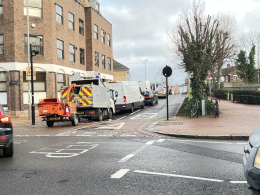

The problems on Putney Bridge Road, Putney High Street, Lower Richmond Road, and Fulham High Street (the latter being primarily an issue for LBHF) are a direct result of decisions made by so-called politicians and the leash-led transport planners and engineers at both LB Wandsworth and LBHF. These authorities have enforced changes without taking a holistic approach, blindly following the “Healthy Streets Agenda” led by Lucy Saunders — a policy that, in practice, has proven both disruptive and counterproductive.
Applying a hierarchical, blanket approach to all types of roads in London is incomprehensible and shows a fundamental misunderstanding of how local communities function. The engineers and planners — most of whom do not even live in the areas they disrupt — have worked towards implementing a policy adopted without meaningful input from the local residents and communities who are most affected. From the outset, this approach was flawed, and its failure is a daily tragedy for those forced to deal with its consequences.
LBHF also bears major responsibility, particularly through its refusal to repair Hammersmith Bridge in a timely manner. Their approach to LTNs (Low Traffic Neighbourhoods) has been heavy-handed and punitive, leaving Wandsworth residents effectively “trapped” and subjected to an excessive regime of fines. This is not responsible governance — it is a demonstration of poor planning, poor consultation, and a disregard for the people who live and work in these boroughs.