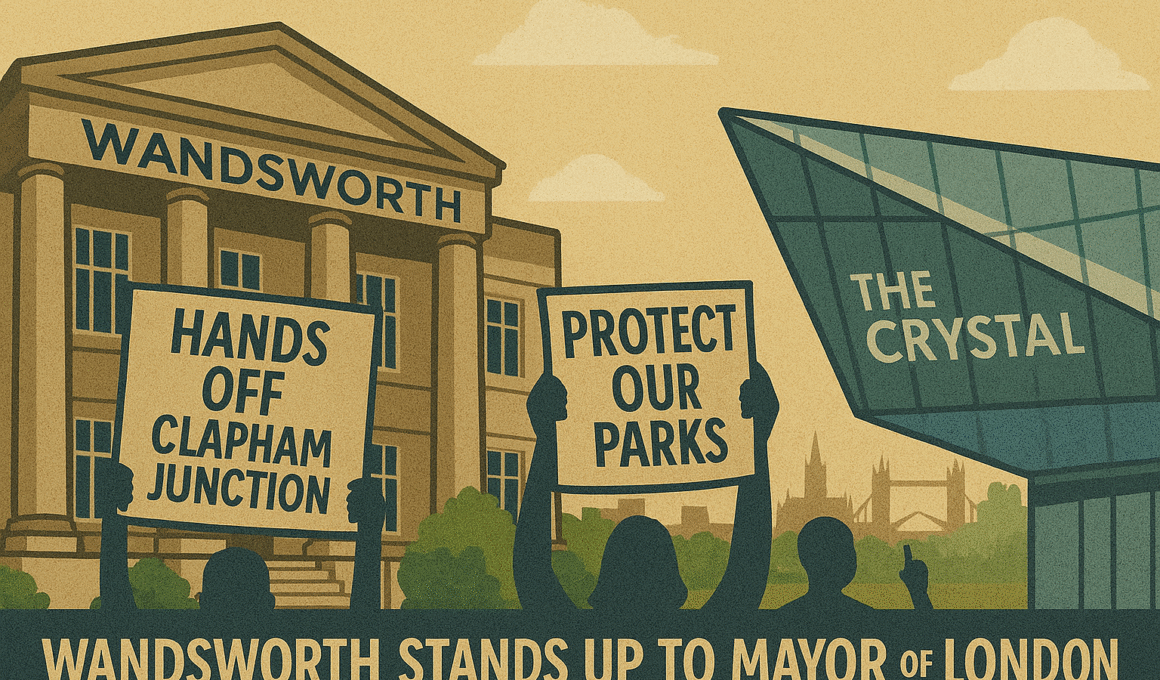
Wandsworth Council has issued a forceful response to the Mayor of London’s proposed overhaul of the London Plan, clashing with Sadiq Khan on key issues including housing policy, green space protections, and the status of Clapham Junction as a growth hub.
The council’s 50-page submission, due for Cabinet approval on Monday, offers broad support for the Mayor’s goals of boosting affordable housing, tackling the climate crisis and improving planning coordination — but also serves as a sharp rebuttal on several fronts where Wandsworth argues its local priorities are being overlooked.
Council defends Clapham Junction’s strategic status
Among the most striking disagreements is the Mayor’s proposal to strip Clapham Junction of its “Opportunity Area” designation — a status meant to support major growth sites with coordinated infrastructure and investment. Khan’s consultation document suggests the area may no longer differ meaningfully from other town centres and cites uncertain timelines for transport upgrades such as Crossrail 2.
Wandsworth pushes back hard, saying the move would symbolise a “downgrading” of the borough’s ambitions and dismisses Clapham Junction’s unique strategic value, despite it being Britain’s busiest rail interchange and a focal point of regeneration.
“There are few comparables in London where there is the same potential to co-locate significant growth with multi-modal transport infrastructure,” the submission reads. The council points to the 3,000–5,000 homes and 3,000 new jobs projected in its emerging growth strategy, and to a well-established public-private partnership developing a masterplan for the area.
Green space defence amid controversy over local parks
The council’s response also includes a strong defence of Metropolitan Open Land (MOL) — London’s urban equivalent to Green Belt — warning the Mayor against presuming that such land could be released for housing or industry.
That stance comes at a politically sensitive moment for the council itself. Wandsworth has faced fierce backlash from residents over its own proposed Events Policy, which could allow more large-scale commercial festivals in public parks — including several designated MOL sites like Wandsworth Common and Battersea Park.
Campaigners argue the plan threatens the ecological and community value of local green space, and although public feedback to the draft policy has yet to be published, it is understood the council has already reviewed the submissions. The tone of its response to the Mayor — warning against “eroding protections for the majority of MOL” — may reflect a desire to publicly reaffirm its green credentials after weeks of criticism.
“Many of the borough’s MOL spaces carry additional protections due to their historic and environmental significance,” the council notes. “They are not realistic development opportunities.”
Housing targets: national ambition, local tension
While broadly backing the Mayor’s aim to increase housing delivery across London, Wandsworth’s submission is laced with caution. It insists that housing targets must be based on genuine local capacity — not uniform formulas — and warns against loosening long-term planning standards just to reflect short-term economic challenges.
The document also presses the Mayor to equalise requirements for non-conventional housing (such as student flats and co-living blocks), which currently avoid the same affordable housing obligations as standard developments. These gaps, the council argues, are distorting the market and squeezing out traditional homes.
Yet here too, political undercurrents are evident. The paper is closely aligned with the vision of Wandsworth’s Cabinet Member for Housing, whose assertive approach to delivery has been dividing opinion within the ruling Labour group. While his supporters praise his urgency in tackling the housing crisis, critics — including some within his own party — are increasingly uneasy about what they see as a rigid, top-down approach that marginalises alternative views.
That dynamic appears in the submission itself, which largely avoids acknowledging any local concerns about overdevelopment or contested schemes — many of which have faced vocal community opposition and cross-party criticism.
Cautious support on key policy areas
Despite these points of friction, the council aligns with the Mayor on several broader themes. It welcomes:
- A greater emphasis on social rented housing
- Ambitious energy efficiency and whole-life carbon standards
- A brownfield-first development strategy
- Streamlining planning documents to reduce duplication
- Cross-boundary infrastructure cooperation, including renewed focus on Crossrail 2
The council also calls for faster planning decisions by raising the threshold for schemes that require referral to the Greater London Authority — a move it argues would speed up approvals for smaller developments.
What comes next
The Mayor’s team will now review borough feedback as it prepares a full draft of the new London Plan in 2026. That version will be subject to public consultation and a formal examination in 2027, before final adoption in 2028.
In the meantime, Wandsworth’s message is clear: it supports a stronger, fairer London — but it won’t back down on local control, treasured open spaces, or the strategic status of areas like Clapham Junction. Whether that stance is seen as principled or politically defensive may depend on how the council responds to growing internal and external pressures of its own.